Google+
This blog has moved. Please go over to this link to see my new website.
Showing posts with label Google+. Show all posts

Wednesday, 22 October 2014

#BookADayUK; A Reader Event For October. Day 22

Okay, so what happened to day 21? Well, the truth is that I was rather otherwise occupied. A neighbour, who was kind and influential during my teenage years, died last week and I attended her funeral, some distance away, yesterday.

But you managed the 'Word tips' post! Yes, that was scheduled, you see?

Anyway, today's theme is 'Makes me want to travel'. Once again, I am persuaded to delve into the past. There is no doubt that reading The Kon-Tiki expedition as a young man fired up my desire to travel. That I was hampered by my first wife, who would neither fly nor travel by sea, somewhat restricted me to this island home. However, my lovely second wife, with whom I've shared 26 years of happiness, is a traveller and treated me to my first trip overseas on my 40th birthday. A fortnight in Rhodes was a real eye-opener and we've visited many more of the Greek islands subsequently.

But it was undoubtedly Thor Heyerdahl's account of his adventures on the oceans that inspired me to travel. It's decades since I read his first book, and I've read most of his others since. Great stuff. If you haven't sampled this author, I suggest you do. You'll learn a little history and geography along the way.

Thursday, 26 September 2013

Building a World from Scratch.

Writing fantasy generally requires the invention of a world different from the one in which we live our daily lives; especially epic fantasy. I’m currently writing volume three of such a trilogy. So, how did I go about developing the world where my story takes place?

The first consideration in fiction has to be ‘theme’. As always in such tales, the basic underlying theme is good versus evil. But there are other ideas layered over that. I’m fascinated by the continuing discussion whether religions rely on what seems like self-delusion to persuade the faithful to join and remain in their ranks. Another aspect of life that intrigues me is the duplicity of our attitude to nakedness. And the way that power is given, often voluntarily, to those who least deserve it has always baffled me. So, these themes are also explored in the books.

Primarily, of course, it’s a story, an adventure story with romantic elements, and a means to entertain my readers. I’m thoroughly enjoying weaving the tale. We all love stories; have done since the very beginnings of language.

Before I could ‘invent’ my world, I had to develop systems of history, politics, religions, customs and traditions. I considered how my characters, in their separate societies, would dress, where and how they would live, what would occupy them and how they would make their various ways through the world. I developed ideas on the evolution of villages, towns and cities. I invented names for these places and the characters who would inhabit them. Names that had to follow some sort of logic in formation, of course. I researched travel by sea, river, horse, camel and on foot. And then I studied some geology and geography so that I could devise a realistic map for my world.

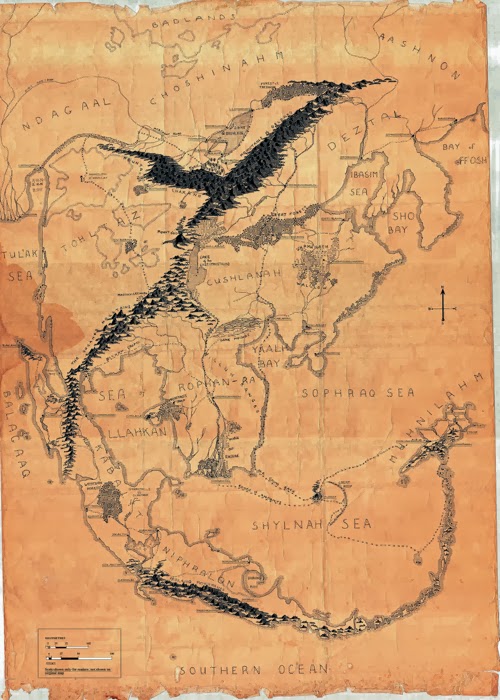
Maps and fantasy are almost inseparable. I wanted mine to do more than locate the places featured in the story; I wanted the map to be a central part of that story and an item of interest in itself. I drew it on a large (A1 – 34x23 inches for those who don’t know) piece of sugar paper in ink, with a drawing pen. I gave it some relief, so that there are mountains, plains, deserts, forests, rivers, seas, islands and lakes. I wanted to make this a real place in the mind of the reader, so it had to be as real as possible to me first. And, I confess, I borrowed from our own beautiful Earth to arrive at a credible outline of my lands.

Once drawn, I populated it with the names I’d made up, checking each on Google to ensure none of the chosen names belonged to anyone else or meant something inappropriate in a foreign language (there is a story that Julie Andrews’ book for children, The Last of the Really Great Whangdoodles caused her some embarrassment when she was told that ‘whangdoodle’ had a rather obvious and obscene meaning in Australia. I’ve been unable to discover any truth in this, and suspect it’s apocryphal, but it still serves as a warning about the use of unknown words.).

All this work took time and all had to be done before I could write a word of the story. Over the period of time it took to complete the preparation and development, the map turned, as hoped, from off-white to a shade of parchment. A little damp here and there installed stains and a few folds creased the map so that it now looks like a piece of ancient cartography that has undertaken several journeys. I added a compass and a rule in kilometres and miles so that readers can appreciate distances. I’ve reproduced it here for you to explore, if you wish.


Only after all this preparation did I begin to think about writing the story. But that’s for another post. It will come, as will some character sketches, to whet your appetite for the first volume, which I hope will be published later this year. Meanwhile, the third volume is growing, standing at 111,000 words as I compose this post. That means I’m a little over half way through the first daft of the final book. Books one and two are ready for publication.
Enhanced by Zemanta

Thursday, 29 August 2013

Character Development is Good for You.

An example of my character template. The picture came via Flickr.com
and, if you click on it, it will lead to the photographer's gallery.
Is it possible to write a story without at least one character? I seriously doubt it, even if the ‘character’ is only something inanimate. But is it desirable? Definitely not. Characters are the writer’s means of delivering story. Plot is a framework, a guide, sometimes a straightjacket, that determines a story’s direction and ultimate end. But it’s the character (or characters) who, taking the reader’s hand, guides her through the twists and turns. And the more believable that character can be made, the more thoroughly will the reader engage with the story.

A lot has been written about character development, so I can add to the cannon only by describing my own method. Before I can start any story, I have to know my main characters. In my current fantasy trilogy, which is well under way (Volumes 1 & 2 are written and edited), I’ve so far developed a cast of 83 named characters. Each of these people has a history, biography, physical description and a picture on which I can hang my memory. I know; a lot of people will think there are too many characters here, but this is a tale in the tradition of the epic fantasy, though it’s more adult than many. It’s common in the genre to have a large cast list: think of Lord of the Rings. How I keep track of all these individuals is for another day, another post. For now, I’ll concentrate on how I ‘invent’ my characters.

As an ex-professional photographer, my driving creative muse is visual. So, having determined gender and age, and having a vague idea of what I want the character to look like, I search my catalogue of images of people. Over the years I’ve been writing, I’ve made it a habit to collect pictures of real people I come across on my flights through the matter on the internet. I copy these pictures and assign them a basic designation according to race, gender, age (approximate), and hair colour. I have so far collected a library of around 1,200 from which I can take my pick. (Some of you will be concerned about copyright infringement, but, as these pictures are never published by me, that’s not really an issue).

Having chosen my picture, I attach it to a template on Word in the form of a table, listing physical features, beliefs, relationships, political persuasion, family history and asking the character two questions: 1. What does this person want? 2. What is this person prepared to do to get it? I now have a pretty good knowledge of my character.

At this stage, I use my table of names to select an appropriate name. (I’ve a document listing over 10,000 names, sorted alphabetically and by gender, with annotations showing the nations that use the name. For access to that list, please visit the tab above, labelled ‘Tools & Links’ where you’ll find a .pdf version that you can copy/print for your own use.) For my fantasy, since I’ve invented a whole world along with everything that goes with it, I’ve made up my character names and tested each against Google to ensure I’m neither using one that already exists, nor naming somebody by using a word that means something inappropriate in another language.

I now have my character with name, age, physical attributes and belief system. I also know what motivates that character and what that character is prepared to do in order to achieve any ambition. That gives me a pretty rounded person to put on the page before I even start writing the story. This may seem a lot of work, but in my experience, the bulk of writing is preparation. Once I have my characters and locations and any historically factual information that may be relevant, I can start the story. I find that the preparation allows me to write very quickly. I always place hyperlinks in the story to each of my character’s bio pages so that I can quickly check to make sure I haven’t either changed some physical aspect or turned a peace-loving pagan into a warrior extremist.


So, there you have it: my method of creating and developing characters. Once they are on the page, I allow them to guide the story for which I only ever have a very loose framework, or none at all. Often, they take me along roads I didn’t know existed. I love that. I learn a great deal along the way, as well. Character is vital to the story; we neglect it at our peril.

This post first appeared as a guest post on Brian Hayden’s Blog where you will find lots of other interesting stuff.
Enhanced by Zemanta

Tuesday, 5 February 2013

So, Where's the Pie Chart?


Okay, so I've been detailing my progress through the year each Tuesday, giving a weekly report on what I've achieved and why, or why not, depending on circumstances. So, where is it this week?

Well, it's time consuming. And I suspect it can be done every bit as well on a monthly basis. So that's what I'll do for the rest of the year. End of the month (or thereabouts, depending on my activity at the time) I'll produce an analysis. It acts as a motivator for me and gives visitors an idea of how time can be spent, wasted or used.

The picture? I like to give a visual spark to my posts, so here's a landscape to inspire you as a setting for a story. If you click on it, it'll appear at a larger size.

Enhanced by Zemanta

Monday, 31 December 2012

Facts and Figures for my 2012

English: A pie chart created in Excel 2007 sho...
English: A pie chart created in Excel 2007 showing the content of tweets on Twitter, based on the data gathered by Pear Analytics in 2009. (Photo credit: Wikipedia)

First, I’d like to pass on a heartfelt THANK YOU to all those readers who have reviewed my writing. Almost without exception these reviews, the majority from people I don’t know, have been positive. That, of course, is very encouraging. It strikes me that the best action I can take to truly thank those who have taken the trouble to share their thoughts on my work, especially those who’ve enjoyed it, is to write more. And that’s what I intend for the coming year. So, my thanks, again, for all those who’ve read and reviewed my work, and my assurance that there’ll be more to come and that it will be the best I can produce.

Second, a brief, but fairly detailed, account of my year. Why? Well, in April 2013 I retire from my part-time day job and will be able to concentrate full time on writing. This means an entirely different attitude to what I do and how I do it. At the behest of the so-called experts in the matter of selling books, I’ve spent a major portion of 2012 building an ‘author platform’ online. This is something, we’re told, that’s essential for the serious writer. I have to tell you that my experience places a large question mark over that assertion.
At the foot of this post, not very far from here, I’ll insert my facts and figures as they stand at the point of writing this: i.e. 20:30 BST, New Year’s Eve.

The simple fact is, in spite of my efforts to build this apparently essential tool to marketing, my sales of books have been anything but startling. There’s huge competition out there, with thousands of new books published every month. Many of these are very poor. But a reasonable number are good and there are a few that are undeniably outstanding. However, quality appears to be only a small factor in producing sales. I’ve read extracts from best-selling books and found myself appalled by poor grammar, syntax and characterisation. Often, however, these best-sellers have, at core, a good story. What is depressing is that, with a little more care and professionalism, many of these sub-standard books could be really great works; but the book-buying public appear willing to settle for ‘that’ll do’ from these good story-tellers.

So, it looks as though, in order to increase my readership, I need to combine good story-telling (for my readers), with good quality writing (for my personal satisfaction). Oh, hang on, that’s what I thought I was doing! Perhaps, then, I simply need to actually write and publish more. And that’s what I intend for the coming year.

The following list of figures will be a source of motivation for the coming year and of comparison at the same time next year, to see whether I’ve managed to get more work out there. It should also enable me to judge whether such an increase in ‘exposure’ actually bears more fruit than the marketing activity I’ve performed this year.

2012
Published work:
Sensuous Touches, an anthology of erotic tales (8).
Heir to Death’s Folly, a short story in the gothic horror tradition.
Rebirth, my contribution to the science fiction anthology published by Fantastic Books Publishing, Fusion.

Writing Contests:
4 entries, one of which was short-listed.

Blog:
1062 posts in total since the blog began.
447 followers
85,511 page views
18,882 visitors who identified their location.

Facebook:
Author page – 379 ‘Likes’
Personal profile – 1599 friends

882 books listed as read (the real number is probably around 3,500 but I haven’t listed them all yet), 52 of them in 2012.
130 reviews written (52 in 2012)
2018 friends.
136 titles in my ‘to read’ list.
49 ratings and 21 reviews of my books on Goodreads.
Goodreads reading challenge - 52 books in the year - Read - 52 books in the year!

2274 connections

662 followers
4774 pins on 32 boards

336 in my circles
In 183 circles.

5,110 followers
Following 5,012
11,823 tweets

So, there it is. If you'd like to connect with me on any of these sites, the links are there for you. Lets' see what 2013 brings, eh?
And, for now, let me wish you all a New Year that brings you all the good things you wish for you and yours.

Enhanced by Zemanta