Google+
This blog has moved. Please go over to this link to see my new website.
Showing posts with label Protagonist. Show all posts

Monday, 4 November 2013

Blood Song, by Anthony Ryan, Reviewed.

Blood Song, the first in a fantasy series titled Raven’s Shadow, takes the reader on a trip through the
intricacies of a world of wars, interfaith conflicts, intrigue and battle. The societies, geography and political structures developed by the author are all very believable.

As regular readers of my reviews will know, I care deeply about character in fiction. This book does not let the reader down. The characters, and there are many, live. All are flawed in their own ways; all are individuals. No stereotypes here.

For reasons I won’t bore you with, I was unable to read this book in a short time. The extended time period was nothing to do with the book but only reduced my enjoyment in the sense that I found myself impatient to get back to it as soon as I was able. The story certainly held my attention.

This is a book that will suit those who like their fantasy to involve battles, unusual friendships, a background love story, minor references to a form of magic and details of fights and weapons. But it has an added theme that interested me a great deal: the book examines religion and its association with various gods. It analyses faith and hints strongly at the lack of validity in many claims made by religions. This is done through story, rather than through the less attractive type of proselytising sometimes evident in books that touch on religious matters. So, it’s thought-provoking as well as entertaining.

I found I grew more and more attached to the main protagonist as he fought his way through the many barriers placed in his way. The pace is good throughout and description is generally limited to those aspects that require explanation. There are many evocative scenes and a great deal of variety in location and setting, making the journey both interesting and engaging.


I enjoyed the read. It’s a long book, typical of the genre in the sheer volume of words and pages. Good value for money. I recommend it to all who love fantasy and suggest those who have so far avoided this genre might try this as an introduction to how good such storytelling can be.
Enhanced by Zemanta

Thursday, 29 August 2013

Character Development is Good for You.

An example of my character template. The picture came via Flickr.com
and, if you click on it, it will lead to the photographer's gallery.
Is it possible to write a story without at least one character? I seriously doubt it, even if the ‘character’ is only something inanimate. But is it desirable? Definitely not. Characters are the writer’s means of delivering story. Plot is a framework, a guide, sometimes a straightjacket, that determines a story’s direction and ultimate end. But it’s the character (or characters) who, taking the reader’s hand, guides her through the twists and turns. And the more believable that character can be made, the more thoroughly will the reader engage with the story.

A lot has been written about character development, so I can add to the cannon only by describing my own method. Before I can start any story, I have to know my main characters. In my current fantasy trilogy, which is well under way (Volumes 1 & 2 are written and edited), I’ve so far developed a cast of 83 named characters. Each of these people has a history, biography, physical description and a picture on which I can hang my memory. I know; a lot of people will think there are too many characters here, but this is a tale in the tradition of the epic fantasy, though it’s more adult than many. It’s common in the genre to have a large cast list: think of Lord of the Rings. How I keep track of all these individuals is for another day, another post. For now, I’ll concentrate on how I ‘invent’ my characters.

As an ex-professional photographer, my driving creative muse is visual. So, having determined gender and age, and having a vague idea of what I want the character to look like, I search my catalogue of images of people. Over the years I’ve been writing, I’ve made it a habit to collect pictures of real people I come across on my flights through the matter on the internet. I copy these pictures and assign them a basic designation according to race, gender, age (approximate), and hair colour. I have so far collected a library of around 1,200 from which I can take my pick. (Some of you will be concerned about copyright infringement, but, as these pictures are never published by me, that’s not really an issue).

Having chosen my picture, I attach it to a template on Word in the form of a table, listing physical features, beliefs, relationships, political persuasion, family history and asking the character two questions: 1. What does this person want? 2. What is this person prepared to do to get it? I now have a pretty good knowledge of my character.

At this stage, I use my table of names to select an appropriate name. (I’ve a document listing over 10,000 names, sorted alphabetically and by gender, with annotations showing the nations that use the name. For access to that list, please visit the tab above, labelled ‘Tools & Links’ where you’ll find a .pdf version that you can copy/print for your own use.) For my fantasy, since I’ve invented a whole world along with everything that goes with it, I’ve made up my character names and tested each against Google to ensure I’m neither using one that already exists, nor naming somebody by using a word that means something inappropriate in another language.

I now have my character with name, age, physical attributes and belief system. I also know what motivates that character and what that character is prepared to do in order to achieve any ambition. That gives me a pretty rounded person to put on the page before I even start writing the story. This may seem a lot of work, but in my experience, the bulk of writing is preparation. Once I have my characters and locations and any historically factual information that may be relevant, I can start the story. I find that the preparation allows me to write very quickly. I always place hyperlinks in the story to each of my character’s bio pages so that I can quickly check to make sure I haven’t either changed some physical aspect or turned a peace-loving pagan into a warrior extremist.


So, there you have it: my method of creating and developing characters. Once they are on the page, I allow them to guide the story for which I only ever have a very loose framework, or none at all. Often, they take me along roads I didn’t know existed. I love that. I learn a great deal along the way, as well. Character is vital to the story; we neglect it at our peril.

This post first appeared as a guest post on Brian Hayden’s Blog where you will find lots of other interesting stuff.
Enhanced by Zemanta

Sunday, 27 January 2013

The Good Guy, by Dean Koontz, Reviewed.


Wow! This book held my attention from the first page and wouldn’t let go until I’d finished. Only the necessities of daily life intruded to make me read it in instalments.

Exciting, moving, sensitive, sometimes violent, thought-provoking and carrying a love story that explains the amazing action of the main protagonists, this is a thriller with heart. I generally don’t much like thrillers; they often lack character development and rely too much on action. This is an exception. Mind you, having read previous books by Koontz, I was unsurprised at the depth of character in all the players in this tale of murder, conspiracy and action. The political manipulation, the suggestion of some controlling force beyond the obvious, the arrogance of the chief antagonist and the quiet confidence and credible fear of the two major protagonists gifts the story with more depth than is usual in the genre.

I’m not going to attempt to synopsise the plot; it would be a pointless exercise and would provide a less than adequate explanation of the story. Suffice it to say that we are in contemporary USA, with all the bluster, hype, overblown confidence and mad over-consumption familiar to those of us in the West but not of the States.

Of course, there’s action that borders on the incredible; this is a thriller. But Koontz has a way of persuading the reader to extend his suspension of disbelief just enough to go with the tale. Because the book is so well written, the language so apposite yet poetic, the characters so beautifully drawn, the reader is willing to accept certain aspects of the story that would become a hindrance in the hands of an inferior writer.

As the tale comes to its climax and the denouement builds, the tension is so palpable that the reader speeds through the pages, hoping for an ending that will satisfy all aspects of the story without leaving a taste of either sourness or disappointment. That the final pages tie up the necessary loose ends and manage to leave the reader satisfied, is testament to the craftsmanship and skill of this excellent storyteller.

If you like your action books with emotional punch, suitable humour, larger than life but credible heroes and heroines, and respect for the reader’s intellect, you’ll enjoy this book. Thoroughly recommended.

Enhanced by Zemanta

Thursday, 30 December 2010

How Should A Story Begin?

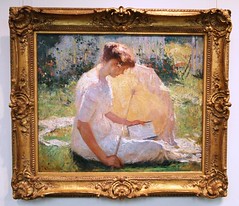
"The Reader - A Summer Idyll" - Fran...Image by pobrecito33 via Flickr
As a reader, do you like your stories to begin with a bang, or do you prefer a slow build-up, perhaps a question to be answered, some mystery introduced? As a writer, do you hook readers or do you tempt them, tease them with small tit-bits of information, make them so involved with your characters that they feel compelled to continue to read?

It's generally considered, by those who are supposed to know such things, that the best way to persuade a reader to travel through the first paragraph and beyond is to engage their interest. And, logically, that makes sense, of course. But it's the how of this that interests me. It comes down, I imagine, to the type of book you're reading or writing. The action book needs to grab the reader at once, posing some threat or challenge that must be faced and resolved by the hero. The love story requires that the reader cares about the heroine and is quickly engaged by her potential lover. The literary story can begin more slowly, more deliberately, with fascinating language and images presented in words well chosen. The crime novel employs the body in the library, or the detective about to embark on a new mystery.

So, this is a matter of horses for courses. I write in many genres and always try to engage the reader with the main character(s) as early as possible. I want readers to care what happens to the people in my stories. If I can introduce an air of menace, intrigue, mystery or simple desire, to fit the story, then I feel I've gone a long way to keeping the reader interested. Some writers, especially when they begin the craft, try to tell the reader too much in one go and drown the reader in facts, forgetting that they can be shown these things as the story unfolds.

So, I ask you; what do you prefer to read as an introduction to a new story? What's your approach as a writer to the beginning of a new tale? Please comment and let others know whether your response is as reader or writer.

Thank you.

Enhanced by Zemanta