Google+
This blog has moved. Please go over to this link to see my new website.
Showing posts with label Stephen King. Show all posts

Saturday, 4 October 2014

#BookADayUK; A Reader Event For October. Day 4

Today's event asks participants to present a book with a beautiful spine. Appearance and content are
inextricably linked in the minds of most readers. One book with a beautiful spine? I must have read hundreds. And then there are all those ancient tomes I've perused on the shelves of crumbling stately homes. How to select a single volume, and display it here? Well, it clearly has to be a book from my own shelves. Most of these are relatively modern. And, scanning my shelves, seeking out those spines that make me tingle (sorry for the pun) I recollect that I went through a period when I removed the dust covers from most of my hardbacks. That means a lot of the good 'uns have now vanished into the paper recycling bin of history. Which leaves me with a rather smaller selection from which to choose.
But I can't select a single book. I find a group, whittle that selection down to a handful and then further reduce to a few. Here they are. Please forgive the inclusion of my own book here: I didn't design the cover, my publisher put it out to a brilliant cover designer. As for the rest, I think they speak for themselves.
Don't forget, if you want to get involved as reader or writer, or both, here's the link to the website.
And don't forget to use the #tag, #bookadayuk for any tweets you send out there. Let's get support going for our high street bookshops, eh?

Sunday, 30 June 2013

Writing? What Constitutes Work for You?

Time and again, we hear wails from writers complaining that writing is such hard work. They moan
about how difficult it all is, so that one is forced to wonder why they do it. Coal mining is hard work, labouring is hard work, working a 70 hour shift as a junior doctor in a hospital is hard work. Writing isn’t, or shouldn’t be, hard work.

No one is forced to write: it’s a personal choice, a selection of a lifestyle. Anyone who becomes a writer in the expectation of making easy money is a fool. Writing fiction is not a way to guarantee a worthwhile income. The average English novel makes around £2000.00 for the writer: that’s for an investment of maybe two years work (and, included in that average is the income made by authors such as JK Rowling. Do the math, as they say). Anyone entering the field without awareness of the realities is either naive or stupid. Few freelancers, writing articles, make a very good living, though some make a reasonable amount. Probably the only way to be sure of a constant income from writing is to become a journalist working on a regularly published journal. Everything else is speculation.

For me, writing is not work. It’s a joy, a journey through my imagination to lands and lives I invent. This isn’t work, this is delight. Editing isn’t work; not for me. I love the chase for the perfect word or phrase. I love the discovery of new vocabulary to replace repetitions, I love the search for new ways to say things. Research isn’t work: it’s an adventure, a trip to new experiences and knowledge.

So, what is work for me, when it comes to the world of writing fiction? Selling. Marketing. Building a platform. I’ve worked as a salesman more than once during my varied career and it was never a role that sat easily with me. We look at life through our own eyes, and tend to expect that people are pretty much like us. I’m that guy who never wants to be advised on what to buy, who doesn’t want to be approached by a shop assistant handing out advice. If I want something, I do some research and buy what appears to be best for my needs. I expect others to be similar, so the idea of actively selling seems either a waste of time or a con trick. Surely people know what they want and where they can obtain it? Marketing is similar, in that it’s a means to persuade people to be interested in something they may otherwise not consider.

I hear the screams of protest. I hear the denials. Yes, I know that the world of books is a tough one with competition that’s often far from fair. I understand that, if I want to sell my books, I have to somehow get them to the attention of readers. In so doing, I have to compete and become involved in league tables, press releases, advertising, promotion, engagement with potential readers, and a slough of other activities all designed to take me away from what I think I do best; writing.

So, I have a choice. I can spend most of my time and effort engaged in activity designed to bring my work to the attention of others; something I’ve been doing with minimal success for the past year or more. Or I can write, publish books, and hope that readers will appreciate those works, spread the word and allow me to build a readership that enables my books to be read by more and more people. My choice should depend on what I do best and what I most love. Writing. So, that is what, from now, I will be doing. If I sell few books as a result of taking this approach, so be it: it’ll be no change from the current situation. Except that I’ll be actively enjoying my time writing instead of finding the task of marketing and selling a drudgery I can barely abide.

I’ve spent the last three days in doing the final editing of book one of a fantasy trilogy. Much of that time has been a re-reading of the book, following the editing, so that I have it fresh in my mind. I’ll spend the next few days in doing the same for book two, already written and edited. Then I can start to write book three, which has been slowly bubbling away in the back of my mind during the last few months. This is what I love to do. Write.

This means I won’t always be free to do these spots, which were once regular. I’ll certainly try to produce a post each week, simply because this is a form of writing I enjoy and find relatively easy to do. It’s also a necessary break from the more imaginative creative writing involved in making up a story. But it isn’t work. Not for me. It’s pleasure, enjoyment, fulfilment.

So. When it comes to the world of writing, what constitutes work for you and why do you do it? Let us all know. Just place a comment here and share your thoughts. You might help some other poor beleaguered writer along the way.

 Here are a few quotes on work from well know writers:

Work is the curse of the drinking classes. Oscar Wilde.
Work is a necessary evil to be avoided. Mark Twain.
Nothing is work unless you’d rather be doing something else. George Halas.
Work consists of whatever a body is obliged to do. Play consists of whatever a body is not obliged to do. Mark Twain.
Talent is cheaper than table salt. What separates the talented individual from the successful one is a lot of hard work. Stephen King.
I put my heart and soul into my work, and have lost my mind in the process. Vincent Van Gogh.
Never permit a dichotomy to rule your life, a dichotomy in which you hate what you do so you can have pleasure in your spare time. Look for a situation in which your work will give you as much happiness as your spare time. Pablo Picasso.
The more I want to get something done, the less I call it work. Richard Bach.
If you cannot work with love but only with distaste, it is better that you should leave your work. Khalil Gibran.


I think you’ll spot those with which I agree. More than anything else, I hope you’ll find ways to enjoy this wonderful craft we call writing.
Enhanced by Zemanta

Sunday, 27 January 2013

The Good Guy, by Dean Koontz, Reviewed.


Wow! This book held my attention from the first page and wouldn’t let go until I’d finished. Only the necessities of daily life intruded to make me read it in instalments.

Exciting, moving, sensitive, sometimes violent, thought-provoking and carrying a love story that explains the amazing action of the main protagonists, this is a thriller with heart. I generally don’t much like thrillers; they often lack character development and rely too much on action. This is an exception. Mind you, having read previous books by Koontz, I was unsurprised at the depth of character in all the players in this tale of murder, conspiracy and action. The political manipulation, the suggestion of some controlling force beyond the obvious, the arrogance of the chief antagonist and the quiet confidence and credible fear of the two major protagonists gifts the story with more depth than is usual in the genre.

I’m not going to attempt to synopsise the plot; it would be a pointless exercise and would provide a less than adequate explanation of the story. Suffice it to say that we are in contemporary USA, with all the bluster, hype, overblown confidence and mad over-consumption familiar to those of us in the West but not of the States.

Of course, there’s action that borders on the incredible; this is a thriller. But Koontz has a way of persuading the reader to extend his suspension of disbelief just enough to go with the tale. Because the book is so well written, the language so apposite yet poetic, the characters so beautifully drawn, the reader is willing to accept certain aspects of the story that would become a hindrance in the hands of an inferior writer.

As the tale comes to its climax and the denouement builds, the tension is so palpable that the reader speeds through the pages, hoping for an ending that will satisfy all aspects of the story without leaving a taste of either sourness or disappointment. That the final pages tie up the necessary loose ends and manage to leave the reader satisfied, is testament to the craftsmanship and skill of this excellent storyteller.

If you like your action books with emotional punch, suitable humour, larger than life but credible heroes and heroines, and respect for the reader’s intellect, you’ll enjoy this book. Thoroughly recommended.

Enhanced by Zemanta

Friday, 16 September 2011

Review of 'Reading A Writer’s Mind: Exploring Short Fiction – First Thought to Finished Story' by Linda Acaster.


Writing manuals come in many guises. Linda Acaster's 'Reading A Writer’s Mind: Exploring Short Fiction – First Thought to Finished Story', if you'll forgive the reference, does what it says on the tin.
If you're a reader, you'll find this book worthwhile and entertaining simply for the stories it presents for examination by writers. The fiction is varied in genre and style but consistent in its good quality. Even the stories specifically written for the 'women's fiction market' are well structured and populated by rounded characters who will be familiar to most readers.
If you're a writer, this is a book that will help develop your short fiction. The sample stories illustrate the author's points perfectly as she explains her reasons for the various selections a writer must make as a piece of short fiction is constructed. Here you'll find advice on character forming and building, plot structure, language choice, viewpoint selection and much more. Linda introduces each story, and then presents it for reading in full. She follows this with an explanation of the processes she used in the construction.  Finally, she sets the reader an exercise in order to consolidate and fully bed in the lesson of the section.
Most writers are resistant to exercises: I certainly am. However, as with the excellent suggestions made by Dorothea Brande in her 'Becoming a Writer', Linda's practice pieces are designed to make the reader a better writer and will pay dividends to those who attempt them.
I'm not a lover of writing manuals, but I place this one alongside the excellent Dorothea Brande's book, already mentioned, and Stephen King's 'On Writing', both of which have been formative in my writing.
Linda Acaster's concise but comprehensive work on approaching short fiction now has a permanent place in my library and I shall return to it each time I begin a new short story, in the hope that I can improve on my skills and reach the market I am aiming at.

Enhanced by Zemanta

Friday, 22 October 2010

Interview with Author, Andy Frankham-Allen

Stephen King wrote, 'Writing controlled fiction is called "plotting". Buckling your seatbelt and letting the story take over, however... that is called "storytelling". Storytelling is as natural as breathing; plotting is the literary version of artificial respiration’. That more or less sums up Andy’s brand of writing. His stories have plots that evolve from the characters and develop as the characters do once a key idea is conceived.
Tell us about your current book titles in a few sentences.
I have two current eBooks; both short stories published by Untreed Reads. ‘Off Flesh’ is a story about a very normal bloke who goes to his very normal work conference, where he meets Mr Wyndham, who promptly goes missing. Mr Jensen foolishly decides to investigate, and discovers a very dark secret at the heart of the conference. The second story is ‘One Mistake’, about a man named Robert who lives a very dull life under his mother’s ever watchful eye. He comes across a notice for lessons in astral projection. He’s introduced to Bernard, an old broken man living in an old broken house. The lesson takes on a very sinister turn when Robert learns how to remove himself out of his body.
What qualities do you need to be a successful writer?
Lack of ego. Everyone has ego, and you absolutely have to believe in what it is you’re trying to achieve with your writing, and that belief includes thinking that your story is the best of its kind. Or at least the best you can do. However. Once the story is written, you must check the ego at the door, since it will be seen and read by agents, proofreaders, editors, all kinds of people, all of whom will have comments to make, suggestions for changes, and so forth. That’s where ego gets in the way. If you’re not willing to accept constructive, and often brutally honest, criticism then you really ought not to be writing.
What is the single biggest mistake made by beginners to writing?
Too many ideas. I have this friend who has remarkable potential, and he often starts working on a story. He begins with one idea, but along the way all these other ideas pop up, ideas which he feels compelled to include into his story. Unfortunately, a lot of these idea conflict, and so he ends up with a story that has far too many ideas, leaving the story without any strong direction. This is a mistake new authors often make; putting into too many ideas. They need to single out the most relevant ideas and focus on them, integrate them together into a cohesive whole. And then there’s a lack of understanding of the basic rules of grammar. But I’ll not get into that, or I’ll be here all day. ;)
If you have a favourite character in your novel, why that particular one?
Of the two current stories, Robert Hoard from ‘One Mistake’ is possibly my favourite. At first he seems almost whimsical, stuck in this rut with his mother controlling his life, but he takes it with good humour and doesn’t seem too bothered with changing his circumstances. Yet at the same time there’s this curiosity about him, which leads him directly into the troubling situation at the heart of ‘One Mistake’. Of course, by the end of the story, he’s made a few decisions that will forever change his life and, by extension, that of his mother. How this pans out... well, you’ll need to read the story to find out.
How can people buy your books?
Both of my Untreed Reads eBooks can be purchased at pretty much any online retailer that sells eBooks. Untreed Reads has the single-best electronic distribution of any eBook publisher, with their titles available in practically every single eRetailer out there. My forthcoming novel, ‘Seeker’ (Book One of The Garden), can be pre-ordered from Hirst Books (www.hirstpublishing.com) at the moment (for those interested in such things, it’s a new breed of vampires for a new decade – go on, get your teeth into it!). My Doctor Who short stories, published as part of Big Finish’s official range of Short Trips (in ‘Repercussions’, ‘The Solar System’, ‘Snap Shots’, and ‘Re: Collections’), are unfortunately now out of print, although they can still be tracked down on eBay and various specialist shops. The same goes for my audio drama, ‘Space 1889: The Lunar Inheritance’.
 
To what extent are grammar and spelling important to a writer?
They’re essential. Editors/Agents will not accept a piece of work that is badly written, and by badly written I mean full of grammatical errors and typos. You could be writing the best novel ever, but with bad grammar and spelling no one will be interested in reading it. Within the space of a page (or less), the prospective agent/editor will dump it on the rejection pile. So it is imperative that new authors brush up on their understanding of written English. The English language, both in written and oral form, is the most flexible language out there. It is constantly changing, developing and evolving, but you absolutely have to have an appreciation of it as it stands today. Don’t play with grammar rules until you’ve proven you know how to use the ones in place.
How much revision of your MS do you do before you send it off?
Endless. I’m constantly revising and editing. This is why deadlines are a good thing; I get to a point where I have to stop and send the story off. If not for deadlines I could, potentially, be there forever fixing perceived imperfections in the story, the characters, the prose, and so on.
Where and when is your novel set and why did you make these specific choices?
Both of the current stories are set in very generic contemporary places. There’s no specification of location in either story, since in these two cases the location is not important. Setting ‘Off Flesh’ in a hotel, however, was necessary since it begins at a work conference and such things are often held in hotels. Plus, they’re great places to meet new people and engage in an illicit rendezvous. And we know how well such things work out in fiction, right?
To what extent do you think genre is useful in the publishing world?
To the extent where it helps the publisher target the stories when selling them. I suppose it helps an author, too, since each genre brings with it certain rules and ethos, but personally I like to cross the lines of genre, create new sub-genre. Not that I’m the first person to do, of course, since there seems to be a new sub-genre created almost every week. Which I love, since it opens the scope and allow authors to play in new sandpits.
What are your writing habits?
While working on a given project I tend to read material pertaining to it; novels of the same genre, factual books relating to the themes, etc, all to keep my mind on track. I also carry a note pad on me, so I can jot down ideas as and when they pop into my head. For the actual writing I tend to write progressively from scene one to final scene. I’m not the kind to dip in and out; it has to be sequential for me. I always, and I mean ALWAYS, have music on when I’m writing. Again, as with reading, the music will more often than not convey the mood of the project I’m working on. If it’s something dark then I’m likely to be listening to metal and rock. I like to write at least 3,000 words a day when working on a book, but sometimes this is not possible. If I did so every single day of the project I would undoubtedly lose touch with life as it continues around me. Not a good thing for a writer to do.
How do you know where to begin any given story?
Instinct. Most of my longer works tend to start with a dramatic scene set some way into the story; start at a turning point in the story so you drag the reader in. Then you backtrack to the beginning and introduce your reader to the key players. It also works for me, since then I also want to know how the story got to that mid-point.
What sort of displacement activities keep you from actually writing?
Everything! Seriously, it’s part of the package of being an author. We are notorious for finding things to distract us. Which is not necessarily a bad thing, since there are times when you just can’t sit down and actually write. For me personally it’s about getting in the zone, and to do so I need to, at first, be distracted. So I resort to dancing, burning CDs for my day job, faffing around on Facebook, watching DVDs, nattering away to friends on IM, taking random photos, and going for walks.
Do you have support, either from family and friends or a writing group?
No writing group per se. Never ever got into the whole writing group thing, but I do have an awful lot of author friends and they are always supportive of me, and vice versa. My family also offer me endless support, that is when they’re not trying to work out how I manage to get all these ideas to actually write! Friends, too. Quite a few people read the beta version of my forthcoming novel, and gave me wonderful feedback.
Is presentation of the MS as important as most agents and publishers suggest?
Absolutely. As I said above about grammar, an agent/editor is not going to spend time on a badly presented MS. By giving them the best presented piece of work you can, you’re showing them how much you have invested in the project. Sending them a sloppy piece of work will just scream that you don’t really care about the project.
How long does it normally take you to write a novel?
A novel will take me three months to write, from beginning to end. That’s the easy part; it’s the revisions, etc, that take longer.
What are your inspirations?
If you’ll excuse the pretention; life! Sounds a cliché, but it also happens to very true. I watch life go on around me, spend hours talking to people. There is no better inspiration.
If there’s a single aspect to writing that really frustrates you, what is it?
The waiting. Once the story is complete, and it’s sent off, you’re stuck waiting to hear back. And once you do hear back, sign the contract, etc, you’re left waiting for the release. I’m not an impatient person... well, okay, yes I am!
Do you think writing is a natural gift or an acquired skill?
It can be both. I think there is out there those to whom writing is a gift, as natural as breathing. It’s what they were born to do. They wake up thinking about writing, and they fall asleep thinking about writing. I am one such person. As far back as I can remember I’ve only ever wanted to write. It’s very instinctive for me. On the flip side you can learn to write just as you can learn any other skill. But, for my money, you can tell the difference between someone who’s been taught the skill of writing and someone who’s born to write.
What are you writing now?
I’m working on several projects as I do this interview. I’m one third of a way through my second novel, Book Two of The Garden, which shall hopefully be out towards the end of 2011 (Book One is being published simultaneously in print and electronic formats, by Hirst Publishing and Untreed Reads Publishing respectively, late Feb/early March 2011). And I‘m working on various short stories/novellas for eventual publishing down the line. After Luna and Garden 2, I’ll be starting work on a novel called ‘As If You Were a Woman’, but I’m saying nothing about that one yet. I'm also putting together a charity anthology for Hirst Publishing, due for release early next year, that features some of Hirst's best authors, and I'm working on a story for that anthology. Plus, still neck-deep in a secret project, of which I can't talk more about. Yet.
Is there any aspect of writing that you really enjoy?
Research! No, it’s true. There was a time when I hated the research, but now I just love it. There’s so much to learn, new things to discover every day, and being a writer just gives you the excuse to do so. Through writing I get to meet some interesting people, too. When someone learns you’re a writer it’s amazing how many stories you hear. Like the old adage says, everyone has a story to tell. I also love creating new characters, and seeing how they take over and dictate to me how they ought to be. That’s always fun. They soon take over the story, and I pretty much just type what they tell me. I don’t think there’s any aspect of writing I truly dislike. I can be a pretty solitary person, so I don’t even mind the alone-ness of writing.
Do you have a website or a blog that readers can visit?
They can find me on Facebook by simply typing my name into the search bar. Early next year I shall be developing my own website, but until then my author page on Facebook will keep them up to date.
Update - added after the interview was posted - I now have a blog http://frankhamallen.wordpress.com/
Given unlimited resources, what would be your ideal writing environment?
A private study, surrounded by shelves and shelves of books, a nice sound system constantly playing my music, and a large window opening out to a wonderful vista of life.
Where do you actually write?
It varies. With a laptop I can write almost anywhere. On trains, in the garden, or sitting on my bed. I take the laptop with me and write wherever, and whenever, the mood takes me.
Enhanced by Zemanta

Thursday, 19 August 2010

Interview with Writer, John Pearson

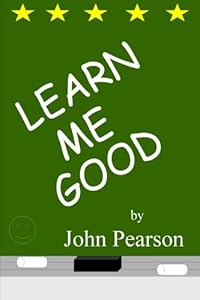
Cover of "Learn Me Good"Cover of Learn Me GoodJohn Pearson was a design engineer but is now a 3rd grade maths teacher who says the only thing that hasn’t changed noticeably in his daily life is the maturity level of the people surrounding him all day. He works in Dallas, Texas, with a very diverse, at times frustrating, at times inspiring group of kids. He writes as well, mostly about said kids and his interaction with them. His book, Learn Me Good, is largely the result of his first year. He also enjoys college basketball (Go Duke!), Stephen King books, Lost and 24, and watching Jeopardy – and hopes to be on it someday!


SA:  Tell us about Learn Me Good.
JP:  Jack Woodson was a thermal design engineer for four years until he was laid off from his job. Now, as a teacher, he faces new challenges. Conference calls have been replaced with parent conferences. Product testing has given way to standardized testing. Instead of business cards, Jack now passes out report cards. The only thing that hasn't changed noticeably is the maturity level of the people surrounding him all day. Learn Me Good is a hilarious first-person account, inspired by real life experiences. Through a series of emails to Fred Bommerson, his buddy who still works at Heat Pumps Unlimited, Jack chronicles a year-in-the-life of a brand new teacher. With subject lines such as "Irritable Vowel Syndrome," "In math class, no one can hear you scream," and "I love the smell of Lysol in the morning," Jack writes each email with a dash of sarcasm and plenty of irreverent wit.

SA:     What qualities do you need to be a successful writer?
JP:      First and foremost, you need to be a storyteller.  Someone who can draw the reader into the world you are creating or describing and then hold their interest.  On the flip side, after the book is written, you need to have perseverance, especially indie authors, in order to get word of the book to the public, promote it, and get people to buy it!

SA:     What is your working method?
JP:      Step one, procrastinate.  :)  Actually, I try to get in a bit of writing when I have free time, which during the school year, is not often.  I write with pen and paper first, then I transcribe it to a computer document, print that out, and make corrections with a red pen.  I went through 7 drafts before publishing Learn Me Good, so revising is a big part of my work.

SA:    What is the single biggest mistake made by beginners to writing?
JP:     Underestimating the importance of good editing.  Spelling and grammar IS important, and the lack thereof can really turn a reader off.

SA:     How did you come to write this particular book?
JP:   In 2001, I was layed off from my job as a thermal design engineer, and I was unemployed for quite a while.  I finally decided to go back and get my teaching certification, and in 2003, I became a 3rd grade math teacher at a public school in Dallas, Texas.  Having gone to private school all my life, I was not quite prepared for what I would experience in public school.  The kids really kept me on my toes, and I realized that I just had to put my stories down in a book to share them with others.

SA:     If you have a favorite character in your novel, why that particular one?
JP:      There is a student named Marvin in Mr. Woodson's class who is based on a real troublemaker that I taught my first year.  He was one of my LEAST favorite students, but he's my favorite character in Learn Me Good because I have had some time removed from the REAL child, and the character is just so darn funny.

SA:  What are you writing now?
JP:   I am working on a sequel, tentatively titled Learn Me Gooder.

SA:     How can people buy your book(s)?
JP:      Learn Me Good is available on Amazon in print and for the Kindle, as well as Smashwords and the ibookstore.

SA:  Do you have a website or a blog that readers can visit?
JP:   My blog is learnmegood.com, where I write about education-related topics.

Here is the link to the UK Amazon page for Learn Me Good:

Thanks!

John Pearson

Enhanced by Zemanta