Some of my writing is available free on a great site called Readwave. It's a place that hosts short - 2-3 minute - pieces of fiction, opinion and fact. There are currently half a dozen pieces of mine on the site. This morning I posted one relating to our future. That's 'our' in the sense of the human race, and looks at what we might do to ensure we maintain a presence on this wonderful world of ours. Please visit the site, read the 3 minute piece, and, if you feel so inclined, give the post a 'like' - You'll find a little pink heart at the bottom left of the story to do that. You can click this link to reach the story. Thank you.
Showing posts with label Environment. Show all posts
Showing posts with label Environment. Show all posts
Tuesday, 17 June 2014


Sunday, 14 July 2013
Where Have All the Wild Things Gone?
 Here in UK we’re
celebrating the arrival of summer at long last. Several days of hot sunshine
and dry
Yesterday, my wife and I
went for a walk along a route we haven’t travelled since last autumn. It’s a 4 mile
stroll through fields around the small market town where we live. The lanes and
paths are rural, winding through farmland for the most part but beginning in
the small village of Little Driffield and ending back in Great Driffield. We
generally stop to watch and listen to the many song birds and we usually,
especially in summer, have to spend a little energy in wafting away the myriad
flying insects that rise from the grass, crops and hedgerows.
This time, the walk was
different. It was hot and dry under a cloudless sky. The birds were quiet.
There was no background hum and buzz of busy insects. Even the crickets were
silent. Disturbingly, we heard only 2 songbirds along the entire walk and saw
only a small flock of Swallows on the wing. The hedgerows were devoid of ladybirds,
the grass hid no crawling or flying insects, the cow parsley was pristine, it’s
creamy flowers entirely undisturbed by the usual crop of cardinal beetles. We
saw 3 small butterflies in a place we would normally lose count. The clover,
usual haunt of honeybees, was silent. No flies, small or large, buzzed us. In
short, the landscape, lush with green vegetation, poppies, wheat, barley, oil
seed rape and wildflowers, seemed bereft of animal life.
I’m no biologist, not even
a naturalist, but I know enough to understand that a lack of insect life must
eventually have a detrimental effect on life further up the food chain. Without
beetles and grubs, the voles, shrews and other small mammals will fail to
breed. The birds will not mate without the promise of food to feed their
fledglings. Not least amongst the concerns at this absence of insects is the
simple fact that most of the food crops grown for human consumption are
fertilised by insects. No insects: no food.
So, where have they gone?
What has happened to cause this unnatural silence and absence of wildlife? The
simple answer is, probably, ‘climate change’. The pattern of weather this year
has been chaotic. We’ve had records in almost every month. Coldest, wettest,
cloudiest, driest and, I suspect, come the end of July, hottest. Such contrasts
within so short a time are all but unheard of. Of course, there have always
been variations in the weather patterns; the climate of this small group of
islands is noted for its changeable nature. And we all understand that, in the
long history of the world, the climate has alternated between tropical and
frozen. But these changes have taken place over millennia, sometimes over
millions of years. What has changed is the time scale.

Like most of my
generation, I recall long, hot summers following mild, wet springs and fading
into cool, damp autumns to end in cold, wet winters. Real seasons. I accept the
evidence may be anecdotal, but somehow, the world ‘feels’ like a different
place now. Rapid change isn’t happening only here in Britain. The world over,
countries are suffering huge variations in their weather patterns. Drought,
storm, flooding, snowfall, natural wildfires, hurricane and typhoon are all
happening with greater frequency and intensity all over the planet.
In the 1980s, I joined
Greenpeace, when that organisation arrived on these shores. At that time, in
spite of other concerns, the scientists involved with the ecological movement
were already predicting that what was then called ‘global warming’ would cause
great variations in weather for the globe. They predicted that the dry places
would become drier, the wet, wetter, etc. ‘Global warming’ in spite of the
accuracy of the term (since global temperatures are on the rise) has been
replaced with the less dramatic ‘climate change’ label. But, whatever we want
to call the process of change, it cannot be denied that change is happening.
I suspect that my local
walk has highlighted a result of climate change. I don’t know if this is the
case, but I can think of no other likely cause. There are those, of course,
mostly with vested interests or employing the ostrich philosophy, who decry all
talk of climate change. This in the face of the fact that most governments and
the vast majority of climate scientists are now convinced the planet is
undergoing serious changes to the climate. The most urgent question we must
answer is, ‘What is causing this disruption?’ If, as most of us who care think,
it is human activity that’s responsible for the dramatic rate of change, then
we need to take action to curb our destructive tendencies. It will mean
changing the way we live, what we eat, how we dress, where we buy our products,
how we utilise energy and resources.
We’re rapidly reaching a
point where a failure to act will cause the changes to form their own momentum.
There’s a strong possibility that we’ll reach a tipping point that, once
exceeded, will be impossible to reverse. Under those circumstances we have no
real knowledge of the consequences. We only know that they’re likely to be
distinctly uncomfortable, possibly dangerous and most likely will lead to war
as resources fail within individual countries. All such change is more likely
to happen after I have gone, of course. It’s for my daughter and her children,
as yet unborn, that I fear for the future. If you have children, perhaps you’ll
give some thought to this issue and, if you don’t already do your share to
avoid the coming catastrophe, maybe you’ll take the trouble to become informed
and take action now, before it really is too late?
Sunday, 25 November 2012
Do You Work Best in Chaos or Control?
 |
| Stones on the beach at Flamborough |
Do you work well in clutter? Does it really matter to you if the desk is
covered in piles of manuscripts, notes to remind you, a document stand
overflowing with ‘things to do’? Is it no problem for you to step over those
things you’re planning to sort out every time you enter the room?
On the other hand, do you have to have a tidy desk, with everything in
its place and nothing outstanding. Is that box of odds and sods already sorted
for sale on Ebay or ready for the local charity shop? Or does such a box never
exist in your life because you always clear these things as they come along? Is
your inbox only ever the place where new emails live for the short while it
takes you to deal with them? Are you obsessive about the places your things are
located, ensuring everything is always exactly where you want it?
I lie somewhere in between these two extremes of chaos and obsessive
tidiness.
For a number of reasons, with which I won’t bore you, I’ve had to allow
certain irritations to build up over the last few weeks. It’s always a question
of priorities. But I do find it difficult to be creative and disciplined in my
writing habits when the desk has a pile of correspondence awaiting attention,
the inbox has over 100 emails I need to explore further, the room I use as a
study is crowded with objects that need some attention before I can either sell
them or recycle them via the local Help the Aged shop.
So, on Wednesday afternoon, when I arrived home from the half week I
spend at an office in order to supplement my earnings from writing, I decided
enough was enough. It was time for a serious bout of deck-clearing. I want to
get on with the fantasy trilogy I’m writing, and all these interruptions are
getting in the way. The only solution is to deal with them.
So far, I’ve reduced the inbox to 13, and 12 of those are required for
future action I can’t actually take at the moment. I’ve updated the Writing
Contests page on this blog and therefore removed from the desk the pile of
magazines, leaflets and other printed matter I consult for this task. I’ve
restored my daughter’s old computer to a working state, which took some 10
hours of attention, reformatting and re-installing of software, so I can see if
that will sell on Ebay. Along the way,
I’ve dealt with all new emails (I get around 70 a day), posted a couple of
items on the blog, kept up to date with Pinterest and Twitter and Facebook and
LinkedIn, all of which are social sites I use to keep in touch with readers.
But, as a happily married man who wishes to remain so, I’ve also spent some
real quality time with my wife, who is a great support to my writing activity.
An earlier post on here describes our
day in Hull to see the Da Vinci drawings and watch the latest Bond film.
And we also managed a longish walk along the local cliffs near Flamborough. I
love the sea and find it refreshes my spirit. Took some pictures along the way,
which I’ll add to the albums I
have on Facebook when time allows.
Why am I telling you all this? Well, the lesson of the last few days has
been that I work better without clutter. And, if I’m able to keep it at bay,
I’ll get a lot more writing done. So, I’ve found my ideal working situation.
Have you found yours, or are you continually in a state where you’re either
fighting against a chaos over which you have no control, or are you so busy
keeping everything tidy that you have no real time to do what matters most; you
writing?
There you go. I’ve even found time to write and post this piece on the
blog. So, here’s your challenge: if you’re not already working in your ideal
environment, do something about it and sort it out so you can work in your
optimum way and actually get that writing done.
Good luck, and have fun!


Sunday, 14 October 2012
Whose Water Is It, Anyway?
 |
| Water cycle http://ga.water.usgs.gov/edu/watercycleprint.html Other language versions: Català Czech español Finnish Greek Japanese Norwegian (bokmål) Portugese Romanian עברית Diné bizaad (Navajo) and no text and guess water vapor (Photo credit: Wikipedia) |
As far as I know, no individual or corporation has laid claim to the air
we breathe or the light that stems from sun, moon and stars (though the
possibility clearly exists in this materially-obsessed world of ours). We
accept that these are naturally occurring phenomena that have enabled life on
the planet we inhabit. Logic suggests that water be included in that short
list. It’s a natural consequence of a long-established cycle that was not
initiated by human activity and it’s a substance that’s the very essence of
life. Yet there are those who lay claim to the water that exists in a given region.
My view is that water, like air and sunlight, should not be allowed to ‘belong’
to anyone.
I hear the cries of those who either run or own shares in water
companies, berating me for robbing them of their profits, and telling me that
treated water doesn’t get that way for free. I know. I wouldn’t dream of arguing
that it does. That isn’t what I’m suggesting. I’m saying that they do not and
cannot make water.
We may clean and modify the raw material. But that raw material is a
natural resource and is therefore not something over which someone can rightly
claim ownership. The processing, storage and delivery are those elements for
which we should expect to pay, allowing the companies concerned to add their
reasonable profit for future investment and to pay their workers a living wage.
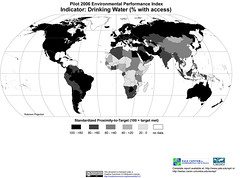
But, to allow anyone to claim rain, which is what all drinking water is at
source, as an owned resource is patently mad, bad and stupid. So, as a society,
and I am talking worldwide here, we should accept that water, which exists
without our intervention, isn’t a commodity to be traded but a resource to be
distributed without reference to either profit or boundaries.
Treatment, modification, extraction, storage and delivery are the only elements
that should be subject to cost. The raw material should be considered a zero
cost component of such a business.
 |
| Drinking Water (Photo credit: SEDACMaps) |
Logic suggests that I should go further in my argument. Is rainfall a
matter of human control? Only inasmuch as, occasionally, societies have seeded
clouds in order to encourage precipitation at a specific time in a specific
place, with variable success. We have no control over where and when those clouds
are formed. That’s a natural process. It’s true that our activities are
increasingly distorting it, but that’s an accidental by-product of our
irresponsible behaviour.
So, it follows that not only is water not the property of any individual
or company; it isn’t the property of any country or state either. The water
cycle knows no boundaries. The presence or absence of water in any given
location is due to a combination of natural influences: geology, geography and climate.
Of course, there are man-made aquifers, reservoirs and other capture and storage
facilities where man has usurped the natural product to direct it for his own
purposes. But such activity doesn’t constitute ownership of the actual
resource, it merely permits the transient capture of a quantity of it for local
consumption and is therefore part of what I’ve referred to as storage.
Over the history of our species, we have instinctively tended to settle near
sources of drinking, or fresh, water. The exceptions are nomadic peoples who
have taken their chances and followed certain natural cycles in order to obtain
their food and water. These are stateless peoples who, for historical reasons
often lost in the annals of unrecorded history, have not been able, or allowed,
to settle in any given location. But, for the majority of us, a settled
existence has been the norm for millennia. And settlements have almost always
developed near sources of drinking water simply because its absence would
prevent expansion.
 |
| English: Mwamanongu Village water source, Tanzania. "In Meatu district, Shinyanga region, Tanzania, water most often comes from open holes dug in the sand of dry riverbeds, and it is invariably contaminated." . Français : Point d'eau du village de Mwamanongu, en Tanzanie. "Dans le district de Meatu (région de Shinyanga, Tanzanie), L'eau provient le plus souvent de trous creusés dans le sable de lits de rivières asséchées. Elle est systématiquement contaminée." (Photo credit: Wikipedia) |
So, whether that water is obtained from boreholes, lakes, wells or
rivers, it remains a natural resource. Yes, there have been more recent
settlements that have provided their own man-made storage facilities and
collected or redirected the water needed to fill them. But the water, the
result of rainfall, remains a natural resource, along with sunlight and air. (I’m
aware that my argument can be developed to include other natural resources, by
the way, but I intend to discuss that in a later piece).
It follows that national borders are irrelevant to the incidence of
water. Presence or absence is an accident of geography for any state, since
this aspect of the cycle is unfixed. A city can grow up on the banks of a river
which then changes course. A settlement can develop around a lake which
subsequently drains due to tectonic or mineralogical activity. The boreholes
leading to an underground aquifer can end up as mere holes in the ground when natural
changes shift the level of that aquifer.
Yes, we, as a species, can and do make changes aimed at preventing such dangers
to our second most essential resource. But the fact remains that the substance
itself stands outside ownership or borders. Something that falls from the sky
in the way that precipitation develops water sources can hardly be claimed as the
property of any person, corporation or state. We are custodians only.
Modifiers; nothing more.
In the near future, water, or its lack, will become an increasing source
of dispute between nations. There are already signs of conflict arising from
the reduction of available water in certain geographical areas. The famines in
parts of Africa are almost entirely driven by changes in the water cycle in
those regions; increased population has merely exacerbated the problem. My
guess is that the problems in Israel are fundamentally caused by the perception
that the most important source of fresh water is growing insufficient to
sustain more than a given population. There are signs that drought will soon
invade the fertile plains of the Punjab in India, making it impossible for them
to provide the food on which that huge continent depends. The western states of
the USA are finding more and more difficulty in obtaining water for
agriculture, industry and human consumption. Not that this has stopped certain
organisations from squandering the precious resource in displays of
irresponsible excess.
If, as a world society, we fail to recognise the basic fact that water is
a natural resource belonging to all and to none, regardless of source, we will
have conflict in the near future. Almost certainly, the next major wars will be
over the ownership of fresh water: man killing man through an inability to
accept a basic truth. Water, like air and sunlight, is a natural consequence of
the location and geography of the planet and belongs to no one and to everyone.
It is time we dealt with it in that way.


Sunday, 11 December 2011
The Green Thing
 |
| Image via Wikipedia |
Checking out at the store, the young cashier suggested to the older woman, that she should bring her own grocery bags because plastic bags weren't good for the environment.
The woman apologized and explained, "We didn't have this green thing back in my earlier days."
The clerk responded, "That's our problem today. Your generation did not care enough to save our environment for future generations."
She was right -- our generation didn't have the green thing in its day.
Back then, we returned milk bottles, soda bottles and beer bottles to the store. The store sent them back to the plant to be washed and sterilized and refilled, so it could use the same bottles over and over. So they really were recycled. But we didn't have the green thing back in our day.
We walked up stairs, because we didn't have an escalator in every store and office building. We walked to the grocery store and didn't climb into a 300-horsepower machine every time we had to go two blocks. But she was right. We didn't have the green thing in our day.
Back then, we washed the baby's diapers because we didn't have the throw-away kind. We dried clothes on a line, not in an energy gobbling machine burning up 220 volts -- wind and solar power really did dry our clothes back in our early days. Kids got hand-me-down clothes from their brothers or sisters, not always brand-new clothing. But that young lady is right; we didn't have the green thing back in our day.
Back then, we had one TV, or radio, in the house -- not a TV in every room. And the TV had a small screen the size of a handkerchief (remember them?), not a screen the size of the state of Montana . In the kitchen, we blended and stirred by hand because we didn't have electric machines to do everything for us.
When we packaged a fragile item to send in the mail, we used wadded up old newspapers to cushion it, not Styrofoam or plastic bubble wrap. Back then, we didn't fire up an engine and burn gasoline just to cut the lawn. We used a push mower that ran on human power. We exercised by working so we didn't need to go to a health club to run on treadmills that operate on electricity. But she's right; we didn't have the green thing back then.
We drank from a fountain when we were thirsty instead of using a cup or a plastic bottle every time we had a drink of water. We refilled writing pens with ink instead of buying a new pen, and we replaced the razor blades in a razor instead of throwing away the whole razor just because the blade got dull. But we didn't have the green thing back then.
Back then, people took the streetcar or a bus and kids rode their bikes to school or walked instead of turning their moms into a 24-hour taxi service. We had one electrical outlet in a room, not an entire bank of sockets to power a dozen appliances. And we didn't need a computerized gadget to receive a signal beamed from satellites 2,000 miles out in space in order to find the nearest pizza joint.
But isn't it sad the current generation laments how wasteful we old folks were just because we didn't have the green thing back then?
Please forward this on to another selfish old person who needs a lesson in conservation from a smartass young person.
Remember: Don't make old People mad!
We don't like being old in the first place, so it doesn't take much to piss us off.
I find my sympathies lie with both camps. As a Greenpeace supporter since the 1970s, I've long had a 'green' awareness. And, as a child of the post war years, I used to attend the local cinema 'free' simply for the price of 9 jam jars to be recycled. So I understand all of the above. The young, on the other hand, are not responsible for developing all the labour-saving devices that have evolved from our love affair with consumerism and technology. These have all come along at the hands of our generation or that of our children. The continued exploitation of the Earth's resources continues with the current generation who merely follow the example we have set. So, whilst it might be true that we did many things to re-use items and resources in our younger days, it is equally true that we did nothing to prevent the decline of such recycling and we did a great deal to ensure the success of the modern throw-away economy.
Lets's not blame one another for the state of the modern world. Instead, let's actually do something about it, by ensuring we avoid the worst excesses of consumerism and embrace the best practices of the ecologically sound.

Sunday, 9 October 2011
Stuart's Daily Word Spot: Downstream or upstream?
 Image via Wikipedia
Upstream: adverb - contrary to the direction of flow
of a river or stream, further up or along a moving body of water.
If you have trouble
remembering these two, just use the analogy of stairs. Water always flows down,
never up. So: as you climb up the stairs, so you go 'upstream', toward
the source of the river in the hills.
'It's much easier to swim
or paddle a boat downstream, as you follow the flow toward the sea.'
'If you intend to drink
from a stream, it's probably best to make sure there isn't a dead sheep lying
in the current upstream.'

Monday, 29 November 2010
Are Folk More Ill-Mannered These Days?
 Image via Wikipedia
We all come across instances of poor manners; those who live in cities must suffer this most, whilst those in towns encounter more inconsiderate behaviour than those who live in rural areas. I believe it's density of population, sheer numbers, that is responsible for the fall in good manners. The larger the local population, the more difficult it is to feel part of a community and therefore to feel that sense of mutual obligation that makes for a more considerate mode of living.
We live cheek by jowl in cities and towns yet know few of those we pass in the street; possibly even being ignorant of the names of those who live next door or across the road. In villages and rural areas this sort of alienation is rare because all residents know each other and only unknown people are classified and treated as strangers. The fact that individuals are generally known tends to make for better behaviour, and rudeness, ignorance and antisocial habits are less frequent. The incidence of juvenile crime in such areas is lower because the children know that their parents will invariably get to hear about any wrong-doing.
But general good manners have been in decline for decades, more or less regardless of location. I can recall always stepping to the side to allow an older pedestrian to pass me in the street, always holding open a shop door to permit the entrance of those following me, regardless of gender or age, and many other small acts of good manners. And I was brought up first in a city and later in a town. But I note that bad manners appear to have nothing to do with either age or gender; people of all generations and both sexes seem equally incapable of applying the lubrication that allows life to run more smoothly.
I recall travelling on the Tube in London some years ago. A young pregnant woman entered the crowded compartment. Without a thought, I rose and offered her my seat; it was a simple natural action. She sneered at me and said something like, 'I can f**king stand as well as you, you condescending twat.' I put down her behaviour as an isolated case of extreme feminism and continue to offer my seat to the frail, disabled or elderly. A more timid man might have never dared make such an offer again.
Driving, I frequently come across situations where one party is required to give way to another and never fail to be surprised by how few acknowledge the action, simply driving through as though they owned the road.
I cannot be alone in decrying such behaviour. Let me know whether you agree or not and let me know why you feel it is important or trivial, please. Tell me about the sort of rudeness that really makes you angry, disappointed or frustrated. I'm interested in how others feel about this topic.

Tuesday, 23 November 2010
Is Population a Primary Cause of Global Climate Change?
 Image via Wikipedia
Does anyone else feel, as I do, that the rising human population is probably the greatest threat to our security on the planet? Currently, according to the World Population Clock as I write, there are 6,855,542,801 (click the link and frighten yourself to death as you watch it increase before your eyes). The same counter estimates a world population of 8,730,121,285 by November 2050.
These numbers are too large to properly comprehend, of course. But the overall upward trend terrifies me. We have already reached a stage where millions are starving, millions if not billions have no access to safe water supplies, energy reserves are too scarce to go round, and many mineral resources are rapidly declining.
As the underdeveloped nations climb the ladder toward a Western level of consumerism, the calls on almost every resource will become unsustainable. If we can’t avoid starvation in the world now, how are we going to do so with a 20% increase in mouths to feed? Many experts predict that the next wars will be over drinking water; that seems to me like stating the bleeding obvious.
The increased consumption of materials and fuel and the resultant output of pollutants and carbon dioxide will inevitably accelerate the rate of climate change, which in turn, will add damaging stress to the ecosystems producing crops.
It is likely that war is inevitable under such circumstances. As a species, and as separate social groups, we have always shown a remarkably blinkered attitude to inevitable changes. Many of the civilisations that preceded ours vanished or declined rapidly as a result of ecological disasters. Are we to go the same way?
We do have a choice. We can do something to prevent catastrophe. It won’t affect me, other than at the very end of my likely lifespan. But it will affect my child and any individual currently under the age of about 40.
A fundamental change has to be the way we view our reproduction as a species. We have long had the means to limit our growth, to reduce the many children born to some couples. Of course, there are authorities in the world who see such intervention as sinful and against the will of their God. Perhaps these authorities should look at the poverty, misery and distress that their insistence on such dogma cause. The perceived need to continually increase the membership of any club (for which, read religious grouping) is hardly a reason to threaten the stability of life on Earth, is it?
They will no doubt use the defence that we must not behave as if we were God. But we do that daily by our intervention in the health and welfare of the population at large. If we can intervene to save life, why can’t we intervene to prevent its development?
I’ve had my say – or some of it – and now invite you to say your piece. Please, let me and the world know what you think about this.

Monday, 15 November 2010
What Does it Mean to Be Green?
 Image via Wikipedia
For some, the Green movement is a political choice, for others, it’s a spiritual matter and yet others see it as a social issue, especially relevant to the future lives of their children. Many people see it as all three, of course. And yet others think it is all so much hype and hysteria – though who, exactly, would gain from such a programme of disinformation about the environment is difficult to pin down.
As a parent, I want to leave behind a world fit for my daughter, and any children she may have, to inhabit. I would prefer to leave the place better than I found it. So, I belong to Greenpeace, and have done since the 1980s. My wife belongs to Friends of the Earth. We pool their information and do what we can to support both organisations.
Are all the warnings about climate change (or global warming, if that’s your preferred term) justified? The climate is a hugely complex system and local weather, on its own, is no clue to what is happening on a global scale. It is the accumulation of changes, extremes and effects that point to serious movement in the way our climate works. Almost without exception, the statistics indicate that the Earth’s atmosphere is altering to the detriment of humankind. I have no fear for the planet itself or life in general: they will continue for untold eons, with or without us. But there are signs that our input to the climate is generally destructive in the way it affects humans as a species. Already, some crops are failing, the water table in many areas - India’s Punjab and Israel’s disputed territory are obvious examples – is dropping to a point where it will soon be unusable. We are experiencing many examples of extreme weather in the form of floods, droughts, hurricanes, ice storms, forest fires etc. Some people believe that because their own local weather is improving, there is no problem. But local weather patterns on their own are no indicators of the general health of the climate over the planet.
Way back in the early 80s, Greenpeace predicted that we would see extremes in the weather all over the world due to global warming. And what do we have today? Extremes in local weather all over the globe. Isn’t that a surprise?
If we accept that mankind is the prime mover in this change (and the naysayers will blame the Sun – a long discredited theory; or cyclical changes – also not a valid defence, as the rate of change we are experiencing is unprecedented) then we need to know whether there is anything we can do about it as individuals. We cannot trust governments to take the necessary steps, unless we are prepared to back their unpalatable changes with action.
Recycling comes a poor second to making things last longer and repairing stuff that needs replacing. We consume as though the planet’s resources were inexhaustible but there are already signs that we will run out of some our basic needs in the near future. It is not unlikely that the next round of wars and conflicts will arise over claims to drinking water. Then will come disputes over food production, as the world’s population exceeds the planet’s ability to support it. Millions are starving today; if they were fed to the level of the most highly consuming societies, there simply wouldn’t be enough food to go round. So, we would struggle to feed a world with its current 6.5 Bn; what will we do with a population of 9 Bn, due around 2050?
Is it feasible to slow down population growth, surely a prime cause of our problems, or better, to reduce it?
Can we persuade people to reduce car use? Will increased nuclear power help reduce the effects of growing fuel use? Will commercial and political interests allow the introduction of factors other than purely material one to be included in pricing, so that the real costs to the planet can be reflected in what we use and buy?
I put these statements and questions to attract comment and debate and invite you to make your contribution here and now.

Subscribe to:
Posts (Atom)