Google+
This blog has moved. Please go over to this link to see my new website.
Showing posts with label Injustice. Show all posts

Sunday, 14 October 2012

Whose Water Is It, Anyway?

Water cycle http://ga.water.usgs.gov/edu/water...
Water cycle http://ga.water.usgs.gov/edu/watercycleprint.html Other language versions: Català Czech español Finnish Greek Japanese Norwegian (bokmål) Portugese Romanian עברית Diné bizaad (Navajo) and no text and guess water vapor (Photo credit: Wikipedia)

As far as I know, no individual or corporation has laid claim to the air we breathe or the light that stems from sun, moon and stars (though the possibility clearly exists in this materially-obsessed world of ours). We accept that these are naturally occurring phenomena that have enabled life on the planet we inhabit. Logic suggests that water be included in that short list. It’s a natural consequence of a long-established cycle that was not initiated by human activity and it’s a substance that’s the very essence of life. Yet there are those who lay claim to the water that exists in a given region. My view is that water, like air and sunlight, should not be allowed to ‘belong’ to anyone.

I hear the cries of those who either run or own shares in water companies, berating me for robbing them of their profits, and telling me that treated water doesn’t get that way for free. I know. I wouldn’t dream of arguing that it does. That isn’t what I’m suggesting. I’m saying that they do not and cannot make water.

We may clean and modify the raw material. But that raw material is a natural resource and is therefore not something over which someone can rightly claim ownership. The processing, storage and delivery are those elements for which we should expect to pay, allowing the companies concerned to add their reasonable profit for future investment and to pay their workers a living wage. But, to allow anyone to claim rain, which is what all drinking water is at source, as an owned resource is patently mad, bad and stupid. So, as a society, and I am talking worldwide here, we should accept that water, which exists without our intervention, isn’t a commodity to be traded but a resource to be distributed without reference to either profit or boundaries.

Treatment, modification, extraction, storage and delivery are the only elements that should be subject to cost. The raw material should be considered a zero cost component of such a business.
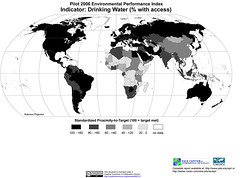
Drinking Water
Drinking Water (Photo credit: SEDACMaps)
Logic suggests that I should go further in my argument. Is rainfall a matter of human control? Only inasmuch as, occasionally, societies have seeded clouds in order to encourage precipitation at a specific time in a specific place, with variable success. We have no control over where and when those clouds are formed. That’s a natural process. It’s true that our activities are increasingly distorting it, but that’s an accidental by-product of our irresponsible behaviour.

So, it follows that not only is water not the property of any individual or company; it isn’t the property of any country or state either. The water cycle knows no boundaries. The presence or absence of water in any given location is due to a combination of natural influences: geology, geography and climate. Of course, there are man-made aquifers, reservoirs and other capture and storage facilities where man has usurped the natural product to direct it for his own purposes. But such activity doesn’t constitute ownership of the actual resource, it merely permits the transient capture of a quantity of it for local consumption and is therefore part of what I’ve referred to as storage.

Over the history of our species, we have instinctively tended to settle near sources of drinking, or fresh, water. The exceptions are nomadic peoples who have taken their chances and followed certain natural cycles in order to obtain their food and water. These are stateless peoples who, for historical reasons often lost in the annals of unrecorded history, have not been able, or allowed, to settle in any given location. But, for the majority of us, a settled existence has been the norm for millennia. And settlements have almost always developed near sources of drinking water simply because its absence would prevent expansion.

English: Mwamanongu Village water source, Tanz...
English: Mwamanongu Village water source, Tanzania. "In Meatu district, Shinyanga region, Tanzania, water most often comes from open holes dug in the sand of dry riverbeds, and it is invariably contaminated." . Français : Point d'eau du village de Mwamanongu, en Tanzanie. "Dans le district de Meatu (région de Shinyanga, Tanzanie), L'eau provient le plus souvent de trous creusés dans le sable de lits de rivières asséchées. Elle est systématiquement contaminée." (Photo credit: Wikipedia)
So, whether that water is obtained from boreholes, lakes, wells or rivers, it remains a natural resource. Yes, there have been more recent settlements that have provided their own man-made storage facilities and collected or redirected the water needed to fill them. But the water, the result of rainfall, remains a natural resource, along with sunlight and air. (I’m aware that my argument can be developed to include other natural resources, by the way, but I intend to discuss that in a later piece).

It follows that national borders are irrelevant to the incidence of water. Presence or absence is an accident of geography for any state, since this aspect of the cycle is unfixed. A city can grow up on the banks of a river which then changes course. A settlement can develop around a lake which subsequently drains due to tectonic or mineralogical activity. The boreholes leading to an underground aquifer can end up as mere holes in the ground when natural changes shift the level of that aquifer.

Yes, we, as a species, can and do make changes aimed at preventing such dangers to our second most essential resource. But the fact remains that the substance itself stands outside ownership or borders. Something that falls from the sky in the way that precipitation develops water sources can hardly be claimed as the property of any person, corporation or state. We are custodians only. Modifiers; nothing more.

In the near future, water, or its lack, will become an increasing source of dispute between nations. There are already signs of conflict arising from the reduction of available water in certain geographical areas. The famines in parts of Africa are almost entirely driven by changes in the water cycle in those regions; increased population has merely exacerbated the problem. My guess is that the problems in Israel are fundamentally caused by the perception that the most important source of fresh water is growing insufficient to sustain more than a given population. There are signs that drought will soon invade the fertile plains of the Punjab in India, making it impossible for them to provide the food on which that huge continent depends. The western states of the USA are finding more and more difficulty in obtaining water for agriculture, industry and human consumption. Not that this has stopped certain organisations from squandering the precious resource in displays of irresponsible excess.

If, as a world society, we fail to recognise the basic fact that water is a natural resource belonging to all and to none, regardless of source, we will have conflict in the near future. Almost certainly, the next major wars will be over the ownership of fresh water: man killing man through an inability to accept a basic truth. Water, like air and sunlight, is a natural consequence of the location and geography of the planet and belongs to no one and to everyone. It is time we dealt with it in that way.

Enhanced by Zemanta

Saturday, 6 October 2012

Is Society Organised for Business or for People?

International Money Pile in Cash and Coins
International Money Pile in Cash and Coins (Photo credit: epSos.de)

An odd question, or one you think should be considered? I suspect your view will be influenced by your basic attitude to the place of money in society.

Why would I even ask the question? I look at the world around me and view the priorities cited by government, commerce and those with a real interest in environment. What I see is a society slewed toward the making of money as a primary purpose. But isn’t money supposed to be the tool, the helpmate of humanity? Isn’t trade, and all those services involved with manufacturing, production and delivery, intended to serve mankind?

When I look at the world, I see that the production of wealth is actually the prime purpose of most commerce. Now, I fully understand that we can’t live in a society where barter takes the place of currency, but I do question the value we place on the process involved in increasing wealth. Businesses appear to exist primarily for the benefit of their shareholders, so that their customers are, in fact, at best a secondary consideration rather than the primary cause of activity.

Banks are probably the best illustration of what I mean: Banks were set up to provide a service that would allow the lending, borrowing and security of the funds of their customers to operate to the benefit of those customers. But the current system benefits primarily the bankers and those institutions and individuals who hold equity in the business itself. The customer who wishes to take advantage of the lending system is now seen more as a threat than a natural client. Customers are viewed as a source of extra income, often by the employment of questionable schemes to extract more money from them to be placed into the banks’ coffers. (There are many examples of this, the recent scandal of mis-sold PPI is simply the most obvious).

Sport is another area where money has become the prime purpose of participation. Football, in particular, has fallen victim of the money men. What used to be local clubs, with locally trained and selected teams, and whose object was the raising of local pride in association with the clubs’ successes, have now become simple businesses. They no longer have any real connection with the locality in which they reside. The teams are made up of international ‘stars’ of questionable value who are paid obscene amounts of money in order to progress their teams to gain more money for the club owners. In the rush to make more and more money from sport, all ideas of sportsmanship have receded to be overtaken by cynical gamesmanship. And this change is so pervasive that many of the fans and players aren’t even aware that cheating, play-acting and tricks are damaging both the sport and society in general. And all this because huge sums of money are on offer from the various media companies who distribute the product to the masses.

Religion has joined the rush for money, in spite of the injunction to the faithful that they should eschew material riches in favour of spiritual rewards. The Roman Catholic church is an obscenely rich organisation that begs for more income from its impoverished congregations whilst keeping its leaders in ostentatious luxury. The Church of England cries out for public funds to repair and support its many crumbling buildings, whilst remaining one of the richest landowners in the country.  I don’t know much about the Jewish and Islamic institutions, but I’m willing to bet they are similarly wealthy whilst many of their adherents remain in poverty.

I could go on with examples, but that would be pointless. My concern is with the way in which we have allowed money to become our master and, in the process, allowed those who own the most money to have power over the vast majority who have little or none. What was intended as a tool to aid interaction and prevent chaos in a growing population has become a weapon in the hands of a very few powerful institutions and individuals. A weapon of control, which promises to become eternally self-perpetuating unless we do something radical to overturn the supremacy of money in the use and abuse of power and return governance to the mass of people.

It is demonstrably unjust that there are individuals who have personal incomes and wealth greater than the GDP of some small nations. It is demonstrably absurd that some individuals have colossal wealth when there are many who have none. We have been sold the idea that those with wealth have somehow deserved it, that they are solely responsible for the good fortune that has happened their way. Please don’t spout the old chestnuts about ‘getting what you deserve’ and ‘work hard and you’ll succeed’ at me. I touched on those two lies a while back and the links (one below) will take you to my arguments.

The simple fact is that no individual ever has been or ever will be deserving of wealth disproportionate to their efforts. The tycoon who claims to be a ‘self-made man’ conveniently forgets that he could not even have risen from his bed in the morning without the help and input of a multitude of other people. For those who find this concept difficult to grasp I feel I must give an example. We all need food to survive. Let’s take the basic loaf of bread, without which our tycoon could not perform, due to hunger. Someone has first to plough and till the ground so that it can be seeded with grain. The crop has to be gathered and transported along roads, made by many more individuals using the tools and machines made by other individuals. At the bakery, more people are involved in turning the raw material into a food product, using machinery and electricity that depends on other individuals for manufacture. Once baked, using power derived from sources mined or generated by yet more people, the product is transported, using fuel and materials produced by other individuals. Eventually, the loaf arrives in the shop to be sold and is there dispensed by even more people. Along the way, we have also to consider the road sweeper who keeps the highway clear to permit the transport to move, the rubbish collector who disposes of the waste that would otherwise clog up the works, the teacher who educates all the people involved in the various process, the nurse who cares for those who fall sick along the way, the unpaid parents who ensure the children get to school…do I need to go on? The reality is obvious. But we seem to have fallen into the trap of believing that certain individuals somehow contribute a great deal more than the rest of us. It simply isn’t true.

The only real difference between the wealthy and the poor is often due to luck, preferential birth circumstances, the possession of a peculiar talent or the wicked selfishness and greed that allows some to ignore the needs of those over whom they wield their power.

Of course we need to reward those who initiate those ideas that are of benefit to the mass of humanity. Of course we must recognise those who possess rare and valuable talent. Of course we should ensure justice for those who accept high levels of responsibility. But none of these people is worth the huge difference in value that is ascribed to them.

In the UK, and I suspect, elsewhere in the world, there is a minimum wage, set so that unscrupulous businessmen cannot exploit too heavily those who produce their wealth for them. If a minimum wage is a sensible barrier to excessive poverty, then a maximum wage can easily be made a similar barrier to excessive wealth. It requires only political will. But, as long as we have a system of government that depends only on the value falsely accorded to money, we will have a control system that prefers the wealthy over the vast majority of hard-working people. Is that what you want?

Enhanced by Zemanta