Google+
This blog has moved. Please go over to this link to see my new website.
Showing posts with label Australia. Show all posts

Thursday, 3 April 2014

Passions in Australia: Faye Hall Guests

Today, I’m hosting another writer; an author of Historical Erotic Romance.


Faye Hall's passion driven, mystery filled books are set in small townships of North Queensland, Australia during the late 1800's.
Each of her novels bring something symbolically Australian to her readers, from Aboriginal herbal remedies, to certain gemstones naturally only found in this part of the world.
Each of her books tell of a passionate connection between the hero and heroine, surrounded and threatened by deceit, scandal, theft and sometimes even murder.
These romances swerve from the traditional romances as Faye aims to give her readers so much more intrigue, whilst also revealing the hidden histories of rural townships of North Queensland.
Faye finds her inspiration from the histories of not only the township she grew up in, but the many surrounding it. She also bases most of her characters on people she has met in her life.
Faye was able to live her own passion driven romance, marrying the love of her life after a whirlwind romance in 2013. Together they are raising their 9 children in a remote country town in northern Queensland, Australia.

Passions in Australia

She giggled knowingly. “I knew your name, Re, both your first and your last.  How could I not.”
“Then why pretend you didn’t know me?”
She shrugged casually. “Would you rather me have told those ladies that we slept together?”
-       From Faye Hall's 'She's a Lot Like You', released April 2014

Faye Hall, an Australian author, will have her second eBook, ‘She’s A lot Like You’ released with Red Sage Publishing April this year.
Like her other passion driven, mystery filled books, her new release is set in a small township of North Queensland, Australia during the late 1800's.

Ravenswood, the setting for ‘She’s A lot Like You’, is a township in Queensland most commonly known for its history in gold mining.  However, for her story, Faye has chosen to show a more glamorous and risqué side of this once very prosperous town.  There are beautiful gowns, gala dances and the hidden beauty of a country estate, all things Ravenswood had and more before the gradual decline of the town.  As with all her stories, Faye has included something singularly Australian to entice her readers into the hypnotic allure of the Australian culture in the late Victorian period. 

Faye has chosen this period to set her stories in precisely because she feels it has not been explored enough, nor has the beauty of Northern Australia during that period been represented to its fullest extent.  Other townships Faye explores through her writings include the Burdekin Shire, Sarina, Proserpine and Bowen (the township made famous by Baz Luhrmann’s ‘Australia’).

With every book, Faye has strived to give her readers not only the passionate connection between the hero and heroine, but also the ever present threat of deceit, scandal, theft and sometimes even murder.

A third book has recently been contracted with Red Sage, but as yet a release date is unavailable.

Faye’s books can be purchased direct from Red Sage at:-
From Amazon:-
Also you can visit Faye’s blog and website for any updates:-
Or find her on social networks:-

Enhanced by Zemanta

Thursday, 26 September 2013

Building a World from Scratch.

Writing fantasy generally requires the invention of a world different from the one in which we live our daily lives; especially epic fantasy. I’m currently writing volume three of such a trilogy. So, how did I go about developing the world where my story takes place?

The first consideration in fiction has to be ‘theme’. As always in such tales, the basic underlying theme is good versus evil. But there are other ideas layered over that. I’m fascinated by the continuing discussion whether religions rely on what seems like self-delusion to persuade the faithful to join and remain in their ranks. Another aspect of life that intrigues me is the duplicity of our attitude to nakedness. And the way that power is given, often voluntarily, to those who least deserve it has always baffled me. So, these themes are also explored in the books.

Primarily, of course, it’s a story, an adventure story with romantic elements, and a means to entertain my readers. I’m thoroughly enjoying weaving the tale. We all love stories; have done since the very beginnings of language.

Before I could ‘invent’ my world, I had to develop systems of history, politics, religions, customs and traditions. I considered how my characters, in their separate societies, would dress, where and how they would live, what would occupy them and how they would make their various ways through the world. I developed ideas on the evolution of villages, towns and cities. I invented names for these places and the characters who would inhabit them. Names that had to follow some sort of logic in formation, of course. I researched travel by sea, river, horse, camel and on foot. And then I studied some geology and geography so that I could devise a realistic map for my world.

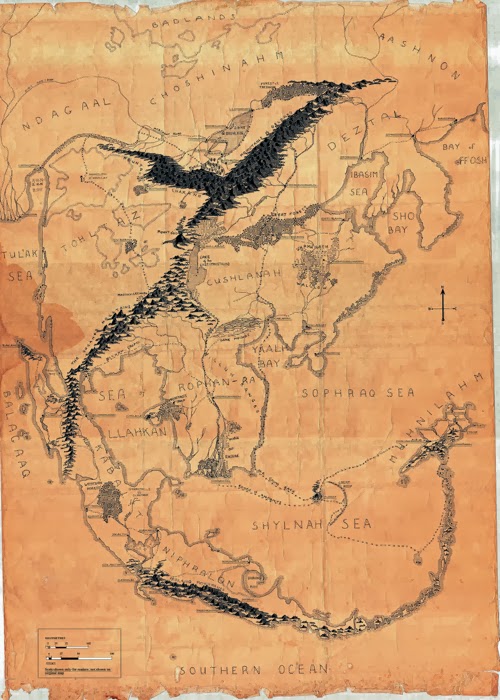
Maps and fantasy are almost inseparable. I wanted mine to do more than locate the places featured in the story; I wanted the map to be a central part of that story and an item of interest in itself. I drew it on a large (A1 – 34x23 inches for those who don’t know) piece of sugar paper in ink, with a drawing pen. I gave it some relief, so that there are mountains, plains, deserts, forests, rivers, seas, islands and lakes. I wanted to make this a real place in the mind of the reader, so it had to be as real as possible to me first. And, I confess, I borrowed from our own beautiful Earth to arrive at a credible outline of my lands.

Once drawn, I populated it with the names I’d made up, checking each on Google to ensure none of the chosen names belonged to anyone else or meant something inappropriate in a foreign language (there is a story that Julie Andrews’ book for children, The Last of the Really Great Whangdoodles caused her some embarrassment when she was told that ‘whangdoodle’ had a rather obvious and obscene meaning in Australia. I’ve been unable to discover any truth in this, and suspect it’s apocryphal, but it still serves as a warning about the use of unknown words.).

All this work took time and all had to be done before I could write a word of the story. Over the period of time it took to complete the preparation and development, the map turned, as hoped, from off-white to a shade of parchment. A little damp here and there installed stains and a few folds creased the map so that it now looks like a piece of ancient cartography that has undertaken several journeys. I added a compass and a rule in kilometres and miles so that readers can appreciate distances. I’ve reproduced it here for you to explore, if you wish.


Only after all this preparation did I begin to think about writing the story. But that’s for another post. It will come, as will some character sketches, to whet your appetite for the first volume, which I hope will be published later this year. Meanwhile, the third volume is growing, standing at 111,000 words as I compose this post. That means I’m a little over half way through the first daft of the final book. Books one and two are ready for publication.
Enhanced by Zemanta

Wednesday, 25 July 2012

Silver Bay by Jojo Moyes, Reviewed


Jojo Moyes has produced a superb piece of modern fiction in Silver Bay. Set mostly in Australia, with some action taking place in London, UK, the story deals with the effects of threatened development on the tranquil eponymous location of the title. But it is the relationships and interactions of the protagonists that drive this story of tragedy, romance, coming of age and redemption.

Presented in 3 parts, with a short prologue and epilogue, Jojo uses first person narration by five of the major characters, four female and one male, to explore emotional, motivational, mental and spiritual aspects of her protagonists. Her research has clearly been thorough and the novel displays the author’s deep knowledge of the subjects she uses for theme and background. The book starts slowly but builds relentlessly until the denouement is reached in a way unflagged and unexpected.

This was a book I would have read at one sitting, had I been able. As it is, my life being a little hectic at present, I was obliged to fit in reading between many other commitments. It’s testament to the quality of the writing and storytelling that I found myself looking forward to my occasional bus journeys, as they are opportunities to read. Normally I dislike this necessary part of my working day, but I was eager to get on that bus and have the chance to read. In fact, had I not finished the book shortly before the end of my journey, I suspect I’d have missed my stop.

Jojo has drawn her characters with skill, care, and love. This is appropriate, since the love stories that run through the narrative form a major thread of the tale. Each passage is in the voice of the chosen character and the author manages to make each unique and totally credible. She has managed to get as squarely inside the mind of her male characters as she has her females.

The main setting for the book, Silver Bay itself, performs the role of an additional character and the reader is immersed in the tranquil location to the extent that he feels all the anxiety, fear, resentment and disgust at proposals that will alter the place beyond recognition. Wales and dolphins, and the occasional shark, play interesting and informative roles along the way.

I thoroughly enjoyed this moving novel and have no hesitation in recommending it to readers of all types.

Enhanced by Zemanta

Friday, 11 November 2011

Stuart's Daily Word Spot: Kangaroo

Red Kangaroo, photo taken at Western Plains Zo...Image via Wikipedia
Kangaroo: noun - a herbivorous marsupial mammal of the family Macropodidae, from Australia, New Guinea, and nearby islands, having small front limbs, powerful hind legs and long feet, which allow it to leap great distances, using its long tail for balance; an Australian representing the nation in sport; in Britain, a parliamentary closure by which some amendments are selected for discussion and others excluded; also used in combinations, such as 'Kangaroo Court', a derogatory term for bad justice.

The word, Kangaroo, is derived from a Guugu Yimithirr word 'gangurru', which refers to grey kangaroos. The story about how the kangaroo got its English name isn't true; it's an urban myth. The story goes that "kangaroo" was an aboriginal word for "I don't understand you." and Captain Cook, exploring the area and coming upon the animal, asked a local what it was called. The local said 'gangurru ', and Cook is supposed to have wrongly assumed it was the name of the creature.
In fact, the aboriginal really was providing the name of the creature, as the linguist, John B. Haviland, has subsequently shown in his research with the Guugu Yimithirr people.

'No matter how they constructed the fences around the vast ranch, there was nothing they could do to exclude the kangaroos.'

'When it became public knowledge that Gordon, a well-known eccentric, had been accused of molesting a small child, the local macho men formed a kangaroo court and decided he must be guilty, so they set fire to his house whilst he was sleeping there.'

11 Nov 2011 - Armistice Day: at 11:11:11:11, in the UK, there will be two minute's silence to commemorate the fallen of many conflicts. No doubt, some numerologist somewhere will make more of this coincidence than it merits, and, in so doing, detract from the main purpose of the event.
For a reading of the evocative and moving 'In Flanders Field' go to  http://www.bbc.co.uk/news/uk-15691951

Enhanced by Zemanta

Thursday, 11 August 2011

Author Interview with Prue Batten


Hello Prue, please tell us about you, as a writer.

Hello Stuart and thank you so much for having me here on your blog.
Like many writers, I have been writing since I was young and that’s a looong time ago. For me, it was a form of emotional fulfilment, an escape and of course the obvious… a creative outlet. It’s interesting that as a child I learned ballet, had art classes and learned to horse-ride but at no time did I have a chance to learn the craft of writing because there was no such thing for primary school children. It was merely something that was vaguely alluded to in English at school under the rather generalised title of ‘composition’. All I knew was that when I was told we had ‘composition’, my heart sang and I would write like a devil possessed.

Your book A Thousand Glass Flowers is a fantasy. Perhaps you’d you give us some insight into it in a few sentences.

Okay, here goes:
Driven by the knowledge that charms exist that could kill the one remaining member of her mortal family in Eirie, Lalita Khatoun is desperate to find and destroy the infamous Cantrips of Unlife. Finnian, an Other, hunted by his insane grandmother after he fails in a murderous attempt on her life, is convinced the only thing that will rid him of her are those same cantrips and he too is desperate to find them. Fate contrives that Lalita and Finnian should seek together. In an ominous quest through a world where spine-tingling Others lace their way in and out of the lives of mortals, it’s a story of legend, love, and clashing ideals; a story of murder, regret and revenge… a story that journeys across a world too hauntingly like our own.

How did you come to write this particular book?

I’ve always been inspired by odd things: stumpwork embroidery, miniature books, pocketglobes, intricately woven fabric and in this particular case… paperweights. It was only a small step to imagine something dastardly and secret concealed within these things and for a ballad or myth to be created.

      Do you have a favourite character from the book? If so, who and why this particular one?

I think Lalita is a woman to be admired. Such loss and grief should have pitched her into a breakdown! But she’s a determined, feisty woman who knows how to handle a dagger and in addition, she’s a calligrapher and bookmaker and I once learned to book-bind at Art School so Lalita is dear to my heart. As for the co-protagonist, Finnian, he is a damaged man… attractive, dark and infinitely dangerous and could kill Lalita with a flick of his fingers, but…

Where can people buy your books?

All my books both in hard copy and e-format are available at Amazon.com http://amzn.to/ks8C6i and Amazon.co.uk http://amzn.to/m01qxa as well as for Apple, Kobo, Nook etc. A Thousand Glass Flowers will be released in September and I suggest readers keep an eye on my blog (see below) for details.

What qualities does a writer need to be successful?

Success is relative, I think. For me it’s the creation of a story that can take people out of themselves and far, far away. But in addition, that story has to be backed up by credible skills, by application, by research and dedication. In short, a form of obsession.

What’s the single biggest mistake made by beginner writers?

Its difficult to generalise but it would perhaps help to show what my own mistake was. A thing called Point of View. My POV would jump from one character to another in the space of a paragraph. It’s rarely handled well and can lead to a jumpy, incoherent narrative. It’s still the thing that terrifies me the most.

To what extent are grammar and spelling important in writing?

Vital. Vital, vital, vital! Enough said.

How much do you revise your MS before sending it off?

A hundred times and then I could revise a hundred times again. I honestly believe that any writer, published or not and re-reading their work in the future, will find things they could revise and write with more polish.

As a writer of fantasy and historical fiction, to what extent do you think genre is useful in the publishing world?

This is a bête noire for me. Genre is necessary to catalogue a work but there are so many subgenres that are rarely used that would make selection easier for a discerning reader. Take Glass Flowers. It’s fantasy. But if I could, I would classify it as any or all of fantasy ballad, fantasy romance or magical realism.

Many authors see marketing as a bind. What's your opinion on this, and how do you deal with it?

It’s a necessary part of the life of a published writer. Of course I would rather be writing but I’m able to engage with many readers as part of the marketing process and so many relationships have been formed with kindred spirits.
In terms of dealing with it, it’s very difficult because I live in the southern hemisphere and most of my readers are in the northern hemisphere. In order to engage properly, I should be awake all night and chatting on the internet! Suffice to say I do what I can and should do more and should have a timetable but I don’t.

      What’s your working method?

I research what has to be researched. I read monographs and internet detail. I use sticky notes a lot. Then I bullet-point my story with pen and paper. My characters have a style file including a photo of any likely face I have seen that fits. I also have a style sheet that I divide into squares in alphabetical order and into which I drop words so that spelling of names, places etc remains consistent. I write mostly on the computer but sometimes I have ideas in bed or in the bath or walking and I will jot those down. Sometimes I wake in the middle of the night and will write pages in pen, taking off from where I stopped on the computer. I will then type that up next day. I edit the previous day roughly. When the story is finished, I edit on the screen and then print a hard copy and edit that with red pen and sticky notes. I send it off to London and when it comes back, I edit (and sometimes re-write chapters) again. Until it gets the seal of approval.

What sort of displacement activities keep you from writing?

I do love that term: displacement. My husband and I are farmers, growing the superfine merino wool for which Australia is famous, so that displaces me more than I want! In addition I have dogs I adore, I volunteer as a dog walker at our local dogs’ shelter, I am an obsessive embroiderer, I love the beach and the sea and spend a lot of time on and in the water.

What support, if any, do you receive from family and friends, or a writing group?

My family are supportive, my husband chiefly so. He is my backbone, my agent and my financial adviser. My friends are marvellous… beta readers of the best kind. I’m a member of YouWriteOn.com and have found the peer-review process to be the best sort of writing group.

Is presentation of the MS as important as agents and publishers suggest?

Indeed. If one wishes to submit mainstream. After a period of time submitting, I decided to go the indie route and such presentation has stood me in good stead for any other publishing method I might follow.

How long does it take you to write a novel?

Taking into account the fact that I submit to an editorial consultancy in London, to bring the novel to the point where it’s considered commercially viable, it takes me two years.

Who or what inspires your writing?

My emotions and a feeling of writing what I need to. It’s the oddest sort of motivation. I’m an eclectic reader and because of that, I couldn’t honestly say it was one writer more than any other that inspires me. That said; I love Shakespeare’s plays and sonnets. I love Yeats. I admire Dorothy Dunnett’s historical fiction and of course, Jane Austen is a given.

If there’s a single aspect of writing you find frustrating, what is it?

Line-editing… it’s excruciating and I always worry I’ve missed something.

Is there a particular feature of writing that you really enjoy?

Two things. Research because I am constantly learning and characterisation because the characters become real and it thrills me to see what happens to them. I think I might be a voyeur!

Do you believe creative writing is a natural gift or an acquired skill?

Being creative is a gift. Being a writer can be an acquired skill. To be a creative writer, you simply MUST have the imagination.

What are you writing now?

A historical fiction called Gisborne and based on the legendary Sir Guy of Gisborne. This is my take on what he may have been and what he might have become in different circumstances. The novel will be released for Christmas 2011.

Do you have a website or blog where readers can visit?

I do. My website is merely an informative site (http://www.pruebatten.com) but my blog is interactive and welcomes all comers. (http://www.mesmered.wordpress.com) I’m also on Twitter if anybody tweets: @pruebatten and on Facebook: Prue Batten

Given unlimited resources, where would you do your writing?

Exactly where I do it now… except maybe the room would be much more of a library room than currently… shelves on all four walls and filled to the brim with books of interest, a sliding ladder, an illuminated manuscript on a lectern, tellurions, and orreries.

Where do you actually write?

At home, I write on a laptop on a couch because I love the sunshine through the window and the birds-eye view of the Derwent River and the city of Hobart. All my books and research are in another room and I jump up and down. It’s good exercise. But when we are at our tiny cottage by the sea, I have a table by a window (also masses of sunshine) where I can look out at the garden and hear the waves and the seabirds. Sometimes in both instances, the view can be a little distracting.

Thursday, 21 July 2011

Author Interview with Susan Moody


Please tell us little about you, Susan.

I've been writing (and being published) for 30 years or so, mainly crime and suspense.  In my time, I've been Chairman of the Crime Writers Association of Great Britain, and World President of the International Association of Crime Writers.  To be a writer was an ambition from my very earliest years and I constantly thank whatever gods there are for having been able to achieve this.  I have so enjoyed all the activities associated with the job – because it is a job, and a hard one, too – especially the opportunities to travel.  Some years back I was invited to be a Writer-in-Residence at the University of Tasmania, in Australia, where I met my Australian/Scottish husband John.  Of necessity, we lead a nomadic life: between us we have children in Australia, Iceland, California and Denmark, and homes in England, Australia and France.

Give us some insight into LOSING NICOLA in a few sentences

It's a book about childhood and the loss of innocence, and though the murderous events described in it never actually happened to me, I'd like to think it captures the essence of a place and time – the 1950s – which has gone forever, and the kind of slightly odd family I grew up in.

How did you come to write this particular book?

Casting about for a new book to write, I remembered a short story I'd written a long time ago, and thought that it had all the ingredients for turning into a much longer piece of fiction.   It was also a huge pleasure to write about parts of my childhood, something I'd not done before.  So although it is in no way autobiographical, it does contain a lot of my past.                                                          

If you have a favourite character in your novel, why that particular one? 
    
Orlando, because he is based on and celebrates my much-loved brother, Barnaby, who died much too young.
                  
Where can people buy your books?

I've written 28 books and nearly all of them have been published in the UK, as well as in many other countries (including the US.)  Most of them are available on Amazon.  (SA – see the full list at the foot of this interview).
        
What qualities does a writer need to be successful?

Perseverance, self-belief, ruthlessness and probably – though I hate to admit it because like most writers I'd prefer to believe that my work is good enough on its own! – a little bit of luck.  Women writers especially have a hard time keeping to a writing schedule and at the same time fulfilling their traditional role of mother, wife, chef, cleaner and bottlewasher. 
  
What is your working method? 

At this point in my life, rather more haphazard than I'd like it to be.  When I still had a child at school, it was easy: as soon as he had gone off for the day, I was at my desk and worked until he returned.  Now, with a retired husband needing attention, it's a great deal harder.  But basically I like to work creatively for about four hours, as early in the morning as possible, and the rest of the day, revise, answer emails, read, research, meet people, prepare talks etc etc. The difficult thing about a writer's life is finding solitary time, and at the same time realizing that unless you interact with others, you aren't engaging with the people and in the life that you're writing about.

What’s the single biggest mistake made by beginner writers?

a)   Opening a book with a funeral or a dream.
b)  Cramming too much information into the first chapter
c)   Not differentiating between characters
But b) is the most usual

To what extent are grammar and spelling important to a writer?

Absolutely vital.  They are the main tools of communication and if they are ignored, the reader is lost.  There is nothing worse for the reader than being pulled up short, wondering what the writer is trying to say and no writer should ever ignore her potential readers.

How much do you revise your MS before you send it off?

Revising a manuscript is not the same as redrafting or rewriting.  These days, most publishers no longer use copy-editors, so a mss has to be as perfect as it can be before it is delivered  I work hard at this but even then it's all too easy for things to slip past me.
For a book which is to appear next February, I've been asked to lose about 9,000 words.  For a writer, this is like leaking blood, but it's such a good lesson: it's all too easy to fill a paragraph with wonderful but extraneous stuff.

As a writer, to what extent do you think genre is useful in the publishing world?

Very useful: apart from anything else, it's helpful for readers to be directed to the area they enjoy.  It also helps to identify the writer, both to the reader and to herself.  I very much enjoy being labelled 'Crime Writer', and belonging to associated groups such as the Crime Writers' Association, the Detection Club and the International Association of Crime Writers.

Marketing is often considered a chore by authors. What's your opinion on this issue and how do you deal with it?

In today's market, we're all scrabbling for attention and should be grateful for any chance to raise the profile of our books. The vast majority of writers can't afford to be finicky or up themselves about it.   I'm always delighted to be asked to 'market' my books in terms of signings, library visits, talks.  Besides it's a great morale-booster to know that there are actually fans out there.

What sort of displacement activities keep you from writing?

Just about anything, from thinking about domestic chores to reading to the card games which came already installed on my most recent computer.  Like many writers, I'm reluctant to take the plunge each day into that abyss of creativity which constitutes the imaginary world you are conjuring up, and it's fatally easy to find an excuse not to do so.

What support do you have from family and friends, or a writing group?

Family and friends are always supportive.  I don't belong to a writing group but it's such a good idea and many of my colleagues do.  Though eagerly encouraging and loyal, it took my husband John quite a while to come to terms with A Writer's Life as lived by me, especially the tantrums and temperamental door-slammings caused by the inevitable frustrations of authorship.
           
How long does it normally take you to write a novel?

That entirely depends on the book.  I wrote one in 5 months last time I was in Australia; I used to write a Penny Wanawake in 3 months, but my bigger one-off novels take a year or more.

Who or what inspires you?

Nothing in particular.  It's a sudden realization that there's an idea waiting, a story waiting to be told, a story that no-one can tell as well as I can.  It's like hearing a long-awaited bus about to come round the corner and stop for you to climb aboard
         
If there’s a single aspect to writing that really frustrates you, what is it?

Not getting paid enough!.

Is there an aspect of writing that you really enjoy?

Writing a novel is an organic process and there is absolutely nothing more wonderful than feeling the thing starting to gel, or your characters proving to be so well-realized that you know exactly who they are and where they are headed, so that writing about them is almost like taking dictation.

Do you think writing is a natural gift or an acquired skill?

I don't think you can learn to be a writer, but you can certainly acquire the skills to be a better writer.  That said, I also believe that writers are born, not made.

What are you writing now?

A book called DANCING IN THE DARK, due out in February.  It's a romantic suspense novel about a young woman coming to terms with the fact that she was apparently abandoned at the age of 11.

Given unlimited resources, what would be your ideal writing environment?

More or less what I have at the moment.

Where do you actually write?

In my house in France, I have a very small red-tiled stone outhouse called Chez Susanne, which has room for a table, a book-case, an armchair and a plug for an electric kettle so I can make endless cups of tea.  
Bliss.

SA: Here is a list of Susan’s books; UK readers will find a buying link to most of them here.  And US and the rest of the world can try this link.

BIBLIOGRAPHY
Penny Black   Macmillan, 1984
Penny Dreadful   Macmillan, 1984
Penny Post   Macmillan, 1985
Penny Royal   Macmillan, 1986
Penny Wise   Michael Joseph, 1988
Penny Pinching   Michael Joseph, 1989
Penny Saving   Michael Joseph, 1990
Playing With Fire   Macdonald, 1990
The Hatchards Crime Companion   (editor)   Hatchards, 1990
Hush-a-bye   Macdonald, 1991
House of Moons   Hodder & Stoughton, 1993
Love Over Gold   (writing as Susannah James)   Corgi, 1993
Takeout Double   Headline, 1993
Grand Slam   Headline, 1994
The Italian Garden   Hodder & Stoughton, 1994
King of Hearts   Headline, 1995
Misselthwaite   Hodder & Stoughton, 1995
Doubled in Spades   Headline, 1996
Sacrifice Bid   Headline, 1997
Dummy Hand   Headline, 1998
Falling Angel   Hodder & Stoughton, 1998
The Colour of Hope   (writing as Susan Madison)   Bantam, 2000
The Hour of Separation   (writing as Susan Madison)   Bantam, 2002
Touching the Sky   (writing as Susan Madison)   Bantam, 2003
Losing Nicola   Severn House, 2011