 The theme for today is, 'Most memorable adventure/journey in literature.' Now, that's a pretty tall order, since so many books involve either a journey or adventure, often both. Obvious choices include The Lord of the Rings, The Hobbit, almost any epic fantasy book, including my own trilogy, A Seared Sky, most thrillers, some crime novels and a number of literary works. Faced with such diversity and numbers, I decided on a book that I've returned to more often than most. Richard Adam's Maia tracks the journey of the eponymous heroine from a social backwater, where she's a neglected daughter put upon by her mother and seduced by her step-father, through sexual slavery and abuse to a life as consort to powerful men and a friendship with the beautiful, brilliant, tough and savvy Occula. It's an engaging and fascinating read, with an undercurrent of moral message about sexual inequality, slavery, and the corruptive nature of power. A great read.
Showing posts with label Maia. Show all posts
Showing posts with label Maia. Show all posts
Thursday, 16 October 2014
#BookADayUK; A Reader Event For October. Day 16
The theme for today is, 'Most memorable adventure/journey in literature.' Now, that's a pretty tall order, since so many books involve either a journey or adventure, often both. Obvious choices include The Lord of the Rings, The Hobbit, almost any epic fantasy book, including my own trilogy, A Seared Sky, most thrillers, some crime novels and a number of literary works. Faced with such diversity and numbers, I decided on a book that I've returned to more often than most. Richard Adam's Maia tracks the journey of the eponymous heroine from a social backwater, where she's a neglected daughter put upon by her mother and seduced by her step-father, through sexual slavery and abuse to a life as consort to powerful men and a friendship with the beautiful, brilliant, tough and savvy Occula. It's an engaging and fascinating read, with an undercurrent of moral message about sexual inequality, slavery, and the corruptive nature of power. A great read.


Thursday, 2 February 2012
Are All Writers Liars?
 |
| Image via Wikipedia |
All writers are liars, you know. They all construct their own
fictional version of the world in which they exist. But honesty's actually essential
for an author. Readers are clever folk and very quickly spot inconsistencies,
inaccuracies and attempts to fool them into believing something that just isn't
true, so trying is a bit daft.
But, how do authors grab the attention of readers and convince
them that the world they're about to drag them into is something they can
accept? How do they take them on a journey into whatever fantasy they've
devised? For, except in the case of straightforward journalism (assuming such a
thing exists), all writing contains an element of fantasy. Whether or not the
reader perceives it that way often depends more on the reader's experiences of
life than the writer's presentation of events. Some people are more gullible
than others, that's all.
There are clear works of fantasy, The Lord of the Rings, 1984, Maia, where the story unfolds in a
land or society that's clearly invented. And these are lumped together by
publishers under the genre of Fantasy as a way of enticing readers who enjoy
such imaginative works. But other works, both fictional and factual, contain
elements of fantasy in that they're always the creation of the mind of another
human being. None of us experiences the world in exactly the same way, after
all. We overlay our view of events and people with our personal sets of values
and judgements, which are based on the combination of those things we've
experienced and those we've been taught to believe.
Even a simple situation seen through the eyes of different
people will contain elements in common but will also be a different experience
for each viewer. The man brought up a Roman Catholic will have an entirely
different world view from the woman raised in a strict Muslim tradition. This
is perhaps an obvious example, but even siblings of the same age and gender
will view life differently, filtered through their individual experiences and
their responses to those things they've been involved in. Every interaction,
every influence, every event impacts on each of us in slightly different ways
to make us into the people we are. Yet each of us, presented with a simple
event, will be sure that what we see is what the others will also see, or,
worse, that we're the only ones to perceive the reality; when, in fact, of
course, none of us sees the reality, even the person creating it.
An example? How do you portray what's actually experienced by
another human being in such a way as to provide something that's likely to be
seen by most people in a similar way? Here's an apple. A simple enough
statement. But what do you see in your mind's eye? Do you see a French Golden
Delicious, an orchard apple plucked fresh from the branch, a bruised and
worm-eaten windfall, a golden representation as presented by Paris, a whole red
fruit, or a crisp green apple with a bite already taken from it? If you're
imbued with Abrahamic fundamentalism, you may be incapable of separating the
image of the apple from the representation of the Garden of Eden and the fall
of man, blaming Eve for her consumption of the apple. Even though you know,
because it's been said many times, that no apple is ever mentioned in your
sacred texts and that the story is, in any case, simply a myth created to
explain the inexplicable, you'll be plagued by that image and it will skew your
world view. Another obvious and well-known example of how we're formed by our
own worlds. But, hopefully, you get the point. None of us exists without
outside influence on our view of the world, but for each of us that perspective
is unique.
So, to return to the original question: how do authors grab
the attention of readers, convince them that the world they're about to enter
is something they can accept, and then take them on a journey into whatever
fantasy they have devised?
First; they accept that there are limits to their ability.
There will be whole cultures that will stumble at the first mention of
electricity, having never experienced this energy. There will be groups that
will have difficulty accepting equality of the sexes, others that will baulk at
the mention of bare skin, some for whom the idea that money is the only
worthwhile pursuit, others who will insist that ghosts exist, and yet others who
are incapable of accepting that a man may love a man, a woman a woman in a
sexual way.
Because of these varied and sometimes opposing viewpoints,
authors are often driven into writing for certain portions only of the population,
levered into expressing their ideas only to a limited few.
The writer of horror, accepting the conventions of that genre,
takes the reader into places that seem superficially ordinary, even mundane,
and then introduces elements designed to raise anxiety, fear, distress,
disgust, loathing and many other emotions that can be described as negative.
Often, it's the contrast between the everyday and the unusual that feeds these
emotions, the partially anticipated crisis arising from a foundation of
apparent normality. Because the reader is familiar with the method, a slow
beginning is often accepted on the promise of the horror to come.
The crime writer either pins attention with the nature of the
crime in the opening scenes, relying on curiosity and fellow-feeling to make the
reader need to discover what's happened and why, or sets a puzzle the reader wishes
to solve, persuading them into believing they can reach the right answer before
the detective and therefore pandering to their ego. Again, convention allows
the author to use a form of creative shorthand, since the reader knows what to
expect, certain aspects of the story can be held as being self-explanatory and therefore
not worthy of description.
In romance, that wide and much-sub-divided genre, the emphasis
is on the emotional bond between the loving protagonists. The reader expects to
find a happy, or at least, a satisfying ending, where the conclusion to the
contest is driven by the perception that justice will inevitably be visited on
those who love and are loved.
The one area where the genre is less likely to determine the
readership is what is loosely called 'literary fiction'. It's a field of
creation in which language is often the primary concern, sometimes to the detriment
of story and character. Because of this cerebral emphasis, the emotional
content is frequently less easily assimilated by the reader, though, of course,
there are exceptions. Indeed, when the best of the other genres meets the best
of the literary, it generally results in something that either is or will
become a classic. The melding of story, character, language and emotion creating
something which is greater than its component parts.
And, finally, the writer for whom the challenge of portraying
real emotion to a diverse readership is seen as too difficult can always turn
to the thriller. Yes, I know, there are thrillers which are full of emotional
content, of course there are. I've written one myself. But, as a genre, it's
generally accepted by its readership that the story is what matters. It's this
basic simplicity that brings readers to authors such as Dan Brown and that most
inexplicably successful of writers, Jeffrey Archer.
So, to conclude; if you're hoping to capture the hearts of
most of your readers, you're going to have to decide which genre to use to
convey your ideas. If you're exceptionally brilliant, you can risk the literary
route, accepting that your readership may be smaller. If, on the other hand,
you want numbers and uncritical acclaim, you can write something mostly devoid
of emotional content and label it a thriller. Up to you.

Wednesday, 25 May 2011
The Gathering Storm by Robert Jordan, Reviewed
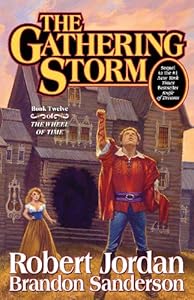 Cover via Amazon
The Gathering Storm is a mighty tome of a book (I calculate it at around 325,000 words, which is big, even by normal fantasy standards) and took me a while to read. One of the times I wished a book had been available for Kindle, as the weight would have been easier on my aching arms.
I must preface this review by confessing that I have not read all the previous 11 books in The Wheel of Time series; in fact, I’ve read only a couple. So, some of the terms, names and affiliations were confusing to begin with, but I soon knew where I was and where the story was going, so to speak. It is a work on an epic scale and was, of course, actually written by Brandon Sanderson, working from copious notes and incomplete work from the original author.
The story is an intricate weave of many threads, which form a whole that is completely satisfying. The language is clear, evocative and appropriate throughout, with no slips into anachronism. Characters, although fully drawn in previous volumes, appear as real on these pages as though they have been created for this book. The settings are fully described, allowing the reader an experience that involves rather than on that simply tells of detail.
The element of magic is restricted, making the tale reliant as much on the humanity of the characters as on their ability to weave spells and use their special gifts and properties. This is, for me, essential in epic fantasy. The overuse of magic reduces the empathy a reader may otherwise feel for the characters and this aspect has been avoided here.
I will not make any attempt to convey the storyline here. There are over 750 pages of text and very few wasted words. Any attempt to précis the plot must inevitably do the work an injustice. As usual, my review is concerned with the quality of the writing and the depth of the story told.
Just occasionally I wondered at the number of names I came across: on one page, I noted twenty new names of characters and/or places.
But this is a very satisfying tale. Clearly, readers will benefit from their greater background knowledge of characters and events if they have read the whole series, but the lack of such experience results in only a small amount of confusion, which is quickly resolved as events unfold in the context of the story.
Anyone who has read and enjoyed Richard Adam’s Maia or The Lord of the Rings, amongst others, will enjoy this book. I happily recommend it and look forward to the final two volumes, still under construction as I write this.

Subscribe to:
Posts (Atom)