Google+
This blog has moved. Please go over to this link to see my new website.
Showing posts with label family. Show all posts

Sunday, 13 November 2011

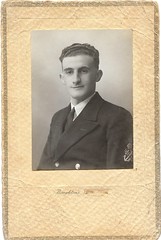
A Commemoration of my father at 100


Mum & Dad on their wedding day, 1953.
My real father, the man who gave me life, died less than 3 weeks before I was born and I know him only through the memories of others, as a good man. But my mother, who died a week after my 16th birthday, married Richard Allison when I was about 5 years old. On the occasion of what would have been his 100th birthday, this short piece commemorates the very special man who raised me as his own son.

Richard Herbert Allison, to give him his full name, would have been 100 years old today. He died, aged 92, on July 13th 2004, following a fall.
An only child, at 18, he lost his own father to cancer. A man who could not live without a woman in his life, he married 4 times; my mother, May, being his 3rd wife. When he married May, he took on my older sister, Denise, and me. May took on his son, Barry, who is 6 weeks my senior. Later, they both brought the youngest member of the family, Stephen, into being. We were a real family, with no delineation caused by different parentage, and, as children, we all received equal love from both parents. In fact, I had what I consider an idyllic childhood, characterised by love, adventure and humour.
Richard worked at two jobs for most of his life. He was initially a dental technician, making false teeth, and later a travelling salesman, representing a national dental supply company and visiting customers all over Yorkshire. His second job was as a wedding photographer, often for his own business but sometimes as a stringer for other wedding photography businesses. He loved his photography, or, more accurately, he loved his cameras. Not a particularly creative man, he was an excellent technician and, in spite of a lifetime with poor eyesight, always ensured his pictures were pin sharp.
Spurn Point, East Riding of Yorkshire in twilight.Image via WikipediaIt was from Richard that I gained an interest in photography when he rewarded me with a folding camera for a good school report at the age of 11. My mother, a talented painter, gifted me with an eye for a picture, so I had both technical and creative influences for my photography.
Richard had an interesting war (1939-45); beginning as a medic with the army, stationed at Spurn Point and Bull Fort in the mouth of the Humber Estuary. He soon went on to become a fire fighter and rose to the rank of Captain, taking his regiment to France on D Day and then travelling to Belgium and Holland, earning a 'Mention in Despatches' on the way by rescuing one of his men from a booby-trapped and burning building.
He was well-read, with a particular liking for the novels of Ryder Haggard and other adventure tales. He taught himself French and Dutch and could still speak both even at the end of his life.
It was from Richard that I learned my love of astronomy. He could point out all the major and some of the minor constellations and recognised the planets as they wandered across our heavens. A nature lover, he could name any bird he saw, either at rest or on the wing. And he knew all the butterflies and most moths we ever came across. But he had no idea about wild plants and only a basic knowledge of trees.
Richard, me, Stephen, May, Barry, Denise. Beverley Westwoods, 1959
A walker, he enjoyed roaming the countryside and often took us on walks, pointing out the various birds and insects we encountered. He'd been a cyclist for many years and, through this, developed a great fear of wasps. On one occasion, when the M1 motorway had just opened, I was travelling with him when a wasp flew into the old Morris Minor he was driving. He stopped the car where it was and got out, refusing to return until the offending insect had been ejected. That there was virtually no traffic on the road made this more a humorous than an anxious episode. It was only later that I learned he'd been cycling through a piece of local common ground, speeding downhill across the Beverley Westwoods, when a wasp had lodged itself behind his glasses and stung his eye. He'd come off the bike at speed and ripped all the muscles in his back: hence his loathing of the striped peril.
On another occasion, we were driving in the local hills and he got out of the car and walked alongside it as it slowly motored up the hill by itself, his skill in judging its ability to travel with minimal power demonstrated. He took us all to the Lake District on one memorable day. A family of five plus a Welsh Corgi, we travelled 365 miles that day. At one point, we were climbing a very steep hill (1:3) and the car stopped. We had to get out and walk as he drove up by himself, the reduced load enabling the old car to make it to the summit. He was a good, if fast, driver who'd learned his skill in the army, driving a fire engine, which he always called an 'escape'; a vehicle with a 14 foot overhanging ladder which he drove around Birmingham during the blitz. Only once did he manage to swipe a set of traffic lights off their pole with the ladders as he swept around a corner in a hurry. And he spoke with amusement of the time he'd been given the chance to drive a tank and had managed to crush a 3 ton truck in the process. In Belgium, his adjutant had come across an abandoned US Jeep, which had apparently simply run out of fuel. He commandeered it and used it as a staff car for the rest of the war.
He possessed a phenomenal memory and could recite verse after verse from The Rubáiyát of Omar Khayyám, quote a nonsense piece of Victorian gobbledegook (In promulgating your esoteric cogitations and articulating your superficial sentimentalities and philosophical and physiological observations, beware of platitudinous ponderosity.  Let your extemporaneous decantings have intelligibility, sagacious facility, an elegant rapidity and ventriloquent verbosity.  Shun pestiferous profanity both obscure and apparent.
In other words, speak plainly, briefly, naturally and truthfully.  Say what you mean and mean what you say.  Do not swear or use big words.) and an alternative version of 'Twinkle, Twinkle, Little Star (Scintillate, scintillate globule vivific, fain I ponder thy purpose specific – is all I can recall, but he could quote the whole thing).
In short, Richard Allison was a pretty remarkable man and I'm both proud and pleased that he chose to take me as his own son and raise me. He wasn't without fault and could be both dictatorial and severe at times. But he was a damned good father and I have every reason to thank him for taking that role seriously and for loving me, my siblings and my mother.

Enhanced by Zemanta

Thursday, 14 April 2011

Writing: a Slight Pause for Some Character Development

It has been a long day. The morning saw me working on Ch20, which is now to 3370 words and page 190. But I reached a point where, due to story development, I needed to conjure 8 new characters. I generally start such profiles with a picture (I have over 1500 on file, collected at random from the internet during searches for other things). These are classified into the two genders and split into age groups and hair colour, simply to make the filing more manageable. I also have a list of names I made up when I started writing the fantasy. Having settled on 8 names and decided on the mix of genders (5 male and 3 female in this case), I selected the pictures and then began the profiles. So far, I have 4 of the males done. The morning will see the others fleshed out and ready to join the adventure.
Meanwhile, I've been out to town, walking, with my wife. Collected currency for Kate for her holiday in Turkey, and sun tan cream and a new shower head. The fun I have when shopping! Don't know how I cope with the excitement. Also brought the Writing Contests page up to date. It now contains over 130 links to various competitons - if you're interested in such things, take a look under the tab above.
Of course, as I'm still recovering from the current spell of CFS, I've had to rest a few times and will do so again when I've finished this post; that'll be me for today.
And here is a local picture for you.
Enhanced by Zemanta

Sunday, 27 March 2011

Empty Chairs by Stacey Danson, Reviewed.

Sexually Abused child.Image via Wikipedia
Empty Chairs, by Stacey Danson, is a remarkable piece of writing. This autobiographical insight into the early life of a girl subject to physical and sexual abuse is honest, frank and characterised by a refusal to hide unpleasant detail. That the abuse was initiated by her mother, who acted as her pimp, when Stacey was the tender age of 3, makes the revelations all the more horrific.
It is natural to expect that an account of this type would be driven by bitterness and revenge but the author manages to tell her story without undue hostility. And that, in itself, is an amazing feat. If ever a woman had just cause to resent the world into which she was born, Stacey Danson is that woman. But she simply lays out the facts; emotional, physical, mental, spiritual and rational. There are places where the text is almost too hard to read. I have been kept awake nights by some of her descriptions. This is, as you would expect, a difficult book to read. But I urge you to read it simply because it is hard.
The prose style is simple, yet eloquent. She writes pretty much as you would expect her to think and spares none of the expletives that, for her, have been an integral part of her upbringing. There is no attempt to deviate from the truth for effect, no attempt to embroider or exaggerate the facts. The simple truth is enough here, and Stacey has recognised that and allowed integrity to describe her experiences.
I am, by nature, an optimist and a lover of women in general. The experience of this book has caused me to question some of my beliefs about people more than any other work I’ve read; and I include such classics as All Quiet on the Western Front and A Town Like Alice as examples of man’s inhumanity in this comparison.
Men and women, authorities and victims, the respected and the reviled, all feature in this book as adults. And all are shown as flawed, many of them seriously so. There are those who simply looked the other way and thus allowed the terrible abuse to continue. There are those who worked in trusted occupations and yet tormented and harmed the vulnerable child they should have been protecting. There are those who exploited, or wished to exploit, a girl who so distrusted people that even those who might have been her friends could not win her trust. And, in the end, it was the children, the other victims, who rescued her from what might otherwise have been a violent and untimely death.
There is no sentimentality, no attempt to rouse the reader’s pity, in the words on these pages. What you get is the simple truth of a life damaged and abused. Yet, through it all, the spirit of the writer rises and grows to become aware of the greater world and, as the book ends, to begin to wonder if there are, after all, some good people in the world, after all.
Stacey wrote this account to alert the world to the reality of child abuse; to tell those complacent souls who blind themselves to facts, by blaming victims, that sometimes children have no choice; to educate those in authority about the reality of life on the streets for the abused. But she has achieved something more than that. She has made a work of such integrity that the reader emerges from the experience both wiser and more compassionate. And she has earned the unbounded admiration of this reader for telling it exactly as it is. 

Enhanced by Zemanta

Monday, 6 December 2010

WE ARE AWESOME!

Image representing LinkedIn as depicted in Cru...Image via CrunchBase
The following is lifted, with permission, from a post on the Linked-In website. I've modified it slightly, but the bulk is as it was originally posted. Thank you David Nicholls

This is addressed to kids who survived the 1930s, '40s, '50s, '60s and '70s, and to their children.

No matter what our kids and the new generation think about us, WE ARE AWESOME!

For those of us born 1925 – 1970: Our Lives Are Living Proof.

First, we survived being born to mothers who may have smoked and/or drank while they were pregnant.
They took aspirin, ate blue cheese dressing, tuna from a can, and didn't get tested for diabetes. Then, after that trauma, we were put to sleep on our tummies in baby cribs covered with bright colored lead-based paints. We had no childproof lids on medicine bottles, locks on doors or cabinets, and, when we rode our bikes, we had baseball caps or nothing, on our heads, not helmets. As infants and children, we rode in cars with no baby seats, no boosters, no seat belts, no air bags, bald tires and sometimes no brakes. Riding in the back of a pick- up truck on a warm day was always a special treat. We drank water from the garden hose and not from a bottle. We shared one soft drink with four friends, from one bottle, and no one actually died from this. We ate cupcakes, white bread, real butter, and bacon. We drank Kool-Aid made with real white sugar. And we weren't overweight. Why? Because we were always outside playing...that's why! We would leave home in the morning and play all day, as long as we were back when the streetlights came on. No one was able to reach us all day. And, we were OK.
We spent hours building go-carts or bogies (as we called them in the UK) out of scraps and then rode them down the hill, only to find out we forgot the brakes. After running into the bushes a few times, we learned to solve the problem. We didn't have Play Stations, Nintendos or X-boxes. There were no video games, no 150 channels on cable, no video movies or DVDs, no surround-sound or CDs, no cell phones, no personal computers, no Internet and no chat rooms.
WE HAD FRIENDS and we went outside and found them! We fell out of trees, got cut, broke bones and teeth, and there were no lawsuits from those accidents. We would get spankings with wooden spoons, switches, belts, ping-pong bats, or just a bare hand, and no one would report this as abuse. We ate worms, and mud pies made from dirt, and the worms did not live in us forever. We made up games with sticks and tennis balls, and -although we were told it would happen- we didn't put out many eyes. We rode bikes or walked to a friend's house and knocked on the door or rang the bell, or just walked in and talked to them. Teams had tryouts and not everyone made the team. Those who didn't had to learn to deal with disappointment. Imagine that!
The idea of a parent bailing us out if we broke the law was unheard of. They actually sided with the law! These generations have produced some of the best risk-takers, problem solvers, and inventors ever. The past 50 to 85 years have seen an explosion of innovation and new ideas. We had freedom, failure, success and responsibility, and we learned how to deal with it all. If YOU are one of those born between 1925-1970, CONGRATULATIONS!
You might want to share this with others who have had the luck to grow up as kids before the lawyers and the government regulated so much of our lives for our own good. While you're at it, forward it to your kids, so they'll know how brave and lucky their parents were. Kind of makes you want to run through the house with scissors, doesn't it?

Enhanced by Zemanta

Saturday, 23 October 2010

Review of They F*** You Up by Oliver James

Oliver James, in They F*** You Up, cites the lives of Prince Charles, Woody Allen, Mia Farrow, Paula Yates, serial killers, victims of sexual abuse, and others, as examples of various personality traits and problems. In the process, he has written an accessible but scholarly treatise on the role of care, or its lack, in early childhood. His observations and quotes from various studies make a convincing case for the primary function of good parenting in raising children. He breaks down the process into periods of childhood and infancy and also describes how conscience, self-awareness and general mental well-being can be fostered by good and appropriate care from parents or carers. His ideas, backed up by the results of many studies and tests, make it clear that the role of genes in forming personality, conscience and the idea of ‘self’ is at best peripheral. Those who cite genetics as the major cause of crime, addiction, low performance, sexuality, depression and other mental illnesses are exposed as frauds or, at best, ill-informed commentators. Whilst our genes play a large part in making the human the animal he is, it is undoubtedly the type of parental care we receive from birth to age 6 that forms us into the adults we become.
Charles, Prince of Wales outside the White Hou...Image via WikipediaJames explains in great detail how personality traits are formed, and describes how early brain patterning can and does form individuals into certain types of adults. Whilst some of the damage done by inappropriate parenting can be modified, alleviated and even repaired, a great deal cannot be changed without huge effort.
What James is calling for with this book is nothing less than a complete overhaul of the way society treats children. That nurture, rather than nature (genes), is the driving force behind personality disorders, depression, disassociation, weak conscience, criminality and madness is no longer disputed by those who understand these matters thoroughly. Those who blame genes, and use this argument as a basis for social discrimination, are both fraudulent and hypocritical.
James suggests a different strategy for dealing with society’s problems and forecasts that a failure to adjust to such a system will inevitably increase the rates of violence, crime, injustice and insanity in our world. I am convinced by his cogent arguments and find myself looking at my fellow human beings with much greater respect, tolerance and understanding.
Alain De Botton urges all prospective parents to read They F*** You Up BEFORE embarking on the hazardous voyage of parenthood. I can only agree with this injunction.
If you are thinking of having children, please, for the sake of your offspring and the future of the human race, read this book FIRST. And, if you have already had your children, or wonder about your own early life and its effect on your personality, read this book as a way of understanding why you are who you are and your friends are who they are. It is a cathartic experience.

Enhanced by Zemanta

Wednesday, 4 August 2010

A Short Story, ELLA. As a change from the pattern.

My mother, May, who inspired this tale.
This short story was first published in Issue 40 of Scribble, a small press fiction Magazine. I offer it here simply as an alternative to the usual posts on this blog.

ELLA
They must re-house her: now. November rain failed to dampen Ella’s determination, though it soaked her hair and shoulders and oozed through gaps in her shoes, as she slogged up the hill to the Housing Office. One more night under the same roof as her father and she’d murder him, sending her to prison and her children to the orphanage.
Carswell, promoted only because the war had disabled or killed his superiors and peers, was not a cruel man: inefficient, bureaucratic, insensitive and self-serving, perhaps. Every time she saw him, she yearned to snip the pathetic comb-over from his shiny pate and leave his crown as bald as nature intended. And his simpering secretary, with her squeaky voice, who’d never been inside a munitions factory or worked the land, enraged Ella with her subservience to a man who would act only according to outdated rules.
‘You don’t know the meaning of compassion!’
Carswell winced and raised round-rimmed spectacles to look down at the form on his desk. ‘You’re not alone in your needs, dear lady.’
Ella fought the urge to hit him, using her clenched fist to strike the desk instead with such force that he jumped back in his seat, almost falling over. ‘Don’t patronise me! If you don’t know what desperation is, it’s staring you in your complacent face.’
He made a condescending grimace, intended as a smile. It was a mistake.
‘I’d hoped to reason with you, Carswell. I’d hoped you might…’
‘It’s Mr Carswell to the likes of you.’ Miss Penny’s squeaked indignation did nothing to calm Ella.
She turned on the obsequious secretary, who backed away at her expression. ‘He has a reason for his idiocy, Miss Penny; he’s a man. What’s your excuse? As a woman, even unmarried, you ought to understand my plight. If you can’t say anything constructive, just shut up.’
The baby boy in her arms whimpered and she finally sat in the chair provided. ‘Excuse me.’ Ignoring Carswell’s look of outrage, his splutterings of protest, she prepared herself and put the baby to her breast.
‘You can’t…’ His protest faltered and failed at the challenge in her eyes.
‘Really, the cheek of some people!’ Miss Penny moved behind her boss so she could glare disgust at Ella.
At her mother’s side, a little girl approaching three, stood silent and still, dripping rain onto the carpet and waiting with unnatural patience. Ella sighed frustration and despair. ‘My children: they’re why I’m here. They’re all the war’s left me. They’ve been through too much already. I won’t put them through any more unnecessary pain. I’m not going to let them suffer any more, just because some hidebound, condescending clerk hasn’t the guts or gumption to put a roof over their heads now their father’s dead.’
‘As I understand it, Mrs Atkinson, regrettably your husband died just months ago. The war’s been over almost three years and I hardly….’
‘Whilst you sat on your idle backside in this office, Carswell, counting forms and filing them in alpha-bloody-betical order, my husband struggled against weather, waves and the foul conditions of an E-boat engine room, to protect you and her from invading forces. Just because torpedoes didn’t get him, just because he wasn’t shot, it doesn’t mean the war didn’t kill him. Eating foul food on the move, whilst he worked his heart out to keep those engines going, damaged his insides and gave him an ulcer.
‘I discovered him: lying face down in a pool of his own blood, after his ulcer burst. Have you the faintest idea what that’s like? Have you?
‘He died from peritonitis and blood poisoning just three weeks before his son was born. The war killed him as surely as if he’d been shot or bombed. Of course, it suits those mindless bureaucrats at the War Office to think along the same lines as you, so I won’t get a war widow’s pension.’
‘We’ve been through your unfortunate circumstances, Mrs Atkinson. I really am sorry for you but there’s nothing I can do. You’ve a roof over your head with your parents. Some people don’t have even that. So much bombing. They’re building new homes as fast as they can, you know. I’m sorry, you must wait your turn.’
‘My parents live in a two-bedroomed council house. My teenage brother and sister still live at home. Where do you suppose we all sleep? I’m in one bedroom, with my children. My poor mother suffers from rheumatism so badly she can hardly walk. My father’s a bigoted fool who, for reasons no one can fathom, accuses me of being an unmarried mother. Every time one of my children makes a sound at night, he curses me and threatens to chuck us out for waking him.
‘Look at these children. See how silent they are? Is that natural? Do you know many such quiet toddlers or babies?’
‘Whether I know… really it’s all rather irrelevant anyway. You don’t score sufficient points. I’m sorry.’
‘Then I’m forced to resort to blackmail. Oh, don’t look so worried, Miss Penny. Your secret’s safe, though God knows what you see in him. I wouldn’t dream of threatening the happiness of any man and woman who’ve found comfort with each other. I’m pleased for you.
‘But, understand me, Carswell, I will do this: if you don’t have a place for me to live, by lunchtime tomorrow, I’ll take these two to the top of the town hall and jump off with them. Wait! I haven’t finished. I’ll write a letter, giving my reasons in full, and hand it to the local paper first.
‘Think about it, Carswell: What price your precious rules, then? And I’ll tell the paper exactly who forced me into such a desperate act, and why.’ Ella detached the baby, covered herself and rose from the seat. ‘Until tomorrow, Mr Carswell, Miss Penny.’
A thoughtful look passed between them as she left but they said nothing.
Now she’d made the threat she wouldn’t carry out, she felt deflated as anger and bitterness were replaced by despair and hopelessness. Carswell might report her to the authorities but they were so stretched and disorganised, dealing with all those orphaned by the war, they wouldn’t take away her children.
The rain still poured, causing muddy streams to wash across the cracked and broken paving slabs out of the piled rubble: all that remained of the factory where she’d placed fuses in bombs for five years. Destruction still lay all around.
She walked, dejected and weary beyond words, along the road out of the town centre, past a row of new, prefabricated homes. Skirting a huge, water-filled crater, she reached the long, blasted road that led to her father’s council house. The little girl walked silently at her side, stepping gravely over fallen masonry, striding over or around puddles she should be jumping in fun. The baby boy slept in her tired arms.
Her father worked on the docks, his hands calloused and torn by labour. Her brother and sister went to school in classrooms with no heating. Her mother toiled over housework on limbs that could barely support her, shivering through each day until it was time to light the fire in preparation for her husband’s return.
Was this what her own dear man had died for? To leave her a life of misery and uncertainty with no hope of a comfortable future?
If their house hadn’t been tied to his job. If her husband’s boss had been more understanding. But, a week after Kenny’s death, the garage owner had evicted her, pregnant and grieving, so he could install a new mechanic in the two-up, two-down terraced house that had been their home since the end of the war.
The next-door neighbours had taken her in and given her shelter, or she’d have wandered the streets, homeless and given birth to her darling son in the gutter. Joan and Arthur had eased her grief and helped her through those first dark days. Arthur had even persuaded her father to give them a temporary home after the baby was born. Joan had only just recovered from the birth of her own second son and they really had no room in their house to let Ella stay, once she’d had the baby.
The birth had been difficult: her grief and shock at Kenny’s death causing complications. The midwife had arrived hours after the waters had broken. ‘It’ll most likely be born dead anyroad, after what you’ve been through.’
She’d suggested Ella would need some sort of stimulus to get the birth going. ‘See if you can’t make the poor love laugh or summat.’ She’d said, as she went off to deal with an emergency further down the road, where she might preside over the birth of a live infant.
Make her laugh? Three weeks after the death of the man she loved so much it had been like losing half of herself? Two weeks after being thrown onto the streets with a toddler in tow and a baby on the way? And they should make her laugh?
But they did. And how! Joan came in, as Ella lay on the bed, hours of exhausting, fruitless pushing already done. Undignified, naked, legs apart, after the midwife’s examination and caring only that the end of the birth should come soon, she lay sweating and frightened on the bed. A bra supported Joan’s milk-swollen breasts but her knickers crowned her head as she entered the room. A look of supreme concentration rendered her pretty face comical, as she shuffled into the room. Behind her, wearing only underpants, on his head, his unlit pipe upside down and dangling from his mouth, Arthur shuffled in step.
Together, they performed the sand dance, à la Wilson, Kepple and Betty’s music hall act, on the bare boards at the foot of the bed. With deadpan faces, and making scraping sounds with their voices to hide the lack of sand, they began this arcane rite as if it were a solemn ceremony. But the sight of them jerking in time to remembered music, as they paraded back and forth, body parts wobbling and arms and legs tangling as they turned, soon had Ella giggling.
Before they’d finished, all three were hysterical with laughter and the baby was well on his way. The midwife returned, unphased, to find them still naked: Arthur holding Ella’s hand, as Joan eased the baby’s head into the world.
That had been in May.
November rain was turning to unseasonal snow, as Ella strode to the Housing Office the following morning. The queue of hopeful, desperate petitioners sat, lounged and stood, a dispirited mass, steaming in the heat of the smoke filled room. Ella grasped her toddler by the hand and forced, insinuated and persuaded her way through to the closed door bearing Carswell’s name and title in gold leaf.
He was alone with Miss Penny and they sprang apart with guilt, as Ella entered without knocking. She waved away their protests, their justifications, their explanations for a situation she didn’t care about, let alone condemn. Holding up a white envelope, clearly addressed to the editor of the local paper, she took her place before the desk.
‘Well?’
‘I want you to know that this has nothing to do with what you believe you just witnessed, Mrs Atkinson.’
‘I saw two people who seem to care for each other. Good luck to you.’
Carswell and Miss Penny shot glances of relief at each other.
‘It’s nothing to do with your irresponsible threat to kill yourself and your children and report it to the papers. I’ve done what I’ve done because I’ve reviewed your case personally and found that you earn more points than I’d previously been advised by my staff. Naturally, such allocation of points has taken you up the list. To the very top, in fact. I’m therefore pleased to be able to hand you this key. The address of the property is on the label and we… that is, I’ve taken the liberty of inspecting the property in person and ensuring the power and water are connected. Now, if you’ll please sign these documents, you may move into your new home as soon as you wish.’
Wordless, in a haze of mingled disbelief and hope, Ella signed the papers he pushed at her, picked up the rent book and grasped the key. She was out on the street before she realised his reasons for his change of mind were a pack of lies.
She didn’t care. ‘It worked.’
She looked at the address and discovered the house was less than fifteen minutes walk away.
Stunned, almost frozen with mixed emotions, she took her children to the redbrick, terraced house on a street untouched by bombs. In front, between pavement and house, a small patch of unkempt weeds behind a low brick wall promised a future of flowers.
She controlled her trembling hand to insert the brass key into the lock of a flaking, green door and pushed into a narrow hall, musty and cool. Her steps, loud on bare boards, took her past the empty front room and into the kitchen.
A pint of milk stood on the stone draining board, beside a plain white cup and saucer, a teaspoon, a brown teapot and a pack of tea. Three sugar cubes formed a small tower. The kettle, blackened with use and already filled, waited on top of a new gas stove. A half used box of matches rested on a sheet of plain white paper bearing the hand-written words, ‘May you be happy in your new home’.
‘Oh, you lovely, lovely man!’
Ella let go her daughter’s hand and, cradling her son in one arm, made herself a pot of tea in her own kitchen. The little girl sauntered to the window and looked out on a garden overgrown with forlorn weeds: a view of the cooling tower dominating the houses that backed on to her own. The snow was falling in earnest, covering ground and roofs with white and casting brightness up into the gloom of the unfurnished room.
Ella sat on bare floorboards, the hope that had sustained her, building slowly into a joy she had almost forgotten. Hot tea in one hand, her son cradled on her arm, she allowed her emotions and senses to take over from the struggle for life that had all but overwhelmed her.
In the silence of that empty house, she became aware of a sound she didn’t recognise at first. Her little girl, standing on tiptoe at the window and watching snowflakes cover the weeds in the back garden, was laughing. Ella gazed at the back of that small joyful head and, at the sound of gurgling, turned to discover the baby awake in her arms, his face alight with wonder.
She looked up into the grey sky full of falling miracles and voiced her relief and gratitude. ‘Thank you, thank you. Oh, thank you.’
And, silently, at last she wept with relief.

Enhanced by Zemanta

Sunday, 20 June 2010

A Fathers' Day Dedication to the father I never knew

Ken BurdenImage by stuartaken via Flickr
Some three weeks before I emerged, unexpectedly, from my mother's womb, my natural father died of a burst duodenal ulcer. I knew Ken Burden only by reputation, initially through the tales from my mother and, later, through his sister, Vera, now 95.
I was told that Ken was a man much loved by those who knew him. He never had a bad word to say about anyone; preferring to remain silent rather than criticise. During the second world war, he worked as chief engineer on the small MTBs skimming the waves of the North Sea and the Channel in search of invading vessels from Germany. He was a Chief Petty Officer and often worked through his meals to keep the boat in tip-top order so it could do its job to the optimum. It was this habit of eating on the job that destroyed his digestive system and killed him just a few years after the end of the war. He was a car mechanic in peace time, and, by all accounts, a gifted one.
I inherited his sense of justice, a basic integrity and his faithfulness. I wish I'd gathered up his tolerance and humility along the way, but I don't blame him for that lack. There's an irony that I have almost no mechanical skills and that my interest in cars and engines extends only to their use as a means of getting from A to B. I understand he was not a very literate man but I live for words, so I must get that from my mother; a gifted painter who died two days after my 16th birthday. She and Ken were in love for the time they had together and I wonder what sort of life I might have had if they had both survived.
So, I'd like to thank you, Ken, my real dad, for giving me life and passing on your genes. I can only aspire to your gentle tolerance, your generous spirit and your kindness. May, my mother, loved you absolutely and unconditionally and, knowing her judgement of people, I am confident I would have loved you as much. Vera, your sister, tells me you were her best friend and she still misses you. I hear that you were fun to be with but had a serious side. I can never bridge the gap between my life and your death but I make this public declaration, for what it's worth, of my love and gratitude. Thank you for giving me a start in life and I hope I can be worthy of you for the future you never had. I love you, Dad, and always will.
Enhanced by Zemanta