Google+
This blog has moved. Please go over to this link to see my new website.

Monday, 19 November 2012

My Next Big Thing


I’ve been invited by Penny Grubb  (http://pennygrubb.blogspot.co.uk/2012/11/my-next-big-thing.html) to take part in the Next Big Thing Blog Tour. My five nominees were supposed to be listed at the end, but, for various reasons, they were unable to commit, so I guess this is the end of this particular leg of the tour!

In common with most published writers, I write to be read. But I also break a great publishing rule, imposed by agents and traditional publishers for reasons of their own: I don’t write in only one genre. In fact, I rarely consider genre before I set out to write a story. This makes my work difficult to categorise, of course. But, as I give a description of every book, I see no difficulty with this approach.

Take a look at the titles under the tab ‘My Books’ and you’ll see what I mean. There’s a romantic thriller, a sci-fi novelette, an anthology of tender love stories, a collection of dark speculative fiction, a cheeky story for the New Year, a selection of stories from my writing group, an erotic anthology and a collection of prize-winning sci-fi and fantasy stories to which I was invited to contribute.

So, it’s not immediately obvious what my next big thing might be. But, I am currently working on the second volume of an epic fantasy trilogy intended for an adult readership. Volume one is ready for publication and volume two is well along the editing path. Volume three is around as an outline combined with a huge number of ideas floating around the caverns of my mind. I intend to publish this story after I have introduced it by publishing a number of short novelettes starring various minor characters from the main story. So, that is likely to be the next big thing for me. Capricious? I’m an artist, in the sense that I create from imagination, and it’s difficult to pin me down. One thing I can promise my readers, however, is that the epic fantasy will be well on the way to completion before I publish volume one. I think there is nothing more irritating for readers than to become involved in a story that runs over several books only to find that the writer has either lost interest or failed to engage the level of discipline needed to complete the work.

What is the working title of your book?

The series will go under a title which, for the moment, remains secret. However, the first volume is ‘Joinings’, the second ‘Partings’ and the third is provisionally titled ‘Endings’.

Where did the idea come from for the book?

This series has been around in my head for so long that I can no longer recall its germination. I can, however, let you know that it deals with themes of injustice, betrayal, religious hypocrisy and the strength or genuine love.

What genre does your book fall under?

It’s an epic fantasy, but excluding elves, dwarves and dragons (thought the latter mythical creatures do feature in the folklore).

How long did it take you to write the first draft of your manuscript?

About seventy years! Actually, for reasons I won’t bore you with, it’s been an on and off project that started over 30 years ago with the development of the imagined world and the drawing of the map. The actual writing was interrupted by domestic events and life that got in the way but began around seven years ago. In that time, I’ve written two volumes of around 220,000 words each. I’ve edited one and am currently half way through editing the second.

What other books would you compare this story to within your genre?

I’m not into comparisons for my work, as I don’t consciously feed off the work of others. The book neither refers to nor borrows from any other. It’s the product of my imagination, influenced by the thousands of books I’ve read, the many films and plays I’ve watched, the multitude of life experiences I’ve passed through. I understand that literature is necessarily incestuous but I’d be hard put to identify any parents or siblings for this work. I’ll let readers decide.

Who or What inspired you to write this book?

My work is almost always the result of free imagination. I’m able to sit at the keyboard and produce a short story without any preparation. Obviously, for a series of this complexity and scope, I had to develop a history, customs, religions, landscapes, social patterns, laws, traditions, myths and all those other things that bring an imagined work to life. The themes, however, as explained above, permeate much of my writing; in particular the issue of injustice and the all-pervasive idea of hypocrisy within organised religion. It was undoubtedly thinking on these matters that brought the pot to the boil until the ideas melted together and became the story that now feeds the books.

What else about your book might pique the reader's interest?

My stories are character driven. I aim to make the people who inhabit my fiction into characters they will know or, at least, come to know. Some are very bad, others are very good and, in between lie those people we all meet and live with, escape from, love, hate, like, despise and worship.

Which five writers will take over from you next week and tell us about their next big thing:-

Here was supposed to be the list for links to the blogs of 5 other writers taking part in the tour. Unfortunately, they were unable to commit for a multitude of reasons, most of which I fully understand, as a busy writer myself.

Enhanced by Zemanta

Sunday, 18 November 2012

Fusion, by Fantastic Books Publishing, Reviewed.


This collection of 25 science fiction and fantasy tales represents the cream of the entries for a short story contest run by Fantastic Books. The stories included are the contest winners plus a couple from professional writers, invited by the organisers. 10% of sales receipts will go to cancer charities.

Anthologies are sometimes patchy affairs, but not this one. The quality of the writing is pretty consistent and all the stories are well told (I must add here that I contributed one of the tales). But consistency doesn’t mean similarity. There’s great variety here. Some humour, some darkness and something for younger readers. All speculative fiction, the stories entertain, amuse, inspire and make the reader think.

There are characters of every sort lurking in this selection and plots to suit all tastes. This is a collection you can read at one sitting, as I did, or dip into for those short breaks over coffee, when a longer piece must be interrupted. I enjoyed all the stories but I don’t intend to describe them in this short review. All are different and all demonstrate the imaginative power of their creators, the skill of these writers as storytellers. I thoroughly recommend the book to all who love their fiction with a twist of the unexpected.

To buy for Kindle through Amazon UK, click here.
To buy for Kindle through Amazon USA, click here. 
To buy for all ebook formats through Smashwords, click here.


Enhanced by Zemanta

Tuesday, 13 November 2012

The Silence of the Lambs, by Thomas Harris, Reviewed.


Everybody has, of course, heard of this modern crime classic. Many people have seen the film. I’m not one of them. Intrigued by the many references to the book, when I stumbled upon it in the charity bin of a local Co-op, I made my donation and brought a copy home.
At last, I’ve got around to actually reading it, and I’m glad I have.

For me, fiction is made real and compulsive by the quality of its characters. I mean by that not the natures of the people themselves but the depth and detail gifted them by the author. The story is important, of course, but I find I’m unable to enter a fictional world if I don’t care about at least one of the primary characters. There was no such difficulty with this book. Crawford is easy to empathise with, in spite of his hard-nosed sheath of self-protective toughness. Dr Lecter is, of course, become the archetypal sociopath; a man more concerned with demonstrating and playing with his intellect than he is with any emotional connection. He is the epitome of the unfeeling genius. And in Starling we have the caring, clever, resourceful, courageous, insightful and strong young woman we can all so easily love. Chilton, of course, is the selfish, cunning and sly man who everyone can as easily hate. And the antagonist, who I won’t name for those few who have yet to come across this excellent work, is a superbly drawn piece of human detritus mostly formed from his history but choosing the path upon which he has set out destructively and without concern for any but himself. The woman we encounter as his final victim is anything but a stereotype, displaying courage, resourcefulness and a strength of character that has the reader desperately urging the authorities to get to her before it’s too late.
Clarice Starling
Clarice Starling (Photo credit: Wikipedia)

I had no idea what the story was really about and was surprised to find it dealt with the hunt for a serial killer in quite the way it does. I’d more or less expected to find a police procedural with little reference to emotion or justice. That the book transcends its genre is clear almost from the first page. I confess to some irritation with the US crime fighters’ jargon that peppers some pages and leaves a UK reader, unfamiliar with police procedures, somewhat confused. But the fact that such a stumbling block never even came close to stopping me read is testament to the power of the story and the characters who drive it.

The denouement is expertly handled. Indeed, I deliberately put off finishing the book at night for fear of having nightmares if I went to sleep on the ending. Read in my lunch hour, the final chapters were no less powerful, the ending no less satisfying than that late night read may have rendered them. The book finishes in the only way it can. A satisfactory conclusion to a tale of pace, incident and superbly engineered personal interrelationships.

I enjoyed this book more than I expected to. Should I now watch the film? Will I be disappointed? I don’t know. But the book is definitely worth the read and I can thoroughly recommend it.

Enhanced by Zemanta

Sunday, 11 November 2012

A Remembrance for the Grandfather I Never Knew.


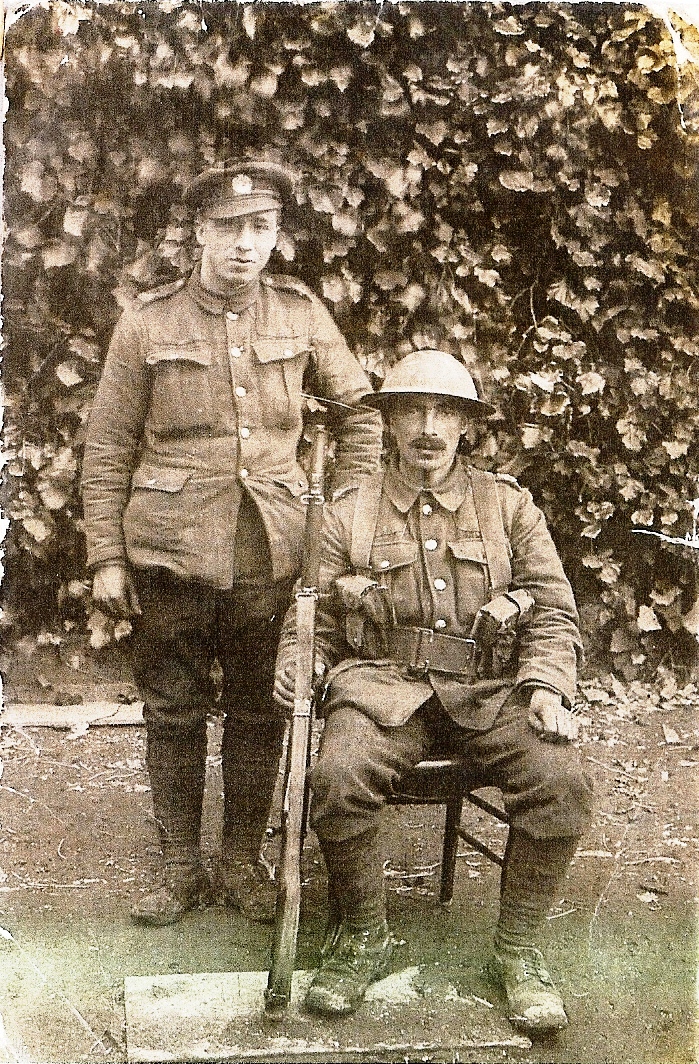
Frederick Burden, seated, with an unknown soldier.
Today, 11th November 2012, is Remembrance Sunday, one of those few occasions when Armistice Day actually falls on a Sunday.

I’d like to take this opportunity to say something relating to my paternal grandfather, and the trip my wife, Valerie, and I recently took to France in order to see the monument in Arras, where his death is commemorated.

Frederick Burden, born in Sculcoates, Kingston-Upon-Hull on 14th September 1886, was one of a large family. He left school at 13 and trained as a plumber. Not much is known about him or his life, as he died before any of his 3 children, Dorothy, Vera and Ken, could get to know him. This fate was later echoed by my own experience of my father, Ken, who died a little over 2 weeks before I was born.

Frederick joined up to serve in the First World War and fought in France with the 1st East Riding Field Company, which later became the 529th Field Coy of the Royal Engineers, part of the 3rd Division. On 9th April 1917, the Company was engaged in the Battle of Arras and became part of the VI Corps, Third Army. Frederick died during the battle, on 18th June 1917, and his body was never recovered. As a result, after the war, he was commemorated, along with others of his Company, on the Arras Memorial:

WE WILL REMEMBER THEM

Those of the 529th (East Riding) Field Company Royal Engineers who died 18th June 1917 with no known grave:
Leonard Alker, 438594.
Frederick William Barnaby, 474333, age 26
Frederick Burden, 474500, age 30
Walter Carmichael, 474562, age 33
Charles Maurice Steele 474102, age 19
William Galpin, 474387, age 20
John William Jones, 177715, age 36
Joseph Henry Parkin, Second Lieutenant, age 29
Robert Pickard Sharp, 474636


Ken Burden
Florence with Vera, Dorothy & Ken.
My own father, the youngest child, was probably at least held by Frederick, when he came home on leave a short time before the battle that claimed his life. Ken was born 16th January 1916 and died 23rd April 1948. Frederick’s eldest daughter, Dorothy, was born 11th February 1912 and died in 2001. Vera, the middle child, was born 15th December 1913 and now lives in Southampton. It was partially on Vera’s behalf that we went to France, as she’d never had the opportunity to see the memorial herself and, rapidly approaching her 100th birthday, is unlikely to do so. Of course, even Dorothy was only 5 when Frederick died, so none of the children had any recollection of their father. And his widow, Florence, who he married in 1910, died in 1958.

Vera
Dorothy’s son, Charles Hunter, started some family research a few years ago and set up a website in memory of our grandfather at http://www.hunt.karoo.net/  And it was through Charles, via Friends Reunited’s Genes Reunited site, that I discovered the existence of my Aunt Vera some few years ago. It turned out she’d been trying to find me. I suspect my mother’s death, when I was aged 16, and my frequent moves around the country had made this search rather difficult.

Outside the Monument.
The Memorial at Arras bounds the eastern side of the earlier Fauberg D’Amiens Cemetery, where 2,681 servicemen are buried, and records the names of 35,700 servicemen and a further 1,000 airmen, all without known graves. Designed by Sir Edwin Lutyens, and commissioned by the Commonwealth War Graves Commission, the Memorial itself is an austere, sober, but rather beautiful stone monument to all these deaths.

Looking along the Memorial Bays.
We visited in September this year on a day when the heavens had decided to weep, the winds to gust fitful and strong. The walk from the railway station, where we’d journeyed from Paris, was wet and wild. It surprised us that there were no directions from there to the monument, but we’d brought maps and found it easily enough.

The open fronts of the tall arches occasionally allowed in drenching rain as we sought out the relevant bay where we could find Granddad’s name. But a quick look in the register, housed in a small cabinet, led us where we needed to go. The names are carved into the stone and the years have softened the letters a little so that they blend with the background. But we found Frederick’s name and spent some time in silent contemplation of a life about which we know so little; a life ended too soon in the madness of war.

There is a visitors’ book and I was able to make a short entry on behalf of ourselves and of Aunt Vera.
Rows of graves
We ventured out amongst the graves for a sortie between blustery showers but quickly returned to cover as the unseasonal weather continued. We met a young couple from Colchester, Essex, who’d made the visit simply out of interest and to pay their respects to these unknown heroes. And we were able to guide a small group from Birmingham who were having difficulty identifying the bay in which their relative was commemorated.
Frederick's name on the Memorial

The whole place has an air of solemn sadness about it, yet manages to convey a feeling of hope for the future in its tall open arches of pale stone. We were glad to have managed the visit and both felt that it, alone, had made our trip to France worthwhile.

Pointing out the Inscription
Our walk back to the railway station took us through the Place de la Victor Hugo, where we followed a French woman out of the lashing rain into the Peter Pan Brasserie, a proper French Café. There, the patron, who spoke no English, and Valerie, whose French is much better than my few words, managed to organise a hot meal for us, accompanied, of course, by a glass of real French red table wine.

On the TGV train back to the Gard du Nord in Paris, the weather slowly improved and, once out of the station, we found ourselves in such bright warm sunshine that we climbed to Sacre Coeur and walked through Montmartre and along the wide avenues until we reached our hotel near the Arc De Triomphe.

A trip worth making for us, and a good day.

Florence Barker, his wife.
Remembering the dead of those appalling wars is often seen as a duty, but, when there’s a personal element, the whole process becomes far more real. Our visit to the Arras Memorial and our short sojourn of contemplation over Granddad, Frederick Burden, will live with me long. Each Armistice Day, I’ll have more reason to spend those two short minutes in silent thought and thanks for those heroes who gave their lives to ensure a safe world so that we now live in freedom.

Commemorative Death Penny
We will never know the exact circumstances of his death; whether it came swift, or in slow agony, whether he died alone under the bullet of a sniper or with others of his Company, victims of a shell. But of one thing we can be confident, since he was posthumously award the Death Penny, inscribed with his name and the words, ‘He Died For Freedom And Honour’, that he died with courage. This small coin came with a note saying "I join with my grateful people in sending you this memorial of a brave life given for others in the Great War. George R J."

Along with all those other men commemorated at the Arras Memorial, and many others in France, Europe, and the whole world, he died fighting in defence of a better future for his family. That other men, and it is always men, caused the conflict that resulted in his death is a matter of great shame for humankind. Whether such violent conflict will ever be eradicated from our race is uncertain. But those of us who remain, those of us provided with a promise of long life and freedom by those who to kept us free, must strive to ensure we make full use of our opportunities. We must live our lives in celebration of the bravery of such men as Frederick Burden, the grandfather I never knew.

Thank you, Granddad Frederick, I Will Remember You.

Notice Board
Information board


Enhanced by Zemanta

Thursday, 8 November 2012

Write What You Like?

English: Symbol of the "New York Society ...
English: Symbol of the "New York Society for the Suppression of Vice", advocating book-burning. (Photo credit: Wikipedia)

There are two pieces of advice that career around the writing world and, it seems to me, often conflict with each other. We are advised to ‘write what you would wish to read’ and, by the same advisor, ‘write for your readers’. On the face of it, these two exhortations can either conflict or make perfect partners. It depends, I think, on your reason for writing.

For me, they often conflict. Perhaps that’s because I write from compulsion and as a way of expressing ideas, making the world aware of my thoughts and opinions on a multitude of subjects. I write because, deep within me, there’s a teacher, even a preacher, trying to get out. Of course, I have to make the best effort to disguise my message without burying it, otherwise my stories will come across as proselytising, and most readers have no wish to be lectured to. A resistance I fully understand and share.

So, for me, the idea that I can write what I want to read whilst, at the same time, writing for readers is fraught with difficulty. I love children and the young, but I no longer live in their world and have no wish to do so, but my favourite genre is one where it seems almost obligatory to write for young adults. I’m talking about fantasy, of course.

I’m currently editing the second volume of a huge epic fantasy, so far unpublished. My problem with the conflicting advice, then, is that I’m writing very much for an adult readership, not for callow youths. I have something to say about sex, nudity and the way in which organised religion has distorted the human view of these two natural aspects of life. It seems to me that I can’t, with any honesty, tackle these themes in a book made suitable for developing minds. Not, that is, unless I’m prepared to cause offence to a large part of the population.

Many adults, especially of a religious persuasion, consider discussion of sex, reference to nudity, topics unsuitable for young minds. If I’m to develop stories that do justice to the subjects, I need the freedom to be truthful in my depiction, I need, under certain circumstances, the freedom to show events, refer to actions, that might be considered obscene by many readers.  Such freedom wouldn’t sit easily with most of the religious community. Though I do note that most erotic literature is produced by the US, a country with the highest number of Christian extremists. (but that’s a matter for another time).

My dilemma, therefore, if I stick to the advice I read, is whether to bowdlerise my story or whether to continue to make my tale open and honest, as I’ve always done in the past. Except, it isn’t a dilemma for me. I will, as I always have, take the route to honesty and if that reduces my readership, offends some potential readers, even loses me followers and virtual friends, so be it. Because, for me, honesty is what matters most. I’ll continue to write the trilogy for adults but place a warning there to let parents know that, whilst the content is not intended to be erotic, it does have many references to sex and nudity. That’s my choice as a writer. Such honesty of purpose is essential to me as an artist.

At the start of this piece, I suggested there were circumstances in which both pieces of advice are apposite. If you write for money, if you see your work as a product to be sold like cans of beans, then the advice to write for your audience will naturally coincide with that to write what you would like to read. Since your driving motivation will be entirely to do with numbers and with sales. Naturally, as a would-be best-seller writer, you will gravitate toward the subjects, style and language that will gain you maximum readership. If you’re writing erotica, you can indulge in any form of sexual distortion with impunity, knowing your readers will be eager to pursue their given proclivities. If you write crime, you can choose the strand that allows as much gore as you wish to portray. And if you write fantasy, you can include the necessary elves, dragons, magicians and, apparently much-lauded thieves, without ever worrying such things might be considered bad influences on young minds emerging into the adult world.

The choice is yours. To write for maximum readership. Or to write what you would like to read. If you write to honestly suit your own tastes, the former instruction is unlikely to apply. But if you write specifically as a way to turn out the next block-buster, you will be obliged to make sure that your writing conforms to certain rules and remains confined within specific boundaries. I repeat; the choice is yours.

I’ve made mine. Have you made yours?

Enhanced by Zemanta

Sunday, 4 November 2012

The American Election: a View From Over the Pond.

IN MY VIEW


Why should I care what happens in the USA Presidential election? It’s a sad fact of life that the USA has a hugely inflated influence in the world. US foreign policy impacts far more deeply, far more widely than the nation deserves, with its inward obsession. And that’s the problem: US policies, regarding the world as a whole, are entirely based on what’s best for the US, rather than what’s best for the world.

Obama at least has an awareness and an interest in what happens beyond the shores of his own continent. I fear not only for the women and the poor of America, but for the world as a whole if Romney succeeds in gaining the post of the most powerful man in the world.

Where Obama displays concern for the poor and disadvantaged, and tries his best, against strong opposition from the right, to do what he can for them, Romney has shown himself indifferent or even worse in his attitude to society’s victims. The wealthy have stripped the poor of their resources and rights for centuries and Romney belongs to that class of people who hold the view that the poor deserve to be poor. He has no conception of the realities of life for those without personal wealth. His attitude to women is appalling: his many statements demonstrate that he has no interest in the views of women and simply wants them to remain silent and under the control of men. This cowardly stance is fed, of course, by his religious background, which, in common with the backward paternalistic culture of many third world countries, considers women as second class citizens or, worse, as no more than goods and chattels. It staggers me that any woman could even consider voting for this man who appears to reside in a Hollywood version of the stone age, where men are depicted as superior beings and women are no more than decorative slaves expected to pander to male whims and fancies. Of course, it’s probable that such women have been brain-washed, often via extreme forms of religion, into not only accepting their subservient role but into evangelising this Neanderthal philosophy.

I hope, without any expectation of satisfaction, that the women and the poor of America will rise up and demand their rights by voting for Obama, kicking the right wing in the teeth for their lack of compassion and their inhumanity regarding all underdogs. There are just two days to go before the momentous decision is made. I appeal to all women, disadvantaged citizens, and right-thinking folk of the wonderful land of America to go out and vote for President Obama. The rest of the world will applaud you if you do. If you wonder how I know this, follow this link.

Free Horror; This Time With Links. Sorry

Around Halloween, I made my new horror story, Heir to Death's Folly free for a couple of days. A friend pointed out to me that there were no links in the post to lead to where it might be obtained. That was an oversight, but I didn't have an opportunity to correct it before the end of the KDP promotion period. So, I'm offering it again as a free book, for one day only. You can get it without cost from now (12:00 PST 4 November 12 until Midnight tonight - this translates to 07:00 Sunday to 07:00 Monday 5 November in UK. For other time zones, I'm afraid you'll have to work it out for yourself).

So, here are the links:
Amazon UK
Amazon USA

It's only available in the Kindle ebook format at present, as I decided I'd try out the Kindle Direct Publishing route for this one, to see whether it really is the aid to authors that Amazon claim.


Don't have a Kindle, but want to read it? You can download free software from Amazon to read Kindle books on your PC, laptop, iPad, iPhone, Android phone, tablet or Mac; use this link from the UK  and, for USA readers, this link , where you can also add it to your browser, Windows Phone 7, Blackberry, and Windows 8 devices.

My apologies to all those who tried this when the links weren't provided. Some of you, quite a lot, actually, managed to do the deed anyway. But I've done this to make it as easy as possible for my loyal readers to obtain the book without cost.

So far, no reviews. I know a lot of Kindle users download books when they're free and don't get around to reading them until later. I'd obviously appreciate the feedback of reviews whenever anyone feels they have the time. That way, new readers will have an idea of what they're buying when the book goes on sale at its normal price of $2.99 or £1.92. My thanks to those who do this.

Thursday, 1 November 2012

Useful Tips on Writing Good English (Especially for Students)

Testtakingstudent
Testtakingstudent (Photo credit: Wikipedia)
I was doing some research for my daughter, who is at university, and, by pure chance, came across this website, which, although intended for university students, is open to the public. If you've ever had questions relating to correct English usage, this is a really useful tool, with easy to follow guides on a number of technical, grammatical and associated issues. Certain worth a visit.
http://www2.hull.ac.uk/student/studyadvice/studyskillsresources/studyguides.aspx

Good luck with your writing.
Enhanced by Zemanta

What to Do on Those Days the Brain Refuses to Function?

Lobes of the brain, color-coded.
Lobes of the brain, color-coded. (Photo credit: Wikipedia)

I suspect it happens to us all from time to time: we have a day when the brain just refuses to do what is required of it. Today has been such a day for me. Why? That’s easy. I’m suffering some sort of stomach bug that has meant I’ve needed to be close to the bathroom all day. I managed a swift walk around the block for fresh air and exercise but that’s all. Now, I’ve had this sort of event before (as a recovering ME sufferer, my immune system isn’t what it was and I’m a bit vulnerable to those idiots at my day job who fail to wash their hands after a visit to the loo: such thoughtful folk, eh?)

Generally, the effect is to deaden the creative and constructive part of my brain so that everything becomes a real effort; like trying to think clearly through clouded water. And, generally, my response to the physical results of such infection is to starve myself for 24 hours, consuming only apple juice warmed and sweetened – a trick I learned from a doctor years ago, which seems to work. But, of course, the energy levels suffer as a result and anything that demands extra effort is just a little too much.

So, what to do with the time? I suppose I could just give in and rest for the day. Read, perhaps? But I’ve been busy recently, devising and publishing a new book. And that means the emails have piled up. So, I spent a good part of the day dealing with those. Most of them are relatively undemanding, so not too difficult to make progress through the numbers and clear the decks for tomorrow, when, hopefully, I’ll be able to do some writing. I also had the basic themes of a review worked out in my head, so I was able to put that together and stick on the blog and Goodreads.

And that’s really what this piece is about. How to make the best of whatever situation you find yourself in. I could’ve given up and spent the day in bed. But what would that have achieved? I’d have been bored to tears and all those emails would still have been waiting for me in the morning to disrupt my return to normality.

I’m very lucky; years of writing have made it relatively easy for me to respond in plain language to messages. As long as I don’t have to get too creative when I’m in this state, I can generally manage to string some words together. But I couldn’t do anything that required the imagination and sheer concentration necessary for making a story. So, I do what I can do and hope to make the time that follows the incident more productive as a result.

I’m curious about how others deal with this sort of brain dulling. How do you cope? What do you do? Let’s share our experiences in the hope someone else may pick up a tip to deal with a similar situation when it creeps up on them.

Enhanced by Zemanta

Wednesday, 31 October 2012

Free Until the Witching Hour


Heir to Death’s Folly, a new book available exclusively as a Kindle ebook, is free until midnight tonight (that’s PST. For UK readers, you have until 07:00 Thursday), so regular visitors have a chance to obtain it without cost. If you take advantage of the offer, I’d appreciate a review, but you’re under no obligation, of course.

No Kindle, but want to read it? Download free software from Amazon to read Kindle books on your PC, laptop, iPad, iPhone, Android phone, tablet or Mac; use this link from the UK http://amzn.to/Uaqusr  and, for USA readers, this link http://amzn.to/UaqUiu , where you can also add it to your browser, Windows Phone 7, Blackberry, and Windows 8 devices.

The story? I won’t give anything away, but a young woman is in peril…
This is the short blurb:
At Kasim's insistence, Julie takes him to visit her Aunt Agatha. Desperate for money, he intends to hasten Agatha's death so Julie will inherit her fortune sooner. But their search for the legendary family treasure leads them into dangers they could never have envisaged. Will Julie escape the fate that awaits her in the ancient tower rumoured to house the hoard?

 Woooo! Scary, eh?  Enjoy your goosebumps!

Enhanced by Zemanta

Shrivings, by Peter Shaffer, Reviewed.


An unusual piece, this: a published play that appears never to have been performed in the form presented ( I think it’s available only as part of a 3 play anthology including, Equus and Five Finger Exercise). But the author wanted this piece out there, even if it wasn’t performed. And I can see why.

This is a device to project certain philosophical views and beliefs rather than a piece of true drama, though it does contain the usual elements of the stage play. As is commonly the case with Shaffer, the setting and the stage directions are precise, leaving no doubt about the intended platform or the actors’ movements and disposition. In this sense, the writer acts much like a director in determining the staging of his work.

The characters, three men and a young woman, are all exquisitely penned and their interactions jump from the page with credible drama. Set around the end of the 1960s and much associated with the peace movements of the time, the play explores what it means to be a pacifist in a real sense. Using the conflicts and relationships that spring from family, friendship, sex, love and hero-worship, Shaffer puts his players through emotional hell in a way that illuminates the variety and depth of the human spirit. Several of the scenes are so powerful they will stay with me for a long time
.
What could so easily have descended into banal bickering, is elevated to considered and emotionally charged discussion that resounds with truth and insight. This is not a play to enjoy; in fact, I have my doubts about whether it would be possible to perform it successfully before a theatre audience because of the detail and depth of meaning that dwells within many of the passages. But, as a reading of the text, it works very well and serves to educate in an entertaining manner, whilst throwing some light on the motives of some of those involved in the early peace movements.

It’s a very human play. There is real love behind the depiction of the characters, allowing the reader to empathise with all four, whilst seeing their weaknesses. Something to give cause for thought to both pacifists and warmongers, I recommend this deeply affecting piece of writing to all readers who enjoy challenges to their belief systems, philosophy and lifestyle. Try it; I don’t think you’ll be disappointed.

Enhanced by Zemanta