 |
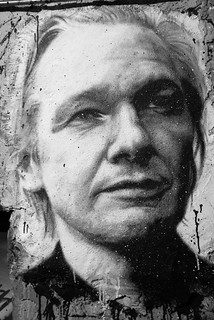
| Julian Assange painted portrait - Wikileaks (Photo credit: Abode of Chaos) |
Are we subject to a type of censorship that curtails freedom of speech
and prevents honest debate of issues of vital importance to civilisation?
In the West, we pride ourselves on our tolerance. This is especially the
case in Europe and even more so in the UK, a land noted for its cultural diversity
and its acceptance of the beliefs, customs and traditions of others. In order
to protect those institutions, beliefs, sensibilities and creeds that differ
from our home-grown varieties, government has implemented laws intended to
prevent prejudice and insult. But, because of the undeniable threat of terrorism,
they’ve also set in place watchdogs to detect activity that may be considered a
threat to the State.
It’s my belief
that the combined effect of these two factors is to stifle serious debate about
religious bodies and/or traditions and customs.
Let me illustrate
my point. If I wish to write a feature, or even a piece of fiction, highlighting
perceived dangers presented
by extremist groups, my first recourse is research, so I can get my facts
right. So, I start to investigate terms
like Al-Qaeda, mujahadeen, taliban, islamist, the Army of God, Ku Klux
Klan, etc. In common with most modern writers, my first port of call is the
web. But wait: if I start typing such words into my search engine, am I going
to immediately become a target for the anti-terrorist organisations that filter
such words from our emails, texts and online searches? The danger certainly exists.
And, I suspect, for many that’s sufficiently worrying to prevent them even
taking the first steps.
In writing this piece, I wanted to ensure I spelt
the words correctly (many of them have variant spellings, after all). For me,
spelling is the prerogative of the SOED, a 2 volume version of the Oxford
English Dictionary, which comes as a printed book of 20 volumes with 3
additional volumes to account for more recent words. My copy of the smaller
book was printed in 2007. Al-Qaeda has been active since 1988, but doesn’t
feature in the SOED. So I went to the web. I used the roundabout route of
searching for Al-Jazeera, a respected broadcasting company, and was directed to
the inimical Wikipedia. From there, I was more comfortable searching for the
other terms.
But you see my point? Fear of the heavy-handed
authorities descending on the house to remove my computer for forensic
dissection, especially in light of the fate of such protectors of free speech as
Edward Snowden and Julian Assange, makes me, and many others, wary of even
investigating certain topics.
The other cause for concern in writing about such
matters stems from the potential outcry and threats of death that may result.
We have only to recall the cases of Salman Rushdie and his Satanic Verses (a
book I actually read at the time, forming my own ideas about the real reason
for the fatwa), and of Jyllands Posten, the Danish newspaper that published
cartoons of the Islamic prophet, Mohammed. But it isn’t just Islam that poses
such problems. There’s evidence that raising the subject of Christian, Budhist,
Hindu or any other form of religious extremism can cause serious problems for
those daring to criticise such organisations.
Even at a less heated level, the criticism of many
religious groups, no matter where those beliefs originate, is invariably seen
as an attack on faith and belief, so that simply questioning these issues often
results in tirades of abuse, threats and even physical atttack.
Those of a rational turn of mind are effectively
silenced by a system that was ostensibly put in place to protect the rights of minorities.
It’s become very difficult to even venture an opinion on the validity of faith,
the truth about religion, or the real value of certain rites and rituals unless
the writer couches such ideas in the most delicate language.
Fear of causing offence, coupled with very real
concerns over both official and extremist responses, has effectively neutered
those who wish to hold open and honest debates about certain religious beliefs,
traditions and customs. It takes a brave writer to raise these contentious
issues. I suggest that the balance of the law has shifted dangerously toward
censorship of those who employ reason and rationality and is now overprotective
of those who wish to maintain what are often erroneous and frequently dangerous
belief systems. This fear stifles the very necessary discussion of subjects
that are often directly responsible for much injustice and harm in the world. What
do you think?


