Google+
This blog has moved. Please go over to this link to see my new website.
Showing posts with label Humor. Show all posts

Saturday, 2 March 2013

Donkeys’ Years, by Michael Frayn, Reviewed.


First produced at London’s Globe Theatre in July 1976 (coincidentally the year in which my novel, Breaking Faith, is set, and a year of drought and heat wave in UK), this three act play is another demonstration of Frayn’s very British humour.

Although described simply as a play in three acts, this is much more like a farce, in the true British, dare I say English?, tradition. If not actually a farce, it could be taken as a parody of the style. It has all the ingredients: sexual misunderstandings, English sexual reserve, hypocrisy disguised as custom, bedrooms and, of course, the loss of clothes for the female and trousers for the male. I imagine the reader would have to become watcher in order to determine whether this is truly farce or the parody I suspect.

It is, of course, full of humour, poking fun at the stuffed shirts of academia, politicians and the servile subclass of those who serve such pretentions. There is much repetition, which, on the page can be a little wearying but on stage would work a treat, given good actors. The action is confined to a single location for each of the three acts and this serves to emphasise the claustrophobic and sheltered nature of the attitudes encapsulated by the cast. These are people who have no understanding of what most of us would call the ‘real world’. Privileged, spoilt and elevated beyond their natural abilities, they posture and pose their way through life completely unaware of the priorities faced by ordinary people outside their favoured circle.

The thread of lust, disguised as admiration until alcohol allows for honesty, permeates the play. The single female representative is the focus of all male attention, apart, of course, from that of the gay vicar (another stock character of English farce). There is little concern for the damage done to either lives or property by their barbs and actions. The level of achievement for most of the protagonists is well above their natural abilities and is an effective way of pointing out how birth and class can elevate beyond desert.

So, a social statement, but one so well submerged in humour that it may be missed by the less attentive. And the humour is brilliant. It had me laughing out loud and frequently, much to the distress of a fellow worker who shared the small room that serves as a temporary sanctuary from the busy and noisy office in which I perform my day job. The jokes come thick and fast, many derived from simple misunderstandings made clear to the audience but hidden from the characters.

I thoroughly enjoyed this play and would definitely attend a theatre for a performance.

Enhanced by Zemanta

Sunday, 4 December 2011

Free Book for Xmas, Help Yourself, and Smile.

It's about time I rewarded my readers with a small gift, so I've published a short story in ebook form for all of you. But, Baby, It's Cold Outside is available through Smashwords for all ebook formats and platforms. All you need to do is click here.
For those of you who don't have an ereader, no problem. You can download a couple from here, just by clicking on the links:
For the Kindle on your PC, click here for UK and here for USA & rest of the world.
For the Adobe ereader, click here.

But, Baby It's Cold Outside is intended for an adult readership and I wouldn't recommend it for anyone under 15 years of age, though there is nothing either crude or violent in this story of an interrupted NewYear's Eve between lovers.


But, Baby It's Cold Outside
I'm seeing in the New Year, with my chosen lover, in front of the fire. Wonderful. Until, that is, an unidentified rural noise makes the townie nervous and something must be done to restore the magic.

Enjoy. And an early Happy New year to all. By all means, spread the word to your friends and family. I'd like to give the gift to as many people as possible. Spread the joy, I say.

Enhanced by Zemanta

Tuesday, 12 July 2011

Stuart's Daily Word Spot: Irony


Irony: noun - a pretence of ignorance used to entice others into saying things that can then be challenged; the use of language, normally expressing the opposite, to make some point; humorous use of praise to suggest condemnation or contempt.
In literature, irony is a device, in which the actual meaning is hidden or contradicted by the literal meaning of what is said or written. In dramatic irony, there is incongruity between what’s expected and what actually happens. Irony often comes from a resigned awareness of the contrast between what is and what should be and is expressed through controlled pathos lacking sentimentality. It’s a type of indirection that avoids overt praise or censure, as in the casual irony of statements like, ‘Brilliant!’ meaning, ‘Stupid’, or ‘The comprehensive philanthropy of conservative politics.’ meaning ‘The absolute self-serving meanness of conservative politics.’.
When used in a none literary fashion, irony is usually called ‘sarcasm’.
There is a pervasive theory amongst Brits that Americans have no understanding of irony, which probably stems from the British characteristic of self-deprecation contrasted with what the islanders see as the brash self-confidence of the newer country.

‘When Brenda referred to the level of intellectual tension conveyed by the two naked female mud-wrestlers, Bryan was oblivious of her irony and actually took his eyes off the action in order to agree with her.’

Picture: In the days before Google took over Blogger, I was able to associate posts with free images through a little widget called Zemanta. I might've delighted some of you, disgusted others, with a picture of nude women mud-wrestlers, but you'll have to make do with this picture of a local landscape, taken on a walk just a short distance from my home. I don't think there's any irony here; unless you think otherwise, of course.

Wednesday, 23 March 2011

Stuart's Daily Word Spot: Habergeon

Detail of a fragment. Each plate has six holes...Image via Wikipedia
Habergeon: noun – a sleeveless coat or jacket of mail or scale armour; a small hauberk (which is the longer version).

'The Duke of Camdarathananman donned his habergeon in preparation for the fight to come against the fearsome hordes of hamsters that were about to invade his bed chamber.'

Enhanced by Zemanta

Friday, 18 March 2011

Edit Going Well

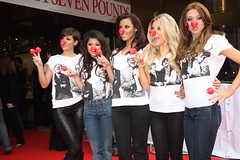
Red Nose Day - Press LaunchImage by Red Nose Day 2009 via FlickrAn interesting and, in some ways, productive day. Chapter 4 of the new book 2 is now done, with some small additions to reflect its new position in the scheme of things. Book 1 is now up to chapter 16 with the alterations and corrections to the text.

The buddleia is trimmed back, the hedge bordering the south western side of the garden is tamed. And both will now give better displays when spring comes into its own. Two of the four borders are now free of their weeds and a couple of plants that were in unsuitable spots have been transplanted to better locations.

Tonight, in the UK, is Red Nose Day, a celebration of comedy on the TV, run to raise money for charitable organisations here and in Africa. Its a biennial event, alternating with Children In Need, which does the same sort of thing exclusively for children's charities. For me, these are two nights when I must participate and watch. There is  mix of pathos and comedy and a great deal of money is generally raised for good causes, so I shall sign off now and spend the evening in front of the box with my family.
Enhanced by Zemanta

Monday, 14 March 2011

Stuart's Daily Word Spot: Yada-yada

Brad Pitt signs autographs for troops during h...Image via Wikipedia
Yada-yada: noun  tedious, trivial or meaningless talk, chatter.

'Caroline comes up to me with that expression she wears when she thinks I'm doing something I shouldn't and gives me this long lecture on how I should be more like Brad Pitt; yada-yada.'

Enhanced by Zemanta

Thursday, 17 February 2011

Stuart's Daily Word Spot: Zany

Jester reading a bookImage via Wikipedia
Zany: noun – originally a comic performer, imitating his master in a ludicrous way; a professional jester or buffoon: adjective - comically idiotic, bizarrely or crazily ridiculous or comic, bizarre, crazy.

'Acting the zany, Gordon spoofed the actions of his immediate superior behind his back, causing great amusement amongst the bank staff.'

'Old Janet dragged her skirt up behind her to wear as a bonnet in a zany display of contempt for the ordinary rules of her strict society.'

Enhanced by Zemanta