Google+
This blog has moved. Please go over to this link to see my new website.

Tuesday, 30 October 2012

Halloween Ebook, Free for 2 Days.


Heir to Death’s Folly, available exclusively as a Kindle ebook at present, is published under the KDP flag. And I’m giving it away free for two days, so that my regular readers can have it at no cost, to celebrate Halloween. Should you take advantage of this offer, I’d appreciate a review, but you’re under no obligation, of course. I just want you to enjoy the story and feel the terror.

For those who don’t own a Kindle, but want to read it in the offer period, or later (when, by the way, it will cost you $2.99 or £1.86), you can download free software from Amazon so you can read Kindle books on your PC, laptop, iPad, iPhone, Android phone, tablet or Mac, just follow this link if you’re in the UK http://amzn.to/Uaqusr and click on the appropriate link on the site. For USA readers, follow this link http://amzn.to/UaqUiu  and you can add other devices to the list as follows: your browser, Windows Phone 7, Blackberry, and Windows 8 devices.

What’s the story about? Well, I won’t give too much away, but a young woman is being taken into danger…
The short blurb is as follows:
At Kasim's insistence, Julie takes him to visit her Aunt Agatha. Desperate for money, he intends to hasten Agatha's death so Julie will inherit her fortune sooner. But their search for the legendary family treasure leads them into dangers they could never have envisaged. Will Julie escape the fate that awaits her in the ancient tower rumoured to house the hoard?

And the period of the free offer?
From now, PST (Monday), to midnight PST on 31 October (07:00 Tuesday to 07:00 Thursday, here in UK). So, get your copy sooner rather than later, or you may miss out. Of course, if you wait, I earn a bit of cash for my work and that’s great. But, either way, I’m happy as long as I have readers. Enjoy.
Enhanced by Zemanta

Monday, 29 October 2012

New Book Published for Halloween


I’ve a new book out for the coming holiday. It’s a story of around 10,000 words in the Gothic horror tradition, so should get those goosebumps rising.

Heir to Death’s Folly is available exclusively as a Kindle ebook at present, under the KDP flag. And it’s going to be free for a couple of days, so that my regular visitors have a chance to obtain it without cost. Of course, if you take advantage of this offer, I’d appreciate a review, but don’t feel under any obligation to write one.

If you don’t have a Kindle, but want to read it in the free period, or later, you can download free software from Amazon to allow you to read Kindle books on your PC, laptop, iPad, iPhone, Android phone, tablet or Mac, just follow this link from the UK http://amzn.to/Uaqusr and click on the appropriate link on the site. For USA readers, follow this link http://amzn.to/UaqUiu  and you can add other devices to that list as follows: your browser, Windows Phone 7, Blackberry, and Windows 8 devices.

So what’s the story about? Well, I don’t want to give too much away, but a young woman is in danger…
The short blurb is as follows:
At Kasim's insistence, Julie takes him to visit her Aunt Agatha. Desperate for money, he intends to hasten Agatha's death so Julie will inherit her fortune sooner. But their search for the legendary family treasure leads them into dangers they could never have envisaged. Will Julie escape the fate that awaits her in the ancient tower rumoured to house the hoard?

And, what’s the timetable for the free offer?
From midnight PST tonight (Monday) to midnight PST on 31 October (which is 07:00 Tuesday to 07:00 Thursday, here in UK). So don’t delay, get your copy sooner rather than later, or you may miss out.

Saturday, 27 October 2012

Five Finger Exercise, a Play by Peter Shaffer, Reviewed


First performed in 1958, this is a play of its time. I’m not sure the modern generation would understand the subtleties of the upper middle class family and its seething social and class tensions. The addition of the German tutor as a fulcrum for change, so short a time after the war, would nowadays not have the power and relevance it must have had for an audience of the day. Of course, those of my own generation, and earlier, would appreciate these factors, but whether the play could be enjoyed by a younger audience is open to debate.

In the written text, there’s an ambiguity surrounding the relationship between the tutor and the son that could hint at homosexuality. But the resolution of this in performance would be dependent on the actors playing those parts and the direction they were given, and I’m still unable to decide whether their attempt at friendship is platonic or subconsciously sexual.

Employing a girl developing into early womanhood as the object of the young tutor’s teaching, enclosed, as they are, in a tight and intimate setting, would now be seen through different eyes. In fifties England, paedophilia was a taboo subject and one not considered for public exposure or discussion as it now is. Again, the playwright may have had ulterior motives and may have been adding a layer of complexity to the plot by suggesting a sexual longing on behalf of the daughter. Certainly she develops a crush on her tutor, and this, once perceived by the mother, is a cause for the older woman’s jealousy, since she also fancies herself in love with the young man. But the crush may have been intended as no more than the sort of puppy love displayed by young girls for objects of devotion, without the sexual connotation it would inevitably acquire for today’s audience.

The relationship between the businessman father and the social climbing mother with artistic pretentions is almost clichéd, though here it is rescued from that fate by making the woman of French origin. The tensions formed by her sensitivity and his pragmatism, especially as these pertain to the raising of the son, are classic in their portrayal. The fight about his education at university, studying English Literature, instead of taking the route of practical apprenticeship in his father’s furniture business, is so well drawn that it may well be based on the author’s own experience. I don’t know whether that’s the case, however. This sort of conflict, where the mother wants her son raised to appreciate the finer things in life and the father wants him to be moulded into his own image in order to carry on the business, is a fairly common element of fiction and drama or the era.

This is a play about class war, the then prevalent theme of the war between the sexes, prejudice regarding nationality, and the ever-present conflict between those who make money and those who merely spend it. Whether it would work for a contemporary audience I couldn’t say. Certainly, however, if it were to be performed locally, I’d attend. As a study of the times, this is an excellent example of drama, and, given the pedigree of the creator, is as   well written as you’d expect. I enjoyed it.

Enhanced by Zemanta

Thursday, 25 October 2012

Does it Matter if the Words Are Not Right?


This might seem an odd question from a writer. I was prompted to ask by a fit of annoyance over poor language used by a journalist on television. She was reporting on a local news item and used the expression, ‘This problem is, of course, very unique to…’ and went on to ask her interviewee just ‘how unique’ he felt the issue was.

So what? Well, ‘unique’ is an absolute. There are no degrees of uniqueness. Something is either unique or not; it can’t be partially unique, very unique or, indeed, almost unique. We have other words to express such things. ‘Rare’, comes to mind, as do ‘uncommon’ and ‘scarce’. Because rarity is an elastic concept, we can use qualifiers with impunity. It’s fine to discuss degrees of scarcity, that degree dependent on the amount by which the object under discussion veers from the commonplace. 

If we begin to use absolutes in such a way, we diminish their real power in describing an event or quality. If I say that a woman conveys a ‘unique beauty’ I paint a picture of someone who is singular, incomparable. If, on the other hand, I describe her as a ‘rare beauty’, then I put her in a class along with others; the number contained in that class can be defined more or less by using qualifiers such as ‘very rare’, ‘unusually rare’, ‘moderately rare’, etc. So, in the ‘unique’ case, the reader is clear that the person described has no equal. In the ‘rare’ case, we know that there are others, though not a great number, who are comparable. It’s a fine distinction, but one worth retaining, I think.

In another example of poor journalism, one increasingly repeated these days, I heard a reporter talking about how ‘…there are less people involved in…’, when, of course, he should have said, ‘...there are fewer people involved in…’.  This is a slightly different matter, however. The use of less or fewer always provides the information that a smaller number is involved than the comparison. Whilst the use of the correct word is preferable, it doesn’t actually alter the basic idea being communicated. So, whilst I find the usage lazy and inaccurate, I can reluctantly accept its adoption because meaning isn’t changed when the error occurs.

This, then, is my question: If meaning is maintained, does it really matter if the wrong word is used to convey that meaning?

Are we concerned about correct usage simply for the sake of correct usage? Or is our concern, as writers, more to do with style, perhaps? Does wrong usage, whilst acceptable to many non-writers, merely illustrate a lack of care, education, or intelligence to those of us who write?
  
Language is primarily a means of communicating ideas. So, if those ideas are expressed without confusion in spite of wrong usage, does that incorrect usage really matter?

I pride myself on knowing correct usage, most of the time, but do my readers care, or even notice when such errors occur? As a writer, I feel duty bound to utilise the many fine shades of meaning possible within the English language. I feel that allowing such distinction to be eroded by ignorance, carelessness or expedience is a step along the road toward ultimate confusion and bedlam, as fine discriminations disappear under a carpet of banality. The poet in me abhors such laziness. But, apart from other poets and writers, do my readers care? That’s what I ask you. And I welcome your responses.

Enhanced by Zemanta

Sunday, 21 October 2012

The Viscount and the Witch, by Michael J. Sullivan, Reviewed


This short story, from the author’s fantasy series, Riyria Revelations, came to me via my Kindle as a free read. It features a couple of characters from the series but can be read as a separate tale, which is just as well, since I haven’t read any of the previous work by this author.

There’s almost no backstory detailing the fantasy world in which the story takes place and the details of the characters are cleverly woven into the fabric of the tale itself. I have a built in prejudice against stories in which thieves are the stars, feeling that glorification of thievery is not a good idea. But I accept that the thieves of most fantasy works are in that situation as a consequence of the society in which they dwell rather than as a matter of real choice, and I’m aware that there’s quite a body of work by a number of authors revolving around guilds of thieves.

This piece is well written and the characters are well drawn. I particularly like the Viscount, with his resigned air. The author has managed to convey the idea of a different world and time without actually describing the setting in great detail. It’s more a feeling derived from the interaction of the characters and the circumstances in which they find themselves. I enjoyed Royce, with his irritation, patience and worldliness that allows him to seem other than he is. Hadrian’s name was a little distracting for me, because of the association with the historical character, but the character was real enough and, once I understood we were not being told about the Roman Emperor, I was able to get on with him a lot better.

There’s humour in the story, which is told with a touch of ‘tongue in cheek’ that raises it above the level of many fantasy works. The author’s familiarity with, and clear love of, his characters comes across in the telling of the story and lends it some authenticity.

I enjoyed this brief insight into the world of Riyria and may well be tempted to investigate further (once I’ve read the 150 other titles lying unread on my shelves!). If you like fantasy or have an urge to try it, you could do worse than give this short piece a go. 

Enhanced by Zemanta

Friday, 19 October 2012

A Pleasure to Burn, by David Bain, Reviewed.


I read this short on my Kindle. It has references to Ray Bradbury, which I didn’t fully get until I discovered Ray wrote a story with the same title (one I haven’t read). I felt the style was closer to some of the US detective stories I read in Ellory Queen, when I was younger, than to the sublime style of Bradbury.

The tale is told from two points of view; the ‘hero’, a celebrity returning to his home town, scene of a family tragedy, and the young female reporter following him and intent on getting a unique story. The writing is tight and moves the action along well. I felt the ending was predictable but that didn’t spoil my enjoyment of the story.

This was one of those books that held my attention whilst I was reading but left me with no after-impression. So, an entertainment rather than a deep piece of work. Nevertheless, I enjoyed this work of horror/ghost story and would recommend it as a way to spend a short spell of time alone in an old house, especially if you’re of a suggestible nature.

Enhanced by Zemanta

The Millionaire’s Nanny, by Carol Grace, Reviewed.


I read this, as a free read, on my Kindle. It’s clearly a romance written with a female readership in mind, but that rarely stops me from reading. What matters is a combination of the quality of the writing and my interest in the characters. The story will generally interest me regardless of subject matter, since I’m interested in the interaction of characters and how they deal with the objects strewn in their paths by the author.
This is a love story involving the relationship between the millionaire of the title, who, by the way, doesn’t act like a normal wealthy man, and the nanny sent to look after his 6 year old son. The separation that caused the need for the nanny, the fact that said nanny has been sent in error to the wrong place, the man’s initial response to an attractive woman when he was expecting an older matron and is currently trying to get over the mess of separation, and the nanny’s recent loss of her own babies and the breakdown of her previous relationship all mingle to form the body of the story.
Misunderstandings roll in thick and fast, sometimes just a tad unbelievable, but acceptable due to the quality of the character building. There are some awkward changes of viewpoint, which can throw the reader when inserted more or less randomly. There is a suggestion, no more than that, of authorial morality, which explains some of the attitudes of the protagonists to their relationship but which I felt might sit a little uneasily with modern readers.
This is a gentle love story with no erotic content but an underlying sexual tension that works well. You could happily let your spinster aunt read this; there’s nothing to offend here. But, having said that, it isn’t anodyne; there’s courage and conviction, along with plenty of incident in a plot that gently wanders rather than twists and turns. It’s by no means a ‘page-turner’, but it jogs along comfortably at a pace that suits the material and style of the story.
I have to admit that I enjoyed the book and happily recommend it to those who enjoy their romance without eroticism or violence. It’s a charming ‘feel-good’ novel.

Enhanced by Zemanta

Thursday, 18 October 2012

Sorry, No Post Today

Sorry for the lack of a writing matters post today, folks. My computer decided to sulk. It demanded to be returned to factory settings, so I've had to re-load all my ancillary software and then restore all my backed-up files (76,376 or 43.2 GB) And then, of course, I had to catch up on the activity I'd missed during the past three days. The free chapter will appear as usual tomorrow, and I'm intending to write a post for Sunday.
So, see you all for those.

Sunday, 14 October 2012

Whose Water Is It, Anyway?

Water cycle http://ga.water.usgs.gov/edu/water...
Water cycle http://ga.water.usgs.gov/edu/watercycleprint.html Other language versions: Català Czech español Finnish Greek Japanese Norwegian (bokmål) Portugese Romanian עברית Diné bizaad (Navajo) and no text and guess water vapor (Photo credit: Wikipedia)

As far as I know, no individual or corporation has laid claim to the air we breathe or the light that stems from sun, moon and stars (though the possibility clearly exists in this materially-obsessed world of ours). We accept that these are naturally occurring phenomena that have enabled life on the planet we inhabit. Logic suggests that water be included in that short list. It’s a natural consequence of a long-established cycle that was not initiated by human activity and it’s a substance that’s the very essence of life. Yet there are those who lay claim to the water that exists in a given region. My view is that water, like air and sunlight, should not be allowed to ‘belong’ to anyone.

I hear the cries of those who either run or own shares in water companies, berating me for robbing them of their profits, and telling me that treated water doesn’t get that way for free. I know. I wouldn’t dream of arguing that it does. That isn’t what I’m suggesting. I’m saying that they do not and cannot make water.

We may clean and modify the raw material. But that raw material is a natural resource and is therefore not something over which someone can rightly claim ownership. The processing, storage and delivery are those elements for which we should expect to pay, allowing the companies concerned to add their reasonable profit for future investment and to pay their workers a living wage. But, to allow anyone to claim rain, which is what all drinking water is at source, as an owned resource is patently mad, bad and stupid. So, as a society, and I am talking worldwide here, we should accept that water, which exists without our intervention, isn’t a commodity to be traded but a resource to be distributed without reference to either profit or boundaries.

Treatment, modification, extraction, storage and delivery are the only elements that should be subject to cost. The raw material should be considered a zero cost component of such a business.

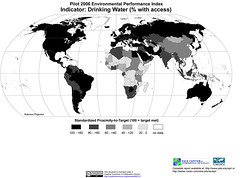
Drinking Water
Drinking Water (Photo credit: SEDACMaps)
Logic suggests that I should go further in my argument. Is rainfall a matter of human control? Only inasmuch as, occasionally, societies have seeded clouds in order to encourage precipitation at a specific time in a specific place, with variable success. We have no control over where and when those clouds are formed. That’s a natural process. It’s true that our activities are increasingly distorting it, but that’s an accidental by-product of our irresponsible behaviour.

So, it follows that not only is water not the property of any individual or company; it isn’t the property of any country or state either. The water cycle knows no boundaries. The presence or absence of water in any given location is due to a combination of natural influences: geology, geography and climate. Of course, there are man-made aquifers, reservoirs and other capture and storage facilities where man has usurped the natural product to direct it for his own purposes. But such activity doesn’t constitute ownership of the actual resource, it merely permits the transient capture of a quantity of it for local consumption and is therefore part of what I’ve referred to as storage.

Over the history of our species, we have instinctively tended to settle near sources of drinking, or fresh, water. The exceptions are nomadic peoples who have taken their chances and followed certain natural cycles in order to obtain their food and water. These are stateless peoples who, for historical reasons often lost in the annals of unrecorded history, have not been able, or allowed, to settle in any given location. But, for the majority of us, a settled existence has been the norm for millennia. And settlements have almost always developed near sources of drinking water simply because its absence would prevent expansion.

English: Mwamanongu Village water source, Tanz...
English: Mwamanongu Village water source, Tanzania. "In Meatu district, Shinyanga region, Tanzania, water most often comes from open holes dug in the sand of dry riverbeds, and it is invariably contaminated." . Français : Point d'eau du village de Mwamanongu, en Tanzanie. "Dans le district de Meatu (région de Shinyanga, Tanzanie), L'eau provient le plus souvent de trous creusés dans le sable de lits de rivières asséchées. Elle est systématiquement contaminée." (Photo credit: Wikipedia)
So, whether that water is obtained from boreholes, lakes, wells or rivers, it remains a natural resource. Yes, there have been more recent settlements that have provided their own man-made storage facilities and collected or redirected the water needed to fill them. But the water, the result of rainfall, remains a natural resource, along with sunlight and air. (I’m aware that my argument can be developed to include other natural resources, by the way, but I intend to discuss that in a later piece).

It follows that national borders are irrelevant to the incidence of water. Presence or absence is an accident of geography for any state, since this aspect of the cycle is unfixed. A city can grow up on the banks of a river which then changes course. A settlement can develop around a lake which subsequently drains due to tectonic or mineralogical activity. The boreholes leading to an underground aquifer can end up as mere holes in the ground when natural changes shift the level of that aquifer.

Yes, we, as a species, can and do make changes aimed at preventing such dangers to our second most essential resource. But the fact remains that the substance itself stands outside ownership or borders. Something that falls from the sky in the way that precipitation develops water sources can hardly be claimed as the property of any person, corporation or state. We are custodians only. Modifiers; nothing more.

In the near future, water, or its lack, will become an increasing source of dispute between nations. There are already signs of conflict arising from the reduction of available water in certain geographical areas. The famines in parts of Africa are almost entirely driven by changes in the water cycle in those regions; increased population has merely exacerbated the problem. My guess is that the problems in Israel are fundamentally caused by the perception that the most important source of fresh water is growing insufficient to sustain more than a given population. There are signs that drought will soon invade the fertile plains of the Punjab in India, making it impossible for them to provide the food on which that huge continent depends. The western states of the USA are finding more and more difficulty in obtaining water for agriculture, industry and human consumption. Not that this has stopped certain organisations from squandering the precious resource in displays of irresponsible excess.

If, as a world society, we fail to recognise the basic fact that water is a natural resource belonging to all and to none, regardless of source, we will have conflict in the near future. Almost certainly, the next major wars will be over the ownership of fresh water: man killing man through an inability to accept a basic truth. Water, like air and sunlight, is a natural consequence of the location and geography of the planet and belongs to no one and to everyone. It is time we dealt with it in that way.

Enhanced by Zemanta

Thursday, 11 October 2012

Do Facts Matter in Fiction?

Cover of "Britannica Encyclopedia (Encycl...
Cover of Britannica Encyclopedia (Encyclopaedia)

You’re a fiction writer, as am I. So, how important is it that we get our facts right? Aren’t we writing pieces that stem from imagination and exist in fantasy? Does it really matter if we present a fact as fiction and distort it a little? Is it important whether we actually tell the truth at all? Isn’t all fiction basically lies?

I ask these questions not frivolously but out of a sense of responsibility to my readers. I know that I’ve learned things about the world, people and things, from my fiction reading. I’ve accepted what a novelist or storyteller has told me in the course of a work of fiction, assuming that anything purporting to be true has, in fact (and, yes, I’m aware of the pun), been checked for accuracy. This is particularly the case when it involves a new subject or something generally only known by a small or esoteric group.

Cover of "The Spire"
Cover of The Spire
As an example, I learned that it was common practice for the builders of cathedrals in mediaeval times to incorporate a body, often a human, into one of the supporting pillars. The skilled craftsmen were largely pagan masons with little respect for the church authorities, and their acts of sacrifice may have been some sort of appeasement for their own gods for working on a monument to another religion. They also, of course, frequently modelled gargoyles on clerics of the time, often in mockery. I first came across this in the excellent novel by William Golding, The Spire, which I studied for my A level English Literature exam. Subsequent reading and some television documentaries seemed to corroborate the information. However, I can find nothing online to substantiate it, so I’m now in doubt about the facts.

Now, I don’t know about you, but I want my readers to have confidence that what I present as facts are actually facts, not some lazy assumption gleaned from inadequate research mixed with folklore and urban myth.

Yes, I want to weave my own story, using imagination and my creative skills to develop a story and people it with characters who come across as real and rounded human beings. But, when I introduce something in that story that’s presented as a fact, I want it to be true. I believe it’s the responsibility of the storyteller to do exactly that: to present facts as facts and not to exaggerate, diminish or embroider them to dramatize the tale. Anything that enhances the reader’s experience in emotional terms should derive from the characters, action and conflict, not from a distortion of the facts surrounding the text.

In preparation for this piece, I undertook some very basic research on a topic I knew to be uncertain. I wanted to illustrate how difficult, and important, it is to get the facts right, or as right as is possible. For it is the case that certain ‘facts’ do change over time, as more information is uncovered relative to the subject. A simple example of that is the way that history is presented over the ages. History, as we all know, is written by the victors. So the records left by a victor are frequently distorted in favour of that victor.

It was previously believed that the Oracle at Delphi in ancient Greece, had special powers of observation that allowed her to see into the future. We now know that the site of her prophesies lies over a fault from which certain gases escape to invade the brain of the prophet, causing psychological disturbances that account for the apparent visions. The rest of her supposed successes are now put down to misinterpretation coupled with the tendency of people to particularise generalities.

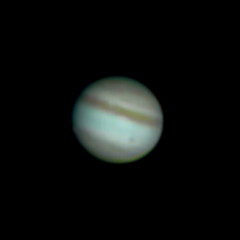
Jupiter 2010-12-05
Jupiter 2010-12-05 (Photo credit: horstm42)
To get back to the subject I chose to illustrate the changing and sometimes unreliable nature of facts. We all know that Jupiter, the gas giant planet of our solar system, has many moons. But how many? I have a print copy of the Encyclopaedia Britannica, purchased as a research tool back in 1994. It’s the 1993 edition and states that Jupiter has ‘at least 16 moons’. This was what was known at the time. As part of the deal, I was signed up to receive printed updates to keep the volumes current and, in 2005, received an amendment that told me there were ‘28 known satellites’ of Jupiter. I found a site online (I won’t name them here), last updated on 14 September 2006, that told me Jupiter has ‘4 Galilean and 57 other moons’. In 2008 I updated my Encyclopaedia Britannica by buying the CD rom version. That edition tells me that Jupiter has ‘more than 60 known moons’. An undated article on the Enchanted Learning website tells me that the planet has ‘67 known moons, so far.’ The NASA website, updated on 2 October 2012, lists ‘50 moons and a further 14 provisional moons’. A Wikipedia article, dated 9 October 2012, cites ‘67 confirmed moons’. And Space.com undated, but copyrighted 2012, states the number as ‘a total of 67 known moons’.  The sensible conclusion, therefore, is that, currently, we know of 67 satellites circling our largest planet. And I’d be happy to use that figure in a story, since it’s the latest corroborated information I have available. I know it will change as more data come to light, but I’m no more able to predict the future than was the Oracle at Delphi, or any of the other prophets whose names litter the annals of religion and history.

So, check your facts before you release them to your readers and, if they’re subject to doubt or change, make that clear in some unobtrusive way. You owe your readers the truth.

Finally, I was inspired to write this piece following a short interview I watched on TV whilst eating breakfast this morning. The piece concerned an episode of a popular soap in the UK, EastEnders, and a storyline about social workers removing a child from one of the characters. There was much discussion about the dramatic element of the story, which was considered good television. However, the representative of the social workers was most concerned with the way in which the work of her fictional colleagues was represented. She accepted that different social workers operate at different levels but was more concerned that the procedures depicted were factually inaccurate and would therefore give viewers a false impression of this very emotive topic. I leave you to make your own conclusions on that.

So, there you have it. My attitude to the representation of facts in fiction is that we, as writers, have a duty to our readers to ensure we’re as accurate as possible. I’d be interested to learn your opinions. Please share them by commenting below.

Enhanced by Zemanta

Saturday, 6 October 2012

Is Society Organised for Business or for People?

International Money Pile in Cash and Coins
International Money Pile in Cash and Coins (Photo credit: epSos.de)

An odd question, or one you think should be considered? I suspect your view will be influenced by your basic attitude to the place of money in society.

Why would I even ask the question? I look at the world around me and view the priorities cited by government, commerce and those with a real interest in environment. What I see is a society slewed toward the making of money as a primary purpose. But isn’t money supposed to be the tool, the helpmate of humanity? Isn’t trade, and all those services involved with manufacturing, production and delivery, intended to serve mankind?

When I look at the world, I see that the production of wealth is actually the prime purpose of most commerce. Now, I fully understand that we can’t live in a society where barter takes the place of currency, but I do question the value we place on the process involved in increasing wealth. Businesses appear to exist primarily for the benefit of their shareholders, so that their customers are, in fact, at best a secondary consideration rather than the primary cause of activity.

Banks are probably the best illustration of what I mean: Banks were set up to provide a service that would allow the lending, borrowing and security of the funds of their customers to operate to the benefit of those customers. But the current system benefits primarily the bankers and those institutions and individuals who hold equity in the business itself. The customer who wishes to take advantage of the lending system is now seen more as a threat than a natural client. Customers are viewed as a source of extra income, often by the employment of questionable schemes to extract more money from them to be placed into the banks’ coffers. (There are many examples of this, the recent scandal of mis-sold PPI is simply the most obvious).

Sport is another area where money has become the prime purpose of participation. Football, in particular, has fallen victim of the money men. What used to be local clubs, with locally trained and selected teams, and whose object was the raising of local pride in association with the clubs’ successes, have now become simple businesses. They no longer have any real connection with the locality in which they reside. The teams are made up of international ‘stars’ of questionable value who are paid obscene amounts of money in order to progress their teams to gain more money for the club owners. In the rush to make more and more money from sport, all ideas of sportsmanship have receded to be overtaken by cynical gamesmanship. And this change is so pervasive that many of the fans and players aren’t even aware that cheating, play-acting and tricks are damaging both the sport and society in general. And all this because huge sums of money are on offer from the various media companies who distribute the product to the masses.

Religion has joined the rush for money, in spite of the injunction to the faithful that they should eschew material riches in favour of spiritual rewards. The Roman Catholic church is an obscenely rich organisation that begs for more income from its impoverished congregations whilst keeping its leaders in ostentatious luxury. The Church of England cries out for public funds to repair and support its many crumbling buildings, whilst remaining one of the richest landowners in the country.  I don’t know much about the Jewish and Islamic institutions, but I’m willing to bet they are similarly wealthy whilst many of their adherents remain in poverty.

I could go on with examples, but that would be pointless. My concern is with the way in which we have allowed money to become our master and, in the process, allowed those who own the most money to have power over the vast majority who have little or none. What was intended as a tool to aid interaction and prevent chaos in a growing population has become a weapon in the hands of a very few powerful institutions and individuals. A weapon of control, which promises to become eternally self-perpetuating unless we do something radical to overturn the supremacy of money in the use and abuse of power and return governance to the mass of people.

It is demonstrably unjust that there are individuals who have personal incomes and wealth greater than the GDP of some small nations. It is demonstrably absurd that some individuals have colossal wealth when there are many who have none. We have been sold the idea that those with wealth have somehow deserved it, that they are solely responsible for the good fortune that has happened their way. Please don’t spout the old chestnuts about ‘getting what you deserve’ and ‘work hard and you’ll succeed’ at me. I touched on those two lies a while back and the links (one below) will take you to my arguments.

The simple fact is that no individual ever has been or ever will be deserving of wealth disproportionate to their efforts. The tycoon who claims to be a ‘self-made man’ conveniently forgets that he could not even have risen from his bed in the morning without the help and input of a multitude of other people. For those who find this concept difficult to grasp I feel I must give an example. We all need food to survive. Let’s take the basic loaf of bread, without which our tycoon could not perform, due to hunger. Someone has first to plough and till the ground so that it can be seeded with grain. The crop has to be gathered and transported along roads, made by many more individuals using the tools and machines made by other individuals. At the bakery, more people are involved in turning the raw material into a food product, using machinery and electricity that depends on other individuals for manufacture. Once baked, using power derived from sources mined or generated by yet more people, the product is transported, using fuel and materials produced by other individuals. Eventually, the loaf arrives in the shop to be sold and is there dispensed by even more people. Along the way, we have also to consider the road sweeper who keeps the highway clear to permit the transport to move, the rubbish collector who disposes of the waste that would otherwise clog up the works, the teacher who educates all the people involved in the various process, the nurse who cares for those who fall sick along the way, the unpaid parents who ensure the children get to school…do I need to go on? The reality is obvious. But we seem to have fallen into the trap of believing that certain individuals somehow contribute a great deal more than the rest of us. It simply isn’t true.

The only real difference between the wealthy and the poor is often due to luck, preferential birth circumstances, the possession of a peculiar talent or the wicked selfishness and greed that allows some to ignore the needs of those over whom they wield their power.

Of course we need to reward those who initiate those ideas that are of benefit to the mass of humanity. Of course we must recognise those who possess rare and valuable talent. Of course we should ensure justice for those who accept high levels of responsibility. But none of these people is worth the huge difference in value that is ascribed to them.

In the UK, and I suspect, elsewhere in the world, there is a minimum wage, set so that unscrupulous businessmen cannot exploit too heavily those who produce their wealth for them. If a minimum wage is a sensible barrier to excessive poverty, then a maximum wage can easily be made a similar barrier to excessive wealth. It requires only political will. But, as long as we have a system of government that depends only on the value falsely accorded to money, we will have a control system that prefers the wealthy over the vast majority of hard-working people. Is that what you want?

Enhanced by Zemanta