Google+
This blog has moved. Please go over to this link to see my new website.
Showing posts with label Breaking Faith. Show all posts

Wednesday, 29 October 2014

#BookADayUK; A Reader Event For October. Day 29

The Books Are My Bag.com promotion to support independent bookshops is coming to a close.

Today's theme is 'Most memorable fashion moment'. For me, this is a difficult one, since I am of the same mind as Oscar Wilde on the issue of fashion. He said: 'Fashion is a form of ugliness so intolerable that we have to alter it every six months.' In fact, I'd go further. Fashion is probably one of the most irresponsible industries that we have to endure. It makes women, and more recently, many younger men, feel inadequate and unsatisfied with their bodies. It demands that people replace their wardrobes with increasing frequency, thus wasting valuable resources in a world with finite supplies of almost everything. And it grants an inappropriate status to those who simply have the good fortune to be today's accepted version of beauty.

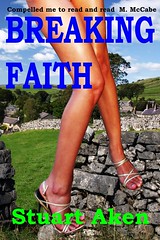
However, since this is actually about book shops, and therefore books, I shall have to find something that has some mention of fashion or at least clothing in its content. To be honest, since the issue doesn't interest me, I'm struggling. And the only book I can recall with any sort of mention of clothing is one of my own. So, I'll shamelessly promote my own book, which can be ordered from your local book shop. It's received a lot of 5* reviews, so it must be considered a good read. Try Breaking Faith: you never know, you might enjoy it!

Monday, 27 February 2012

Thursday, 16 February 2012

Faith Introduces Herself to Readers


Stuart's asked me to give you some insight into how I think, what matters to me, why I'm the person I am. Let me introduce myself. I'm Faith Heacham and I narrated the story of Breaking Faith along with Leigh. I hope that some of my rather strange background came through that narrative but there will be elements that you will either not know or be unfamiliar with, of course.
When I first started to work for Leigh, I was still imbued with my father's rather strange brand of Christianity and I was determined to develop Leigh's conscience and convert him into a devout follower of my religion. I don't tell you a lot about that aspect in the book, because I didn't want to come across as too evangelical. As it happened, I quickly learned that Heacham was in the wrong and that Leigh, for all his unusual and, dare I say, unconventional ways, was often in the right.
But I'm getting ahead of myself. Let me set the scene. I was brought up for the first few years as part of a small family with my mother, and two younger sisters as well as Heacham. I'm sorry, I can't refer to him as my father knowing what I do now. He was, to me, relatively normal and although he was always a very strict parent, he seemed no more odd or different than any other parent, until Mother left him and took my youngest sister, Charity, with her. It was then that I certainly noticed changes in my life. I was very young but I was expected to take over most of the duties my mother had carried out.
Heacham was a man who gave the impression of being pious. It was only later I learned how truly awful he was, not only as a father but as a man. However, I was placed in a position where I was required to look after him domestically as well as nurse my severely disabled sister, Hope. She, of course, had no hope of ever becoming anything other than a baby in a woman's body. But I didn't know that until I was a lot older. My life was difficult and restricted, as I was no longer allowed to attend the local school but was taught by Heacham. His teaching took the form of indoctrination with his peculiar form of narrow-minded Christianity taken from the Bible and some books of sermons by a rather extreme clergyman. I was allowed an atlas, and a dictionary and two volume encyclopaedia, both of which he censored for all sexual matters apart from the purely biological aspects. We had no television, no radio and he would allow no magazines or newspapers in the house. Living in an isolated cottage well out of the small Dales village, I had virtually no contact with children or with other adults. This obviously left me with a very odd view of the world. But I was a quick learner and loved to read. As a result, I picked up a wide vocabulary and a knowledge of many things that most people never come across.
For exercise, I did the housework, kept Hope free of bedsores by massaging and manipulating her limbs and body, walked the local hills and swam in the isolated tarn up the hill from our cottage. I loved the freedom of those few hours, away from home and father's constant watchfulness. I would strip to my skin and plunge into the freezing clear water and splash about until I was thoroughly tired. By the time I returned home, my clothes had mostly dried on my body. Not that it mattered, since Heacham required me to work in the house wearing the bare minimum of cover. He told me it was to save my clothes from becoming stained and dirty. I know now that it was to afford him a sexual thrill of both watching me and controlling me in a state of more or less permanent exposure.
He indoctrinated me to believe that most men and women were inherently evil and would eventually spend eternity in the fires of Hell. If I erred, even slightly, he would beat me with his hand, a cane or his belt, always on my naked skin. He told me he was saving my soul and I believed him. We prayed together every morning and each evening before bed. He attended some old barn that he and a few other men with similar views had converted into their meeting place, which he called their chapel.
When I first started to work with Leigh and discovered his free-thinking ideas and his openness toward nudity and sex, I thought he must be the most wicked man alive. His models were all beautiful and showed no shame or shyness in displaying their entire bodies for his camera. I was initially incensed and later intrigued. But, though Leigh gave all the appearance to my uneducated mind of being a wicked heathen, I quickly learned that he was a kind, warm, generous and basically good man. I suppose it was inevitable that I would fall in love with him, as the only other mature male I had any contact with. Apart, that is, from his printing assistant, Mervin. He was the embodiment of true evil in my eyes. A crude, ugly, cruel and utterly selfish monster of a man.
If you've read the book, you'll know how I came to change and what those changes involved for me and those I came into contact with. If you haven't read it yet, I can only point you in the direction of this blog, where Stuart's posting the whole book for you to read, free of charge, a chapter at a time. I hope you get as much out of reading my story as I did from telling it from my point of view and learning Leigh's view of things along the journey.

Enhanced by Zemanta

Friday, 23 September 2011

Daily Cheap Reads

This is a website that selects and promotes good books selling at reasonable prices. If you're looking for a good read that won't cost you a fortune, this is the place to look. This week, they featured Breaking Faith. The link to the site is here:  http://dailycheapreads.co.uk/page/2/

Sunday, 14 August 2011

Stuart's Daily Word Spot: Unreliable narrator


Unreliable narrator: A literary term for a narrator who, out of ignorance, bias, limited viewpoint, simple self-interest or through inability to tell the truth, cannot be trusted. Generally, this character appears in first person stories, of course. Probably the most well-know is Humbert Humbert, the wicked teller of Vladimir Nabokov’s tale, Lolita.
In my own romantic thriller, Breaking Faith, I employed the device of paired narrators, allowing the reader to see things from the points of view of both the male and female protagonists. I did this to illustrate that even the most well-meaning and honest of narrators can sometimes be unreliable and mislead the reader, even if unintentionally.

Other examples of unreliable narrators are:
Wuthering Heights - Lockwood and Nelly Dean.
Wilkie Collins’ detective story The Moonstone (1868), in which the plot unfolds through different characters, who contradict each other and reveal their biases.
In Ken Kesey’s novel, One Flew Over the Cuckoo's Nest  the narrator, "Chief" Bromden suffers from schizophrenia.  Since his telling of events includes people growing or shrinking, walls oozing with slime, and other bizarre events, the reader quickly recognises that this story teller is not to be trusted.
In Sebastian Faulks’ Engleby, the narrator, Mike Engleby, leads the reader to believe a version of events that’s increasingly at odds with reality.

Wednesday, 6 July 2011

Author Interview with Stuart Aken


Yes, I know it’s an odd idea: to interview yourself. But there are a couple of reasons for this. Firstly, I’ve been interviewing authors on here for a little over a year now and thought it was time to give myself a taste of my own medicine and discover how easy or difficult it is to answer these questions.
Secondly, I’m away from the computer at present. Since I like to give my invited authors as much marketing and publicity as I can, but also didn’t want to starve my followers and visitors of an author interview, I decided to interview myself. There won’t be one next week, I’m revisiting past interviews on that Thursday, but they’ll be back with a vengeance on 21 July with an excellent interview with none other than Susan Moody (aka Susan Madison). Miss it at your peril!

Hello Stuart, please tell us about you, as a writer.
My bio is already on this site, so I won’t bore you with it again. But, as a writer, I’m driven by compulsion. I must write, or I become even more difficult to live with and my health suffers. Fiction is my chosen field because I love to work with the imagination. Even in my early days, I told stories. And reading has been a passion since I was able to understand the written word. I’ve no particular favourite genre; the stories come to me and choose their own route, generally by the behaviour of the characters. People fascinate me: they are so variable and intriguing.
Two main themes drive much of my fiction: justice and injustice in all its manifestations is one. The other is the innate hypocrisy I find in most organised religion: religion has an amazing opportunity to enlighten, educate and improve the world, but almost inevitably it divides, mistakes dogma for truth, and causes conflict wherever it sits with unreasoned passion.

Your novel, Breaking Faith, is a romantic thriller; perhaps you’d you give us some insight into it in a few sentences.

As Faith stands shivering before the gates of the notorious Longhouse, she has to ask herself why she’s contemplating work with the man her father describes as the Devil’s Henchman. Everything in her past warns her that this move may be dangerous. But that’s the reason she applied for the job in the first place.

Leigh can’t believe he’s invited the local village idiot to interview as his Girl Friday. Her ‘homeless’ style of dress hides any female attributes she might possess and she has the reputation of a simpleton. But, on the phone, she sounded warm and intelligent. The only cause for concern was the way his printing assistant, the woman-hating Merv, might react to a woman working so close to him.

How did you come to write this particular book?

I love walking the countryside; it enriches life and invigorates the spirit. I was walking the steep hills of the Yorkshire Dales, many years ago, and visiting a slightly sinister natural collection of sink holes called the Buttertubs. Looking down in the dank, dark depths of the largest of these, I was visited by the question, ‘Suppose there was the body of a young woman down there?’ From that simple question the rest of the book developed over a period of years. Much of the time, it lay at the back of my mind, absorbing the influences that daily came my way. But, when it was ready to emerge, it did so more or less fully formed. Though, the original had different names for the characters and was told in the third person. The idea to write it in the first person viewpoints of the two leading protagonists came later.

Do you have a favourite character from the book? If so, who and why this particular one?

Faith is definitely my favourite. She’s an innocent; naïve through her isolated up-bringing. But she’s also naturally clever and quick to learn. I loved her for that quality of a clean slate on which her experiences of life could be written for readers to witness how they made her grow and change.
Of course, I really should identify more with Leigh. I was a professional photographer for some time and I’ve worked with models. But I was never the type of man he is, having always been a one woman man who understands that love is far more potent than mere sex in a relationship.

Where can people buy your books?

Breaking Faith, Ten Tales for Tomorrow (an anthology of speculative fiction), Ten Love Tales (an anthology of gentle love stories) and A Sackful of Shorts (a collection of short stories I edited for my writing group of professional writers) can all be bought through Smashwords as ebooks in any format, by clicking on the link for each title above.

Breaking Faith, as a paperback and for Kindle, and the other books for Kindle can all be bought here for UK  and here, for USA and rest of the world.

In addition, Breaking Faith, as a paperback, can be ordered from most retailers, using the ISBN 978-1-84923-314-9. And, should you live in the East Riding of Yorkshire, it’s available in all your local libraries to borrow.

What qualities does a writer need to be successful?
The hide of a rhino, to shrug off the inevitable rejections; the perseverance of Hercules, to continue putting down words and writing stories even when no one seems to be listening; the ability to get under the skin of every living person from innocent child to whore, from dying woman to world’s greatest and most brutal bully; and a compulsion to write that’s so deep that you feel incomplete on those days when no words have been written.

What’s your working method?

When I’m in a really good spell, I write the creative stuff in the mornings, as my imagination is more active then. I edit the current work in progress in the afternoons. Emails, blog posts, group participation, and other writing duties have to take their turn in the evenings.
My stories all begin with characters and I do a full page profile of all named characters, using a picture,  as I find it easier to hang personality on an individual I can actually see. Once I have my protagonists and antagonists, I weave a fairly loose web of story threads in which to involve them. I always know my theme before I start and rarely write down the story details beyond a very vague framework. I allow the idea to develop in my subconscious until the characters emerge from hiding. That’s when I start to actually write. I never look back at the day’s writing, unless I can’t recall a particular detail that’s essential to some part I’m writing the following day. Only when the whole story is down on paper (or the screen, since I write on a computer keyboard always: my handwriting is worthy of any doctor) only then do I think of editing. And I leave the created piece alone for at least a month before I start on the editing process. That is a thorough process, which can often take longer than the original writing.

What’s the single biggest mistake made by beginner writers?

I’m going to be honest, and therefore unpopular. The biggest mistake made by many wannabes is to think they can write just because they have a keyboard available. Writing is a craft, sometimes merged with art, always combined with imagination. It requires a minimum level of facility with language, an understanding of the rules of grammar and spelling, which many people seem either incapable of achieving or too lazy or arrogant to bother to acquire. Sorry, but I’ve read too many books that have been poorly written to encourage even more onto the overstocked market, thereby diluting the overall quality.
But, if a writer has the compulsion and the dedication to learn the rules and understand the medium, then the biggest mistake is to expect instant success and allow early discouragements to dissuade them from continuing.

To what extent are grammar and spelling important in writing?

Utterly essential. Words and grammar are the writer’s tools. It would never occur to an untrained, or unskilled man or woman to rewire their house without finding out how electricity works. The same goes for writing: if you don’t know the rules, learn them BEFORE you put anything out there for the public to read, please. There are plenty of peer review sites on the web, where you can go to have others read and comment on your early work. Poor spelling and grammar can render the meaning of a piece the exact opposite of the intention. Writing is communication, and whilst it’s true that language is organic and changeable and can be manipulated, it really does matter that the writer knows how to say what he or she desires to say. I will now descend from my hobby horse.

How much do you revise your MS before sending it off?

3 million times. Okay, so there’s a touch of hyperbole there. I usually start by reading the piece as a reader, rather than a writer. Then I apply essential description that’s been omitted in the heat of creativity. I reduce or remove passages where little or nothing happens. ‘Telling’ is changed to ‘showing’, where appropriate. Then I check for consistency of settings, characters, events, etc. Next, I look for spelling, grammatical and syntactical errors and only then read the whole piece aloud. Any clumsy sentences or difficult passages revealed by this essential part of the process are then dealt with. I then ask my angelic and patient wife to read the chapters as I print them off. She has an eagle eye for spelling and grammatical errors and spots inconsistency with ease; she is also honest enough to tell me where she feels the story flags or fails to make the point intended. At this stage, I usually subject my writing group to several passages to gauge their response. Then it’s time to get the whole MS printed and out there for publication via whatever route seems sensible.

As a writer of different genres, to what extent do you think genre is useful in the publishing world?

I hate to be stuck into some sort of box, along with other works supposedly similar. But I understand that readers, libraries, bookshops and publishers need to classify work in some way and I can’t come up with anything better. So, I put up with an imperfect system in the same way as most of us put up with the imperfections of the government system called ‘democracy’: it’s the best of the available evils.

Many authors see marketing as a bind. What's your opinion on this, and how do you deal with it?

In common with most writers, I’d much rather be writing than selling my wares. There was a time when publishers employed staff to do this and the author was expected to do only a small amount of publicity work so that the next book could be written. Unfortunately, since the advent of the ghost-written celebrity novel, the celebrity book of lies called ‘autobiography’ and the celebrity book of opportunity, publishers seem to have fallen into the trap of thinking that authors are the best people to sell their books. They aren’t. Most writers are shy and do not speak well in public; that’s why they put their words into written form.
But, it’s a task that must be undertaken and I do what I must and do it as well and as professionally as I am able. And I loathe every minute spent on marketing when I could be writing.

What sort of displacement activities keep you from writing?

My part time day job eats into my writing time, but in common with the majority of writers, I have to earn a living from other sources. Beyond that, I’m involved in many writing orientated groups online and I produce this blog; the daily posts take up time, as do the interviews. The time I spend with my wife and daughter is separate and I don’t view that as something that keeps me from writing. But I also tire rather easily, due to my health, and that requires me to rest at fairly frequent intervals.

What support, if any, do you receive from family and friends, or a writing group?

My wife is amazingly supportive; apart from feeding and caring for me, she reads and checks everything I write, and involves herself in other activities like book signings for friends. Kate, in spite of her teenage needs, understands when I need to be left alone to get on with things. My writing group, Hornsea Writers, is composed of professional writers and we meet weekly to expose our work to one another and receive forthright but positive criticism. Their encouragement is always present.

Is presentation of the MS as important as agents and publishers suggest?

If a piece of work is to be sent to a publisher, agent or editor, it had better be as good as it’s possible to make it. Anything less is an insult to the professionals approached and to those who might become readers of the work. It is even more important if the work is to be self-published; there are no checks and balances there, beyond the skill, honesty and integrity of the author.

How long does it take you to write a novel?

All my life. I’ll expand on that. Everything a writer writes is, to some extent, informed by that author’s life to that point. But if we’re talking about the mechanics, then it depends on the circumstances of my life at the time. Breaking Faith took around 18 months to write but it has gone through various different manifestations and the basic idea for the novel came to me many years ago. On the other hand, I have recently finished the second volume of a proposed epic fantasy trilogy. The first draft, which runs to 200,557 words, took about 3 months to write. It’ll take at least that long to edit and possibly longer. Just before I started on this interview, I wrote a piece of flash fiction (500 words), which took about twenty minutes. I’ve yet to discover how long it will be before that piece is fit to be read.

Who or what inspires your writing?

Inspiration comes from many sources and there’s no single author I can point to as a focus for any particular piece of writing I’ve completed. However, I have a particular empathy with the work of William Horwood. I’m visited by ideas at any time, so I keep notebooks all over the house. I have four in total; all Moleskines, and all rewards for letters published in the British writing magazine, Writers’ Forum. Each has a dedicated pen, so I can jot down an idea as soon as it comes to me. Long experience has taught me that putting off the recording of any idea is a sure way of forgetting it.

If there’s a single aspect of writing you find frustrating, what is it?

I love writing. But I really do find the marketing aspect a pain and a bore. I’m no salesman (though I did work for a year as a company representative and I’ve also managed a retail shop, so I have some experience of such things).

Is there a particular feature of writing that you really enjoy?

I love the creative phase. Getting down the story and developing the characters along the way is what most excites me. But I enjoy the editing process as well; there’s something particularly satisfying about creating a sentence that says exactly what you intend. Perhaps I should try some poetry…

Do you believe creative writing is a natural gift or an acquired skill?

I think the ability to tell good stories in an entertaining fashion is probably a gift. But I believe that the development of that gift into something that will produce work of a quality acceptable to the world of publication is an acquired skill.

What are you writing now?

I’ve just finished the first draft of the second volume of an epic fantasy trilogy. I need to edit that, once I’ve had a break from it. So, I’ll write some short stories and may try my hand at another romance novel; something different from the fantasy to create whilst I complete the edit.

Do you have a website or blog where readers can visit?

I run this blog, of course. My website – the link is at the top of the page – is full of links to various sites of interest to readers and writers as well as carrying some of my short stories and samples from the novel, Breaking Faith, and my other books.

Given unlimited resources, where would you do your writing?

By the sea. The sea is in my blood; my natural father was a sailor and my mother’s father worked on the docks in Hull. So, I’d love to write from a house on a solid cliff top, in a warm climate, with the sea accessible below and visible from the window, as I sat behind an antique desk in a study lined with books and fine works of art.

Where do you actually write?

At a modern desk in a tiny room, with books either side and the window behind me; it looks out on the fence that divides the house from the one next door, so nothing to view there anyway. Music plays to hide other extraneous sound and the map for my epic fantasy hangs on the back of the door so I can consult it easily when necessary.

Review Links:


Next week, no author interview, but I’ll revisit those from the past, so you can check out those you’ve missed along the way.

Sunday, 19 June 2011

Breaking Faith, Reviewed by Kim Tomsett-Fowler

Breaking Faith by Stuart Aken
Reviewed by Kim Tomsett-Fowler

You often hear about stories that stay with you long after they have been read. Well, for me this was 'that' story. I was bombarded by several different emotions whilst reading this book and I loved every minute of it!

This book was a rites of passage tale. We are taken on a journey by the female lead of this story and how her life changes therein. I was amazed at how much time and emotion I invested in each of the characters – really feeling their every emotion, they were so real to me. I also like the way the author changed the narrator almost each chapter between the two main leads. It meant we could see both sides of the story as it were and was a nice touch.

It was beautifully written, in such a way as I could not put it down. Almost to the detriment of my sleep! Thank you Mr Aken for writing a story that has taken me over so completely that now I have finished it, I feel a little lost! May there be lots more from you.


As the author, I'd like to thank Kim, publicly, for this great review. I came across Kim on a Facebook group I belong to, and she was offering reviews of books by Indie authors; a service both generous and valuable. I commend her for her dedication and her love of books and reading. Many thanks for this, Kim.

Saturday, 18 June 2011

Writing: 3100 Words For Today

Best laid plans....  I completed 3,100 words of the epic fantasy this morning, in a single session. I'd intended returning to do more later in the day, but other things also needed doing. The novel continues to go well and I'm well on target for the 200,000 or so I think will take me to the end of this volume. I need to write 16,314 words to reach that target.
However, in the not-too-distant future, I'm intending to have my annual break from the computer, so I need to build up some of the daily word spots to be scheduled whilst I'm away from the keyboard. So far, with today's efforts, I've got word spots and author interviews scheduled up to and including 30 June. Also, the Writing Contests page needed an update: this is a time-consuming operation, but I managed to add a good 20 or so and removed those where the entry date has passed, so that's now up to date. You know where it is if you're interested in entering competitions.
Emails are more or less up to date, though there are a couple from friends that need a bit more thought before they are answered.
A member of one of the groups I belong to on Facebook is reading my romantic thriller, Breaking Faith, and will be reviewing it once she's finished. So I'm keen to see what she thinks of the book. Watch this space for her review later.

The photograph is one I took in Crete, on my last holiday there.

Monday, 19 July 2010

Interview with Yorkshire author Stuart Aken


A short while ago, one of my writing group offered me an interview on her website. I was so taken with this idea that I have decided to adopt it for my own blog. I shall issue an open invitation in the next post, giving details of how authors can participate. Those who contact me will be featured on a first come first served basis. Author interviews are a source of interest for both readers and writers, and it is that group of people I am trying to reach here. As a taster for the series, I am featuring the interview Avril did with me, reproduced below, with Avril's permission.

Interview with Yorkshire author Stuart Aken.


Farmland near Wharfe, Yorkshire Dales National...Stuart Aken is a talented man in all senses of the word. He has overcome reverses that would flatten most people. Happily married for many years, he has found success in various spheres of the working world. His abiding passion, though, is writing, although he would probably call it a compulsion. Successful crime writer Penny Grubb says of Aken's writing that it has a magic quality achieved by few. High praise indeed.

You can find out much more about Stuart on his website:

http://http://www.stuartaken.co.uk

AFT: Breaking Faith is set in the Yorkshire Dales during the 1976 heat wave. What prompted your choice of location and period?

SA: In the words of Max Boyce, ‘I was there.’ Believe it or not, the initial inspiration for the book came to me on a visit to the Buttertubs, in the Dales, at that time. I looked into the depths and wondered how I would feel if I discovered a body down there. From that simple question, the rest of the book eventually flowed. The Yorkshire Dales is acknowledged for its exceptional landscapes and it’s a place I know well. The heat wave was a useful backdrop to a story which needed a credible climate in which the action could take place: few would enjoy being naked in the area’s usual weather conditions. 1976 was long before the era of the ubiquitous mobile phone, an item that would have altered the tone of the novel. It was a time when fashion and the ideas of youth were still fresh enough to encourage experimentation. Cameras used film and a good printing assistant was still necessary for any professional photographer.


AFT: Some might consider there is a strong erotic edge to the novel; is this a marketing ploy or does it serve another purpose?

SA: I’m fascinated by our modern attitude to nudity and the body in particular. As a culture, we are fast approaching the extreme level of hypocrisy that has long existed in the USA. It’s the largest producer and user of pornography but has a puritanical attitude bordering on insanity. Our world is dominated by double standards imposed by Judo-Christian ethics that pretend to celebrate creation whilst denigrating the means of creation in humans. The Islamic world has, of course, taken this duplicity to even greater extremes. The word, ‘love’ is misused to the extent it has no real meaning to many people. Yet, for those who have experienced it, love is so superior to mere sex that it almost defies definition. I wanted Faith to be subject to the prevalent attitudes regarding sex but to actually experience love. She is forced to witness the destructive forces that can accompany sex whilst appreciating the positive force of love; her choice of honesty over deception is what the book is about.

AFT: What made you choose an innocent as your eponymous lead character?

SA: We live in a world where innocence is damaged almost from birth. Goodness, truth and honesty are qualities we pretend to value whilst we indulge in behaviour that destroys these things. Faith was an innocent in the material sense but damaged by her father’s hypocritical insistence on adherence to an extreme version of Christianity. This is only hinted at in the novel, as I wanted his cult to represent all organised religion. The effect of organised religion, as opposed to spirituality, is to distort truth and turn it into a commodity that can be exploited and used as a power base for the unworthy to govern those too lazy to think for themselves. Children are effectively brainwashed from infancy into believing the set of myths and untruths that their parents and peers were brought up with. It is such an insidious force in society that most people are not even aware of its continuing influence on their lives. The very language we use is riddled with religious imagery and ideas, so that it is impossible to escape its influence. I wanted to employ an innocent so that she could rise above much of the hidden influence and expose it, but I had to make sure I didn’t overdo this and proselytise.

AFT: One can’t help but be aware that photography plays a huge part in the story, almost like another character, in fact. Or is it perhaps an allegory?

SA: I was a professional photographer for some time, and worked with models during my early career. Photography is an excellent recording medium that is also capable of functioning as an art form. It has an unfortunate side effect in its representation of reality in two dimensions, as this can affect the photographer, making him unaware of depth in other aspects of life. It is this superficiality that Faith makes clear to Leigh, of course. But there is also a sense in which the mistaken 'belief' of the photographer in the purity of his images, echoes the blind faith that religious people place in their particular doctrines, ignoring the fact that theirs is but one interpretation amongst many when it comes to defining both God and true morality. Organised religion, by its very nature, cannot help but be superficial, since it reduces enormous questions to a set of dogmas that barely address the real issues, let alone provide answers. Photography is, of course, also considered ‘glamorous’ and is therefore a fitting occupation for the necessary alpha male of the romance.

AFT: You have had a number of short stories published as well as a radio play on BBC Radio 4. What advice would you give to new writers?

SA: Write only if you are compelled to. Writing is something that almost every literate person can engage in but good writing, writing with something worthwhile to say, even writing that is simply entertaining, requires a degree of dedication bordering on the obsessive. There are many people who write for fun but then want to be published. Such writing is fine for personal fulfilment but it’s self-indulgent to impose it on the reading public and it clogs up the works for those who have real talent. If you must write, and I mean that literally, then do so but ensure that everything you write is the best it can possibly be.

AFT: What are you currently writing?

SA: I’m working on the first volume of a three part fantasy series. It’s an adventure and a quest set in an invented world and centres on, surprise, surprise, organised religion and its corrupting power. I’d like to entertain those with open minds whilst inciting the dogmatic into fits of apoplexy. And, yes, I intend to make it a good read.


Enhanced by Zemanta

Sunday, 11 July 2010

A Shameless Plug for my Own Book

perf6.000x9.000.inddImage by stuartaken via Flickr

Here are some reviews of Breaking Faith, my self-published novel. I hope they might tempt you into buying the book. But, if you want a flavour of it first, visit my website www.stuartaken.co.uk and use the BookBuzzr widget to read the first 30 pages or go to the ‘Novels’ page and read the first 2 chapters, all for free. You can then buy it through amazon or any of a number of other booksellers.

By S. D. Mace "Shirley Mace" (High Bentham)
After several years of not having the time or making time to read novels I could not believe how determined this book was to make me read it and was surprised how quickly I read it and how much I enjoyed reading it. 
"Breaking Faith" is about a young naive, innocent girl, set in the summer of 1976, it details Faith's journey from one of isolation, deprivation and abuse where she is bullied by Heacham, acting as his skivvy and financial support and also nursemaid to her brain damaged sister, to enlightenment and self-knowledge in which she slowly falls in love with Leighton and overcomes all the obstacles that are put in her way. Writing from alternating perspectives (Faith and Leighton) adds detail, richness, interest and understanding of the characters. A shocking but captivating story that is definitely worth reading.

By  Mr. P. F. Field (UK)
"Breaking Faith" is the story of Faith, ignorant, naive and completely overshadowed by the sadistic bully Heacham. Faith struggles to nurse her brain-damaged younger sister, skivvy for Heacham and be the family's total financial support. 
Awakening comes as she gets a job with Leighton, the local glamour photographer and she falls in love with him, despite the terrifying threats from Leighton's assistant, the disgusting Mervyn.
I read this book in one sitting, unwilling to put it down, immersed in the Yorkshire of the sweltering summer of 1976 and Faith's journey from darkness to self-knowledge. Her sometimes frightening honesty wash all hypocrisy away, for she is a girl who sees things as they are and tells it the way it is. The book is written from the alternating perspective of Faith and Leighton, giving the reader a greater understanding of their interactions with each other and those around them. The characters are drawn with a fine brush, especially Faith's mother and father. The denouement is sudden, violent and completely satisfying.

By Michelle Mccabe (Gateshead, North East England)
I thought this was a really original story with an intriguing hero and an even more intriguing eponymous heroine. I also felt an intense dislike for some of the other characters meaning Stuart Aken's characterisations were really well done and the denouement tied all of the plots up to a surprising conclusion. Switching the first person narrative from one to the other and looking at the same events from both sets of eyes was a wonderful means of seeing the reasoning behind both of their actions. The story compelled me to read and read and read (a habit that, with an eight year old son, I confess, I have lost recently). 
I would recommend it to anyone and look forward to reading Stuart's next novel!
A triumph of good over evil and an enthralling read

Posted April 13, 2009, 1:37 PM EST Barnes and noble, by Retreiver470:
"Breaking Faith" is the story of Faith, ignorant, naive and completely overshadowed by the sadistic bully Heacham. Faith struggles to nurse her brain-damaged younger sister, skivvy for Heacham and be the family's total financial support. Awakening comes as she gets a job with Leighton, the local glamour photographer and she falls in love with him, despite the terrifying threats from Leighton's assistant, the disgusting Mervyn. I read this book in one sitting, unwilling to put it down, immersed in the Yorkshire of the sweltering English summer of 1976 and Faith's journey from darkness to self-knowledge. Her sometimes frightening honesty wash all hypocrisy away, for she is a girl who sees things as they are and tells it the way it is. The book is written from the alternating perspective of Faith and Leighton, giving the reader a greater understanding of their interactions with each other and those around them. The characters are drawn with a fine brush, especially Faith's mother and father. The denouement is sudden, violent and completely satisfying.
A compelling human story

Review by AJ Field
I have read some of Stuart Aken’s earlier work and he always writes with an immediacy that goes straight to the heart. “Breaking Faith” is the story of one girl’s journey from horrific abuse and bullying, through emotional turmoil, to finding love. But, of course, Aken doesn’t make it easy for her. This is no girl meets boy moonlight and roses book. It is, in parts, deeply disturbing, especially the character of Heacham and his treatment of Faith and her brain-damaged sister. Richness comes from the alternating perspectives of the two main characters, Faith and Leighton. Faith is a girl who sees things as they are and tells it like it is. The way Aken writes his characters pulls your emotions from one to the other. And over all of this is another character, the Yorkshire Dales in the searing summer of 1976. It pervades the action of the book, mirroring the lives of the characters in its landscape. The story builds to a wholly satisfying climax that is sudden and violent, but fitting. It is a book I shall read again.

Karen Wolfe
This is a story of triumphant human spirit. Heroine Faith's rite of passage from horrific neglect and abuse to fulfilment and true love is an inspiring one. Stuart Aken's novel, set in the summer of 1976, simmers with heat, lust, decadence and sexuality, all of which Faith transcends to become her own woman. I loved the Yorkshire Dales setting, and I was rooting for Faith all the way to her well-deserved happy ending. Stuart Aken is indeed a writer to watch.

Word of the Day: joy – delight, vivid pleasure, happiness; ‘Returned from the battlefields of Flanders, he was filled with joy as he approached his beloved wife.’

Enhanced by Zemanta

Sunday, 27 June 2010

Love Reading

Love Reading is a dream website for readers. (And all writers should read, as we know).
Providing a search facility for over 1,800,800 authors and book titles, they run a comprehensive site with everything a reader needs to know.
Accepting Paypal as well as the usual credit cards, they provide links to allow visitors to buy from their own pages or from Amazon, giving prices for both.
Featuring Books of the Month, a Top Ten of extracts, a comparison table giving book prices for various suppliers and personalized email newsletters, this is a site to explore if the written word is your thing.
I tired the book comparison feature on my own Breaking Faith and discovered it on 6 different sites, each with a direct link to the store and with a range of prices, some including free postage.
You can read extracts from most of the books on site so that you can taste before buying. The featured books give fuller details, some YouTube videos, facts about the author and, where appropriate, Editor’s recommendations.
If you’re a browser, have a look at this one; it’s worthy of your time and I have no hesitation in recommending it.


Enhanced by Zemanta

Sunday, 30 May 2010

Frustrations of titles

For some years, I've been writing a fantasy novel; volume one of a trilogy. I'd always planned on calling the series 'Skyfire'. So, somewhat belatedly, I checked Amazon for the title, having failed to do that with Breaking Faith and then discovering umpteen books with the same title. The search came up with 75 results for Skyfire, so, back to the drawing board. But I've come up with an alternative, which I think will work as well; watch this space for more news on that. Whilst I was at it, I devised titles for each volume and checked those out online at Amazon and on Google, as well. All OK on that score. I'm on the final edit before I start the search for an agent on this one; working on chapter 16 of 68 at present.
Spent a little while bringing the website up to date. There are links to over 220 sites of interest to writers and readers on http://www.stuartaken.co.uk. Give it a look, if you're interested in books, fiction or stories.
Had a bit of good news yesterday; I've won an unspecified prize in the LaScala Studios short story contest. I'll discover what at the prize-giving ceremony at the end of July.

Reblog this post [with Zemanta]